

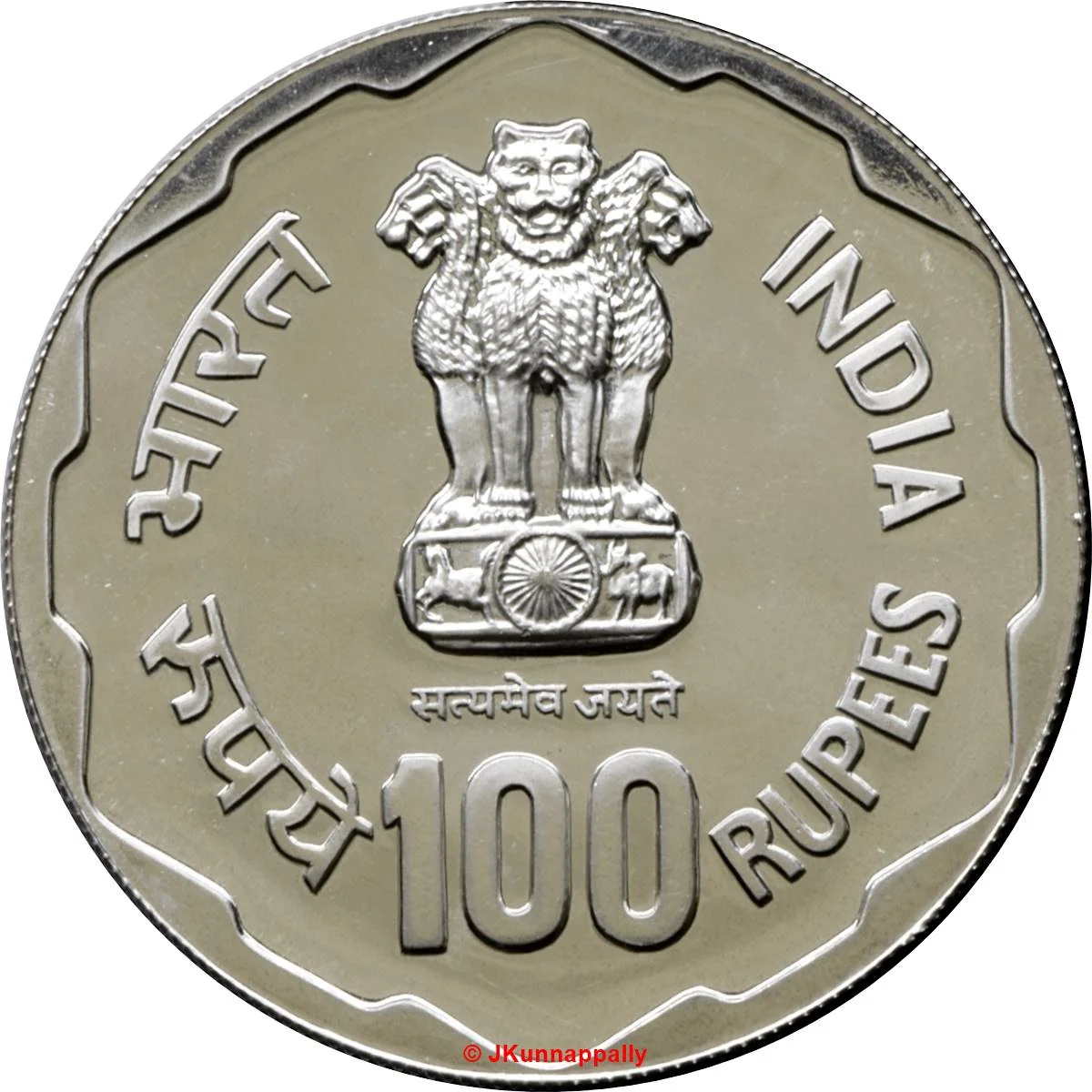

100 rupees – India
Non-circulating coins
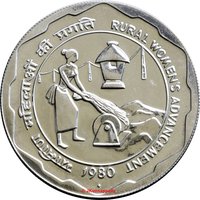
Commemoration: Rural Women's Advancement
India
Context

Material
References
KM: #Click to copy to clipboard275
Numista: #23339
Value
Exchange value: 100 INR = $1.10
Bullion value: $52.39
Inflation-adjusted value: 2722.11 INR
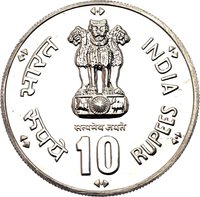
Obverse
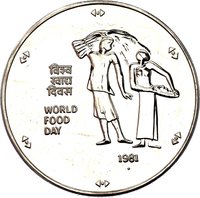
Reverse
Edge
Reeded
Mints
| Name | Mark |
|---|---|
| Mumbai / Bombay | ♦ |
| Mumbai / Bombay | B |
Historical background
In 1980, India's currency situation was characterized by a tightly controlled and insulated monetary system, operating within the framework of a planned economy. The Indian Rupee (INR) was pegged to a basket of currencies of its major trading partners, though it was effectively managed with a strong reference to the British Pound Sterling. This period followed the economic turbulence of the 1970s, including the oil shocks and the legacy of the 1966 devaluation. Foreign exchange reserves were critically low, and strict capital controls were enforced under the Foreign Exchange Regulation Act (FERA), 1973, which heavily restricted the convertibility of the rupee and aimed to conserve scarce foreign currency for essential imports.
Domestically, high inflation was a persistent challenge, averaging around 11% in the late 1970s and early 1980s, driven by fiscal deficits, supply bottlenecks, and rising oil prices. The monetary policy of the Reserve Bank of India (RBI) was largely subservient to the government's financing needs, with deficit financing often leading to an expansion of money supply. Currency in circulation was growing, but the economy remained significantly cash-based and under-banked, with a large informal sector. Bank nationalization in 1969 had expanded reach, but financial deepening was still limited.
Overall, the currency regime of 1980 was defined by stability in the official exchange rate, but at the cost of rigidity and scarcity. It was a system designed for control and autarky rather than integration with the global economy. This inward-looking framework would, within a decade, come under severe strain, culminating in the balance of payments crisis of 1991 that forced a dramatic devaluation and the eventual shift to a market-determined exchange rate system.
Domestically, high inflation was a persistent challenge, averaging around 11% in the late 1970s and early 1980s, driven by fiscal deficits, supply bottlenecks, and rising oil prices. The monetary policy of the Reserve Bank of India (RBI) was largely subservient to the government's financing needs, with deficit financing often leading to an expansion of money supply. Currency in circulation was growing, but the economy remained significantly cash-based and under-banked, with a large informal sector. Bank nationalization in 1969 had expanded reach, but financial deepening was still limited.
Overall, the currency regime of 1980 was defined by stability in the official exchange rate, but at the cost of rigidity and scarcity. It was a system designed for control and autarky rather than integration with the global economy. This inward-looking framework would, within a decade, come under severe strain, culminating in the balance of payments crisis of 1991 that forced a dramatic devaluation and the eventual shift to a market-determined exchange rate system.

⭐ Somewhat Rare