

1 Dollar (Toronto) – Canada
Non-circulating coins
Commemoration: 150th Anniversary of Toronto
Canada
Context

Material
References
KM: #Click to copy to clipboard140
Numista: #23276
Value
Exchange value: 1 CAD = $0.73
Bullion value: $33.79
Inflation-adjusted value: 2.79 CAD
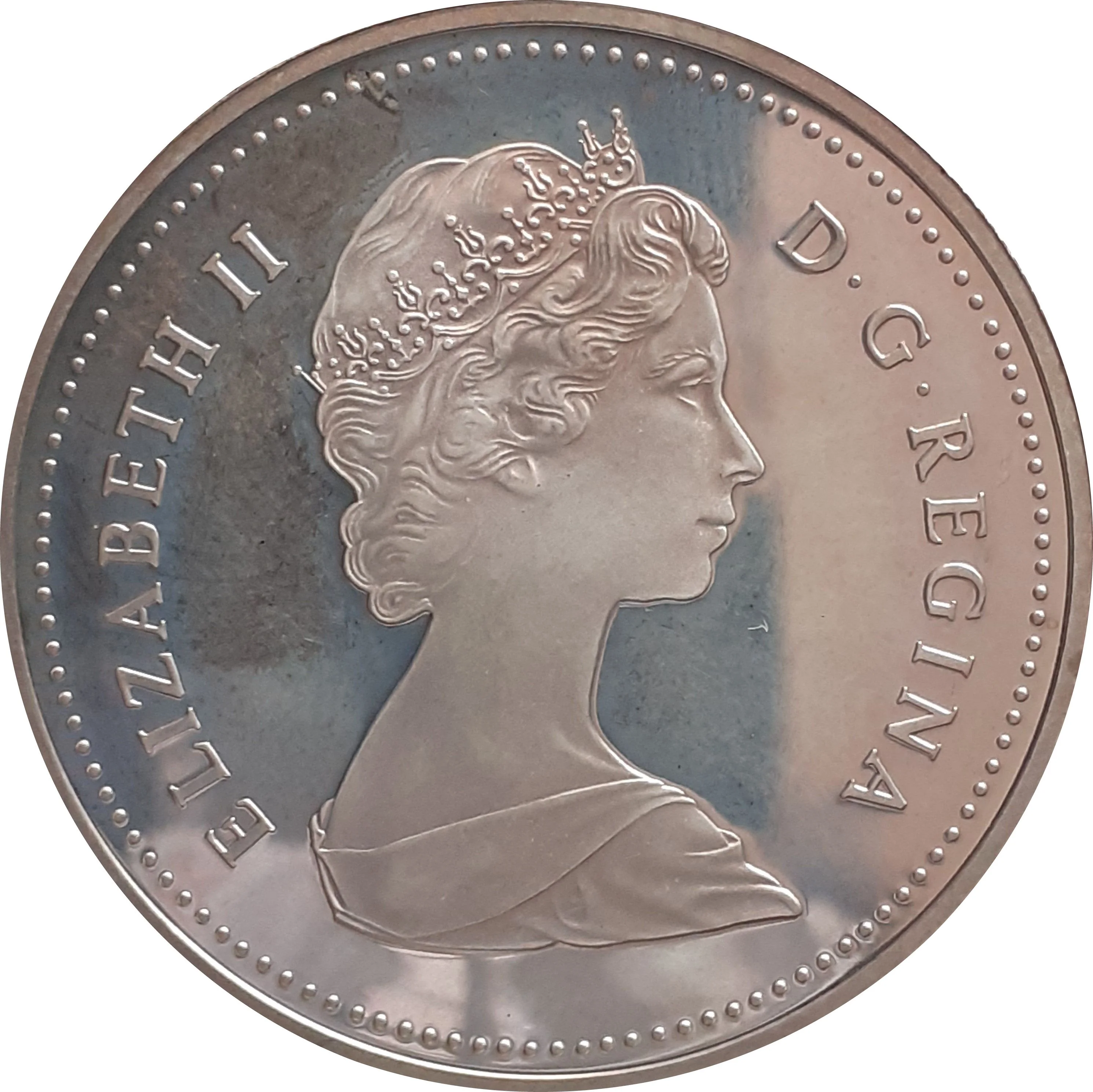
Obverse
Description:
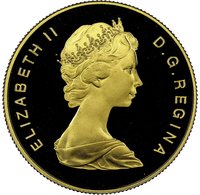
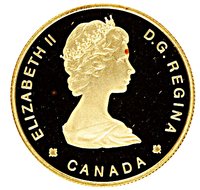
Bust of Queen Elizabeth II at age 37, wearing a tiara and facing right.
Inscription:
ELIZABETH II D·G·REGINA
Translation:
Elizabeth II by the Grace of God Queen
Script: Latin
Designer: Arnold Machin
Reverse
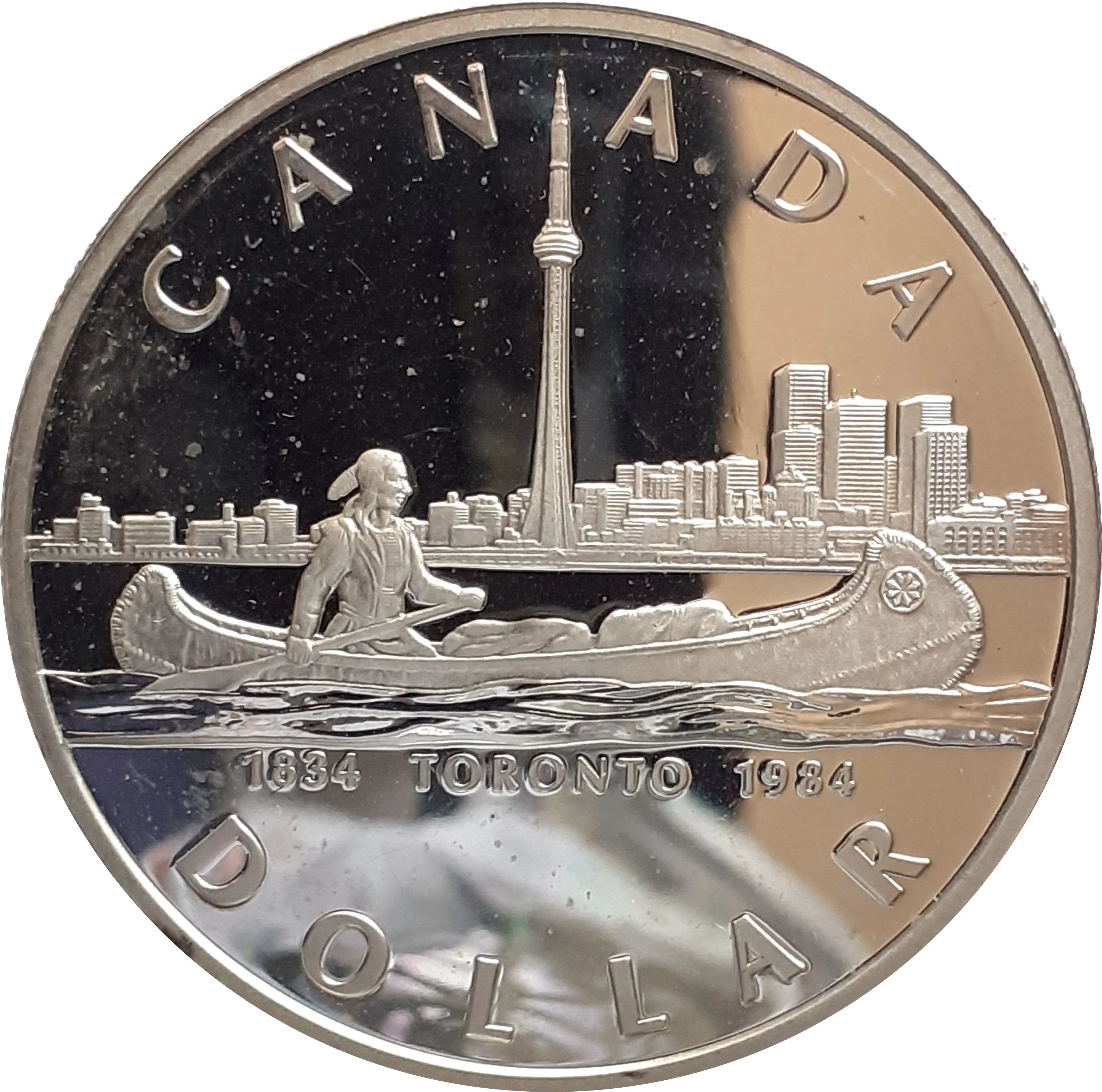
Description:
Canoeist with Toronto skyline.
Inscription:
CANADA DOLLAR
1834 TORONTO 1984
1834 TORONTO 1984
Script: Latin
Engraver: Walter Ott
Designer: David J. Craig
Edge
Reeded
Categories
| Transportation> Watercraft |
Mints
| Name | Mark |
|---|---|
| Royal Canadian Mint of Ottawa | — |
Mintings
| Year | Mint Mark | Mintage | Quality | Collection |
|---|---|---|---|---|
| 1984 | — | 571,563 | Proof | |
| 1984 | — | 133,563 | BU |
Historical background
In 1984, Canada's currency situation was characterized by significant volatility and a notable depreciation of the Canadian dollar against its U.S. counterpart. The year began with the "loonie" trading near historic lows, hovering around 80 U.S. cents and even dipping briefly into the 79-cent range. This weakness was largely driven by a strong U.S. dollar globally, high U.S. interest rates attracting capital southward, and persistent domestic concerns. These included large federal budget deficits, a high national debt, and ongoing anxiety about the economic policies of Prime Minister Pierre Trudeau, who was in his final year in office after a long tenure.
The economic backdrop was one of recovery from the severe early-1980s recession, but the situation remained fragile. While inflation had been tamed from the double-digit peaks of the previous decade—falling to around 4%—the Bank of Canada maintained a relatively tight monetary policy to anchor these gains. This policy tension, aiming to control inflation while the currency weakened, was a key feature of the period. The dollar's decline was a double-edged sword: it provided a boost to Canada's export-oriented sectors like forestry and manufacturing by making their goods cheaper abroad, but it also increased the cost of imports and servicing foreign-denominated debt.
The currency's trajectory became a focal point in the federal election campaign of 1984, which saw a landslide victory for Brian Mulroney's Progressive Conservatives in September. Mulroney campaigned on a platform of economic renewal, fiscal restraint, and improved relations with the United States, all of which were seen as potential stabilizers for the currency. While the dollar found some footing and recovered modestly to approximately 82 cents by year's end, its weakness underscored a period of economic uncertainty and set the stage for the major fiscal and trade policy debates—including the push for free trade with the U.S.—that would define the latter half of the 1980s.
The economic backdrop was one of recovery from the severe early-1980s recession, but the situation remained fragile. While inflation had been tamed from the double-digit peaks of the previous decade—falling to around 4%—the Bank of Canada maintained a relatively tight monetary policy to anchor these gains. This policy tension, aiming to control inflation while the currency weakened, was a key feature of the period. The dollar's decline was a double-edged sword: it provided a boost to Canada's export-oriented sectors like forestry and manufacturing by making their goods cheaper abroad, but it also increased the cost of imports and servicing foreign-denominated debt.
The currency's trajectory became a focal point in the federal election campaign of 1984, which saw a landslide victory for Brian Mulroney's Progressive Conservatives in September. Mulroney campaigned on a platform of economic renewal, fiscal restraint, and improved relations with the United States, all of which were seen as potential stabilizers for the currency. While the dollar found some footing and recovered modestly to approximately 82 cents by year's end, its weakness underscored a period of economic uncertainty and set the stage for the major fiscal and trade policy debates—including the push for free trade with the U.S.—that would define the latter half of the 1980s.

🌱 Common