

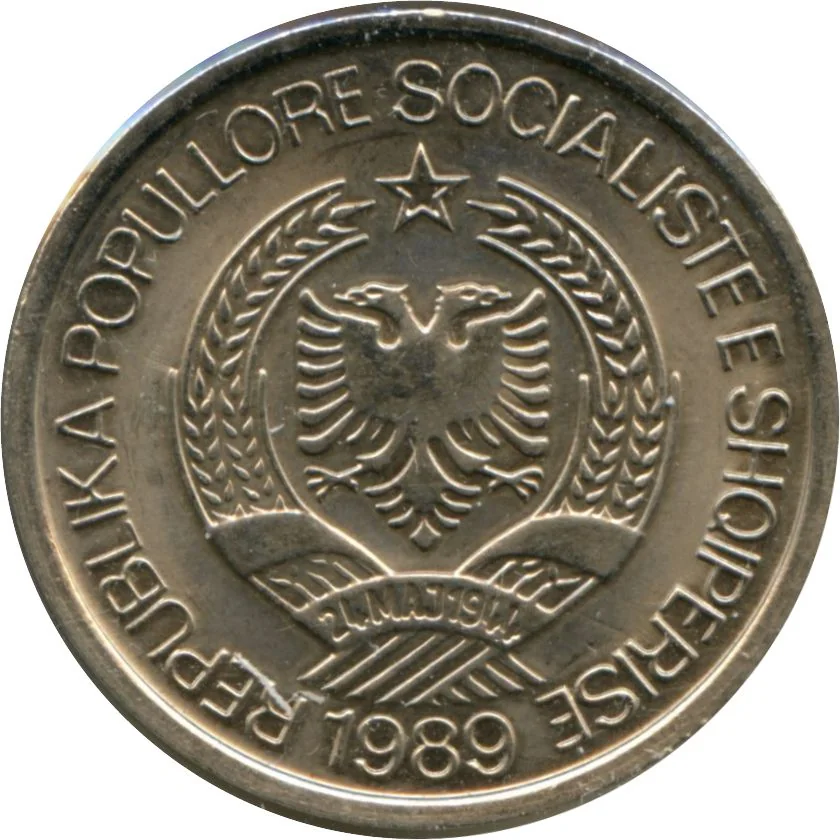
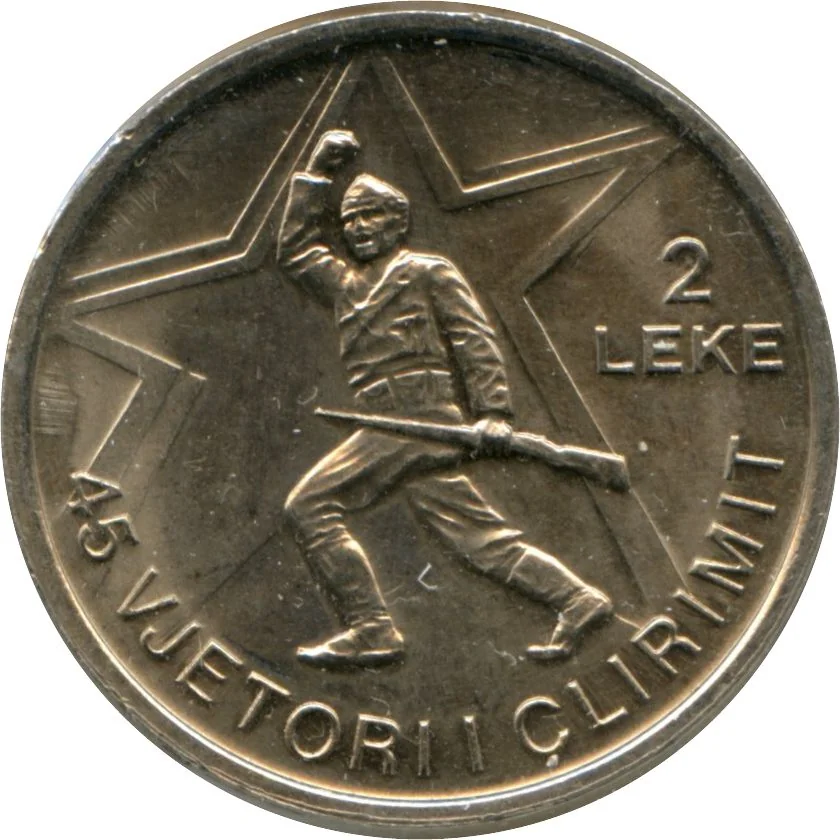
2 lekë (Albania's Liberation) – Albania
Add to wishlist
Circulating commemorative coins
Commemoration: 45th Anniversary of Albania's Liberation
Albania
Context
Year: 1989
Issuer: Albania
Period:
(1945—1990)
Currency:
(since 1965)
Demonetization: 1 January 1992
Material
Diameter: 26 mm
Weight: 7.6 g
Thickness: 2 mm
Shape: Round
Composition: Copper-nickel
Technique: Milled
Alignment: Medal alignment
flip
References
KM: #
Numista: #23247
Value
Exchange value: 2 ALL
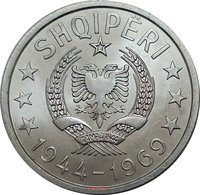
Obverse
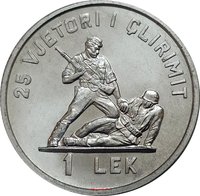
Reverse
Edge
Plain
Categories
| History> War |
| Animal> Bird |
| Symbols> Coat of Arms |
| Symbol> Double-headed eagle |
Mintings
| Year | Mint Mark | Mintage | Quality | Collection |
|---|---|---|---|---|
| 1989 | — | — |
Historical background
In 1989, Albania’s currency situation was defined by extreme isolation and rigid state control under Europe's last Stalinist regime, led by Enver Hoxha. The national currency, the Albanian lek, was a non-convertible currency with an official exchange rate set arbitrarily by the state, bearing no relation to market forces or its real purchasing power. The economy was entirely centralized, with no private foreign trade or accessible foreign exchange reserves for citizens, effectively sealing the country off from the international financial system.
Internally, this resulted in a severe disconnect between currency and goods. While the lek was used for salaries and domestic transactions, chronic shortages of basic consumer items and food were widespread, rendering much of the population's monetary savings largely meaningless in practical terms. A black market for foreign currencies, particularly the US dollar, Italian lira, and Greek drachma, existed clandestinely and operated at rates vastly different from the official ones, reflecting the lek's true, depreciated value for those with connections or remittances from abroad.
This precarious monetary environment existed on the brink of monumental change. The events of 1989 elsewhere in Eastern Europe would soon trigger Albania's own political and economic collapse in the early 1990s. The currency situation of that year, therefore, represents the final phase of a collapsing command economy, setting the stage for the traumatic hyperinflation, currency devaluation, and painful transition to a market system that would define the following decade.
Internally, this resulted in a severe disconnect between currency and goods. While the lek was used for salaries and domestic transactions, chronic shortages of basic consumer items and food were widespread, rendering much of the population's monetary savings largely meaningless in practical terms. A black market for foreign currencies, particularly the US dollar, Italian lira, and Greek drachma, existed clandestinely and operated at rates vastly different from the official ones, reflecting the lek's true, depreciated value for those with connections or remittances from abroad.
This precarious monetary environment existed on the brink of monumental change. The events of 1989 elsewhere in Eastern Europe would soon trigger Albania's own political and economic collapse in the early 1990s. The currency situation of that year, therefore, represents the final phase of a collapsing command economy, setting the stage for the traumatic hyperinflation, currency devaluation, and painful transition to a market system that would define the following decade.
🌟 Uncommon