


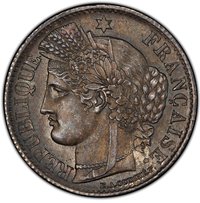
Obverse
Description:
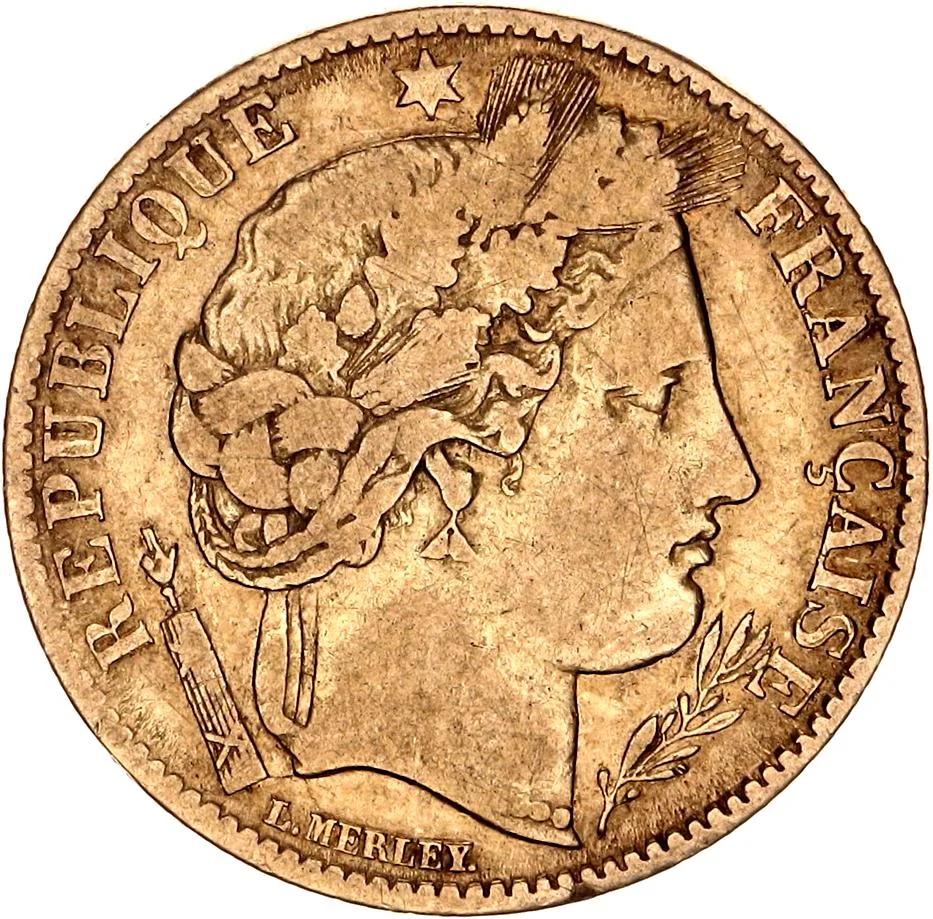
Ceres facing right.
Inscription:
REPUBLIQUE * FRANÇAISE
Translation:
FRENCH REPUBLIC
Script: Latin
Language: French
Engraver: Louis Merley
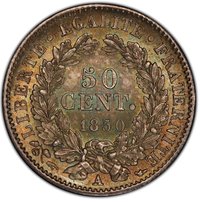
Reverse
Description:
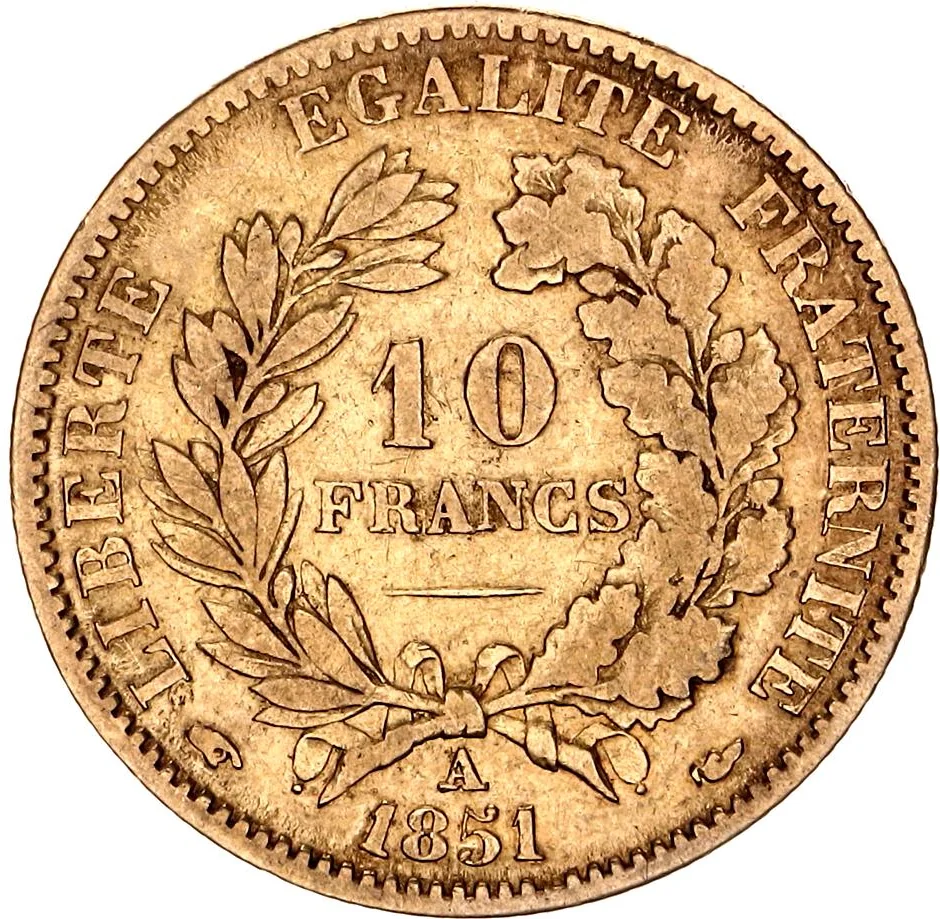
An olive branch and an oak branch, linked by a ribbon, form the crown.
Inscription:
LIBERTE EGALITE FRATERNITE
10 FRANCS
1851 A
10 FRANCS
1851 A
Script: Latin
Engraver: Louis Merley
Edge
Reeded
Mints
| Name | Mark |
|---|---|
| Monnaie de Paris | A |
Historical background
In 1850, France was in a period of monetary transition and uncertainty following the political and economic upheavals of the 1848 Revolution. The provisional government had inherited a bimetallic system, established by the Franc Germinal law of 1803, which fixed the value of the silver franc and the gold 20-franc napoléon in a strict 15.5:1 ratio. However, this classical system was under severe strain. A major factor was the global influx of gold from new discoveries in California and Australia, which began to destabilize the fixed ratio, making it more profitable to mint and hoard silver, thus threatening a disappearance of full-bodied silver coinage from circulation.
The most pressing issue was a severe shortage of small-denomination currency for everyday transactions. The economic crisis of 1848 had triggered bank runs, leading to the suspension of convertibility of banknotes into specie. While the state issued small paper notes and token coins to alleviate the shortage, public trust in paper money was low, and the scarcity of reliable small change hampered commerce. Furthermore, the government faced a significant budget deficit, financing which led to inflationary pressures. The public largely preferred tangible, metallic money, creating a disconnect between official policy and practical economic life.
Consequently, the monetary landscape was fragmented. Alongside the official gold and silver coins, a mix of depreciated small paper notes, fractional token coins (often of inferior alloy), and even foreign coins circulated with varying degrees of acceptance. This period of confusion set the stage for the monetary reforms that would follow under Napoleon III after 1852. His regime would move France towards a de facto gold standard, a shift formalized in the Latin Monetary Union of 1865, which ultimately ended the bimetallic struggle by aligning France with several European nations in a unified silver and gold system.
The most pressing issue was a severe shortage of small-denomination currency for everyday transactions. The economic crisis of 1848 had triggered bank runs, leading to the suspension of convertibility of banknotes into specie. While the state issued small paper notes and token coins to alleviate the shortage, public trust in paper money was low, and the scarcity of reliable small change hampered commerce. Furthermore, the government faced a significant budget deficit, financing which led to inflationary pressures. The public largely preferred tangible, metallic money, creating a disconnect between official policy and practical economic life.
Consequently, the monetary landscape was fragmented. Alongside the official gold and silver coins, a mix of depreciated small paper notes, fractional token coins (often of inferior alloy), and even foreign coins circulated with varying degrees of acceptance. This period of confusion set the stage for the monetary reforms that would follow under Napoleon III after 1852. His regime would move France towards a de facto gold standard, a shift formalized in the Latin Monetary Union of 1865, which ultimately ended the bimetallic struggle by aligning France with several European nations in a unified silver and gold system.
🌟 Uncommon