

100 markkaa – Finland
Add to wishlist
Finland
Obverse
Description:
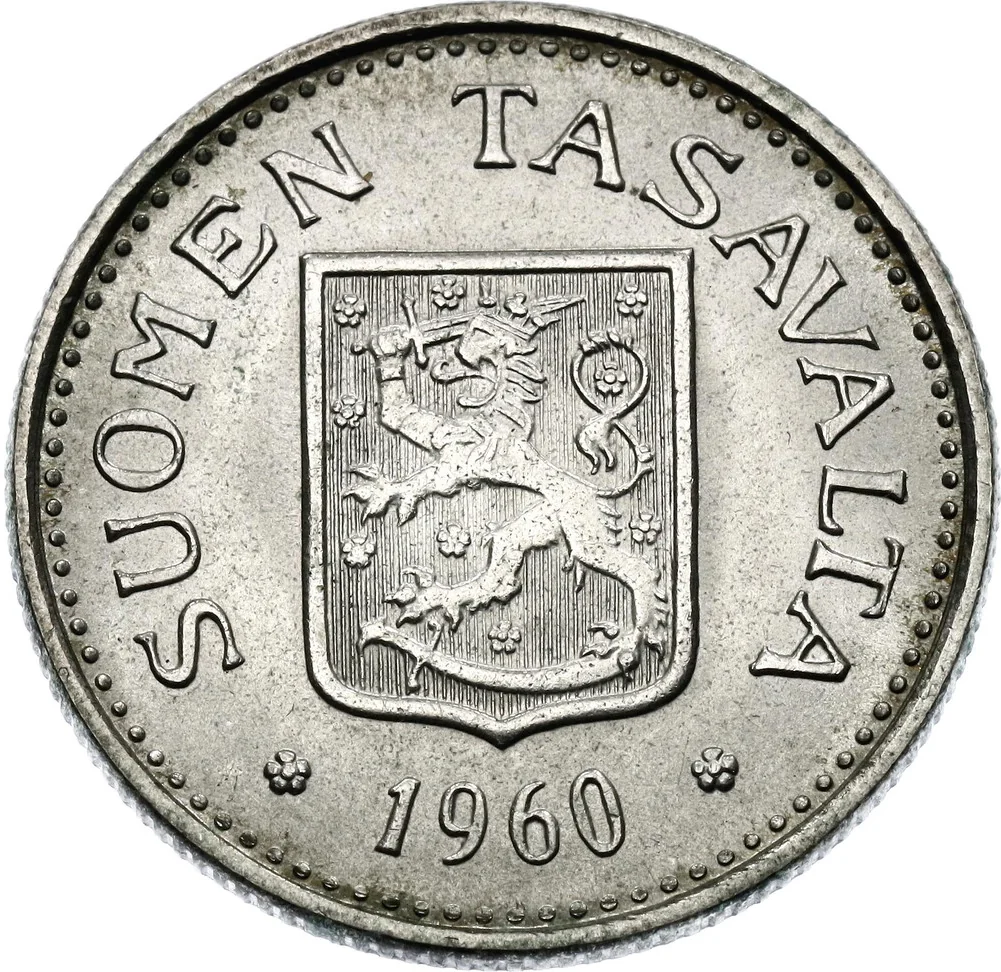
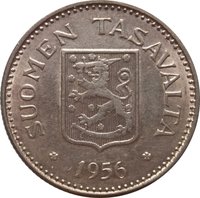
Coat of arms above date, encircled by legend.
Inscription:
SUOMEN TASAVALTA
1956
1956
Translation:
REPUBLIC OF FINLAND
1956
1956
Script: Latin
Language: Finnish
Engraver: Peippo Uolevi Helle
Reverse
Description:
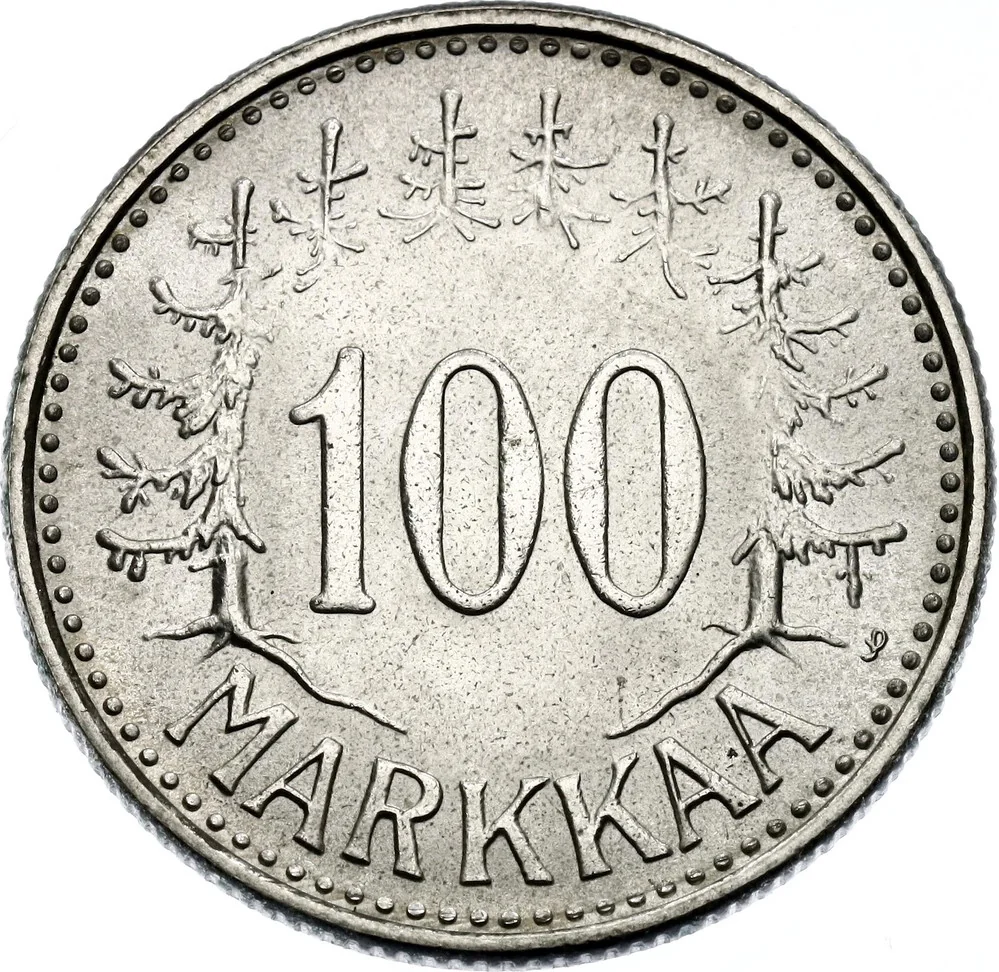
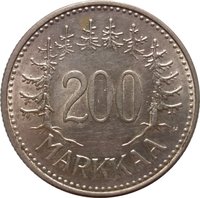
Tree-ringed denomination.
Inscription:
100 MARKKAA
Script: Latin
Engraver: Peippo Uolevi Helle
Edge
Reeded
Categories
| Animal> Feline |
| Plants> Flower |
| Plant> Tree |
| Symbols> Coat of Arms |
| Object> Cold weapons |
Mints
| Name | Mark |
|---|---|
| Mint of Finland | — |
Mintings
| Year | Mint Mark | Mintage | Quality | Collection |
|---|---|---|---|---|
| 1956 | — | 3,012,000 | ||
| 1957 | — | 3,012,000 | ||
| 1958 | — | 1,704,000 | ||
| 1959 | — | 1,266,000 | ||
| 1960 | — | 290,000 |
Historical background
In 1956, Finland's currency, the markka, operated under a managed system with its value pegged to the U.S. dollar as part of the Bretton Woods framework. This fixed exchange rate regime, established after World War II, provided stability but required the Bank of Finland to maintain strict currency controls and actively manage foreign reserves to defend the peg. The Finnish economy was in a period of significant transition, moving from post-war reconstruction and reparations payments to the Soviet Union towards a more industrialized and export-oriented model, heavily reliant on the forest industry. This made the stability of the markka crucial for predictable trade.
However, the fixed parity came under growing pressure. Domestically, the economy was overheating, with strong investment and rising wages fueling inflation, which eroded the markka's real value. This created a widening gap between the official exchange rate and its purchasing power, making Finnish exports less competitive—a serious concern for a trade-dependent nation. Furthermore, the system's rigidity limited the government's ability to use monetary policy to cool the economy, leading to recurrent balance of payments difficulties.
Consequently, 1956 was a year of mounting strain that set the stage for a major devaluation the following year. The pressures culminated in 1957 when the markka was devalued by 39%, a dramatic adjustment that reflected the unsustainable nature of the old peg. Thus, the currency situation in 1956 was one of a brittle stability, where the institutional framework of the Bretton Woods system was increasingly at odds with Finland's domestic economic realities, necessitating a sharp corrective measure to restore external balance.
However, the fixed parity came under growing pressure. Domestically, the economy was overheating, with strong investment and rising wages fueling inflation, which eroded the markka's real value. This created a widening gap between the official exchange rate and its purchasing power, making Finnish exports less competitive—a serious concern for a trade-dependent nation. Furthermore, the system's rigidity limited the government's ability to use monetary policy to cool the economy, leading to recurrent balance of payments difficulties.
Consequently, 1956 was a year of mounting strain that set the stage for a major devaluation the following year. The pressures culminated in 1957 when the markka was devalued by 39%, a dramatic adjustment that reflected the unsustainable nature of the old peg. Thus, the currency situation in 1956 was one of a brittle stability, where the institutional framework of the Bretton Woods system was increasingly at odds with Finland's domestic economic realities, necessitating a sharp corrective measure to restore external balance.
🌱 Common