

50 zlotys – Poland
Add to wishlist
Non-circulating coins
Commemoration: Frederic Chopin
Poland
Obverse
Description:
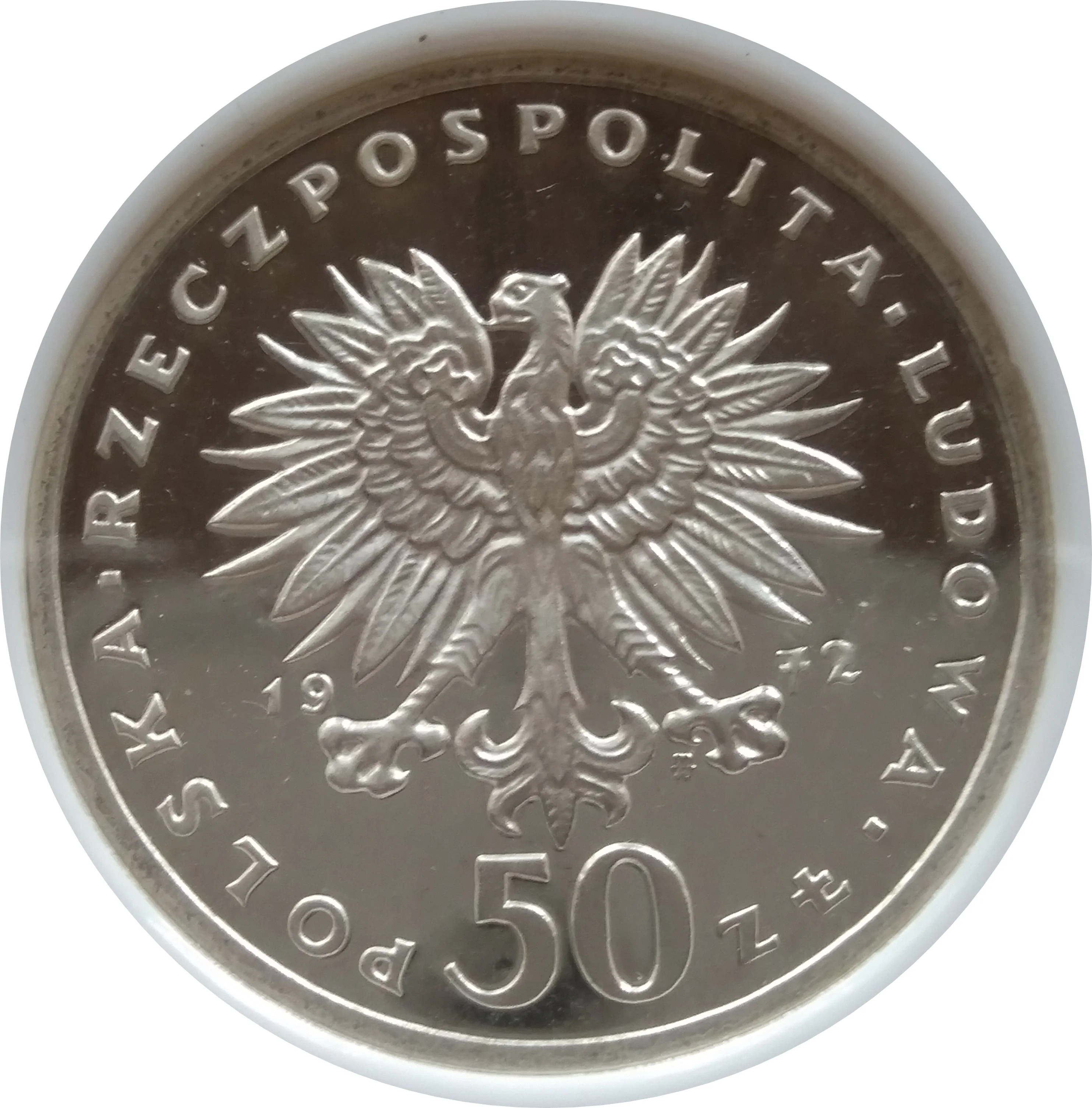
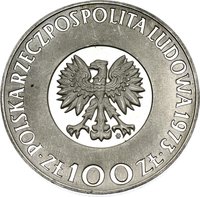
Soaring eagle
Inscription:
POLSKA • RZECZPOSPOLITA • LUDOWA •
1972
mw
50 ZŁ
1972
mw
50 ZŁ
Translation:
Polish People's Republic
1972
mw
50 Złotych
1972
mw
50 Złotych
Script: Latin
Language: Polish
Designer: Jerzy Jarnuszkiewicz
Reverse
Description:
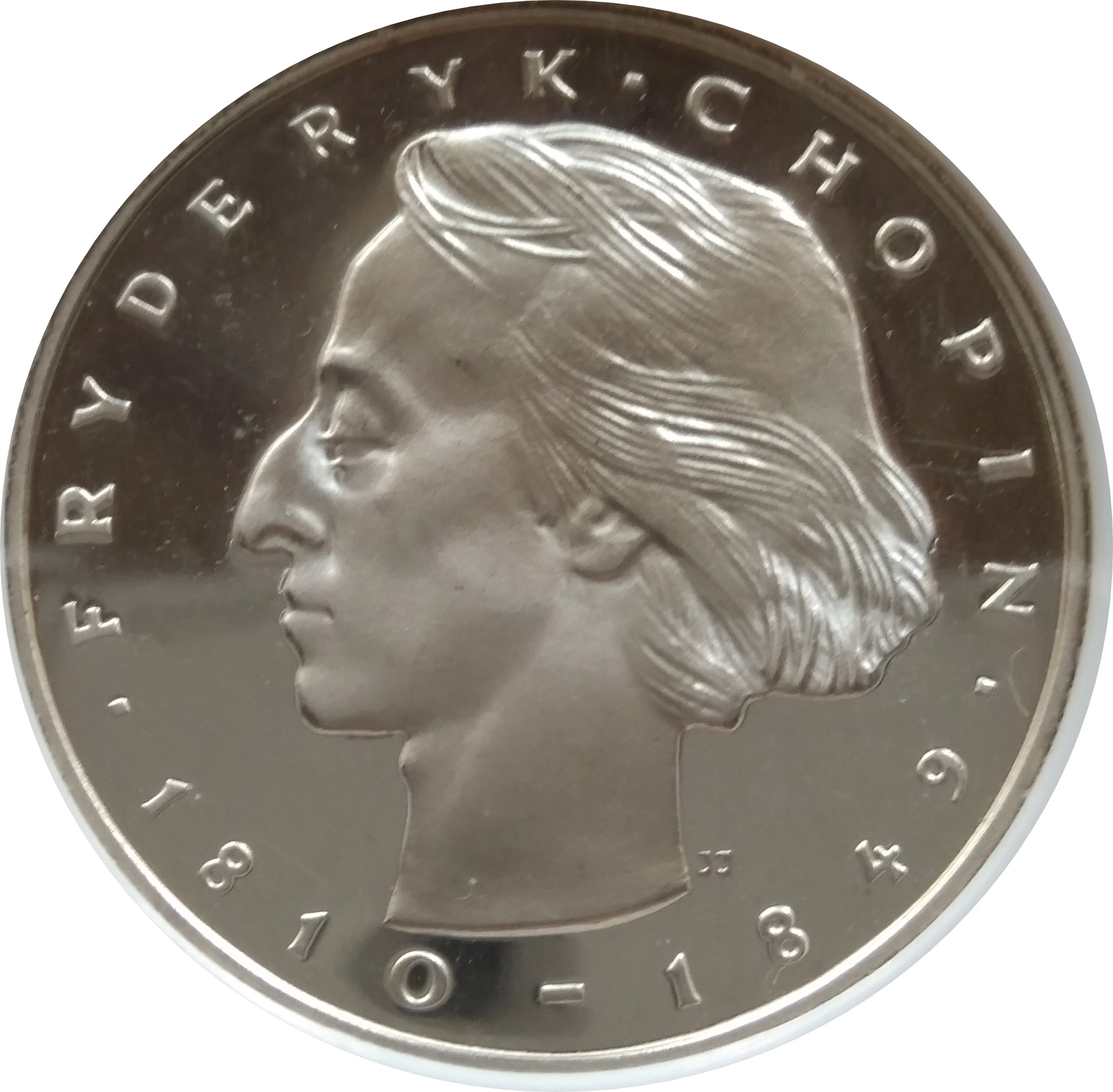
Chopin's preserved heart.
Inscription:
• FRYDERYK • CHOPIN •
JJ
1810 - 1849
JJ
1810 - 1849
Script: Latin
Designer: Jerzy Jarnuszkiewicz
Edge
Plain
Mints
| Name | Mark |
|---|---|
| Mint of Poland | (MW) |
Mintings
| Year | Mint Mark | Mintage | Quality | Collection |
|---|---|---|---|---|
| 1972 | MW | 49,999 | Proof | |
| 1974 | MW | 10,375 | Proof |
Historical background
In 1972, Poland's currency situation was defined by the rigidities and contradictions of a centrally planned economy within the Soviet bloc. The official currency, the złoty, was a non-convertible "soft currency," meaning it could not be freely exchanged for hard currencies like the US dollar or Deutsche Mark on international markets. Its value was set by administrative decree at an artificially high official exchange rate (approximately 3.32 złoty to 1 US dollar), which bore no relation to its real purchasing power or the condition of the Polish economy. This system created a vast black market for foreign currency, where the złoty traded at a fraction of its official value, reflecting widespread shortages of consumer goods and suppressed inflation.
The state maintained a complex system of special foreign currency shops (known as Pewex and Baltona), where Poles could purchase Western-quality goods—unavailable in regular stores—using hard currency or special certificates. This created a two-tiered society: those with access to foreign remittances from family abroad or black-market dealings lived with significantly greater material comfort. Economically, the overvalued złoty hampered exports, as Polish goods were artificially expensive on world markets, while making imports (outside of state-planned capital goods) prohibitively costly in official terms.
Underneath this seemingly stable facade, significant economic pressures were building. The Gierek regime, which had taken power in 1970, embarked on a strategy of massive borrowing from Western nations to finance industrial modernization and import consumer goods to placate the population. While this initially boosted living standards, it sowed the seeds for a future debt crisis. The currency regime of 1972 was thus a brittle component of a wider policy that deferred economic reckoning, storing up severe problems that would culminate in the debt spiral and social unrest of the late 1970s and 1980s.
The state maintained a complex system of special foreign currency shops (known as Pewex and Baltona), where Poles could purchase Western-quality goods—unavailable in regular stores—using hard currency or special certificates. This created a two-tiered society: those with access to foreign remittances from family abroad or black-market dealings lived with significantly greater material comfort. Economically, the overvalued złoty hampered exports, as Polish goods were artificially expensive on world markets, while making imports (outside of state-planned capital goods) prohibitively costly in official terms.
Underneath this seemingly stable facade, significant economic pressures were building. The Gierek regime, which had taken power in 1970, embarked on a strategy of massive borrowing from Western nations to finance industrial modernization and import consumer goods to placate the population. While this initially boosted living standards, it sowed the seeds for a future debt crisis. The currency regime of 1972 was thus a brittle component of a wider policy that deferred economic reckoning, storing up severe problems that would culminate in the debt spiral and social unrest of the late 1970s and 1980s.
🌟 Limited