

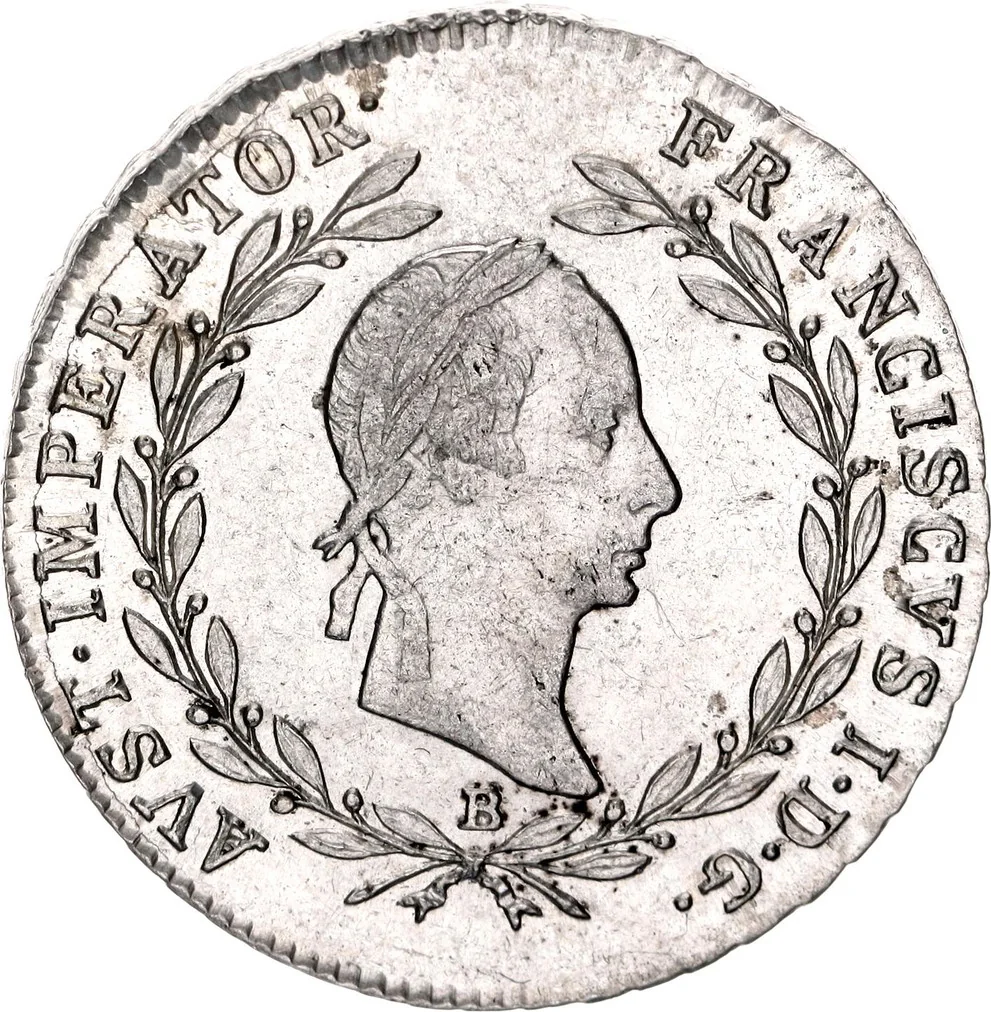
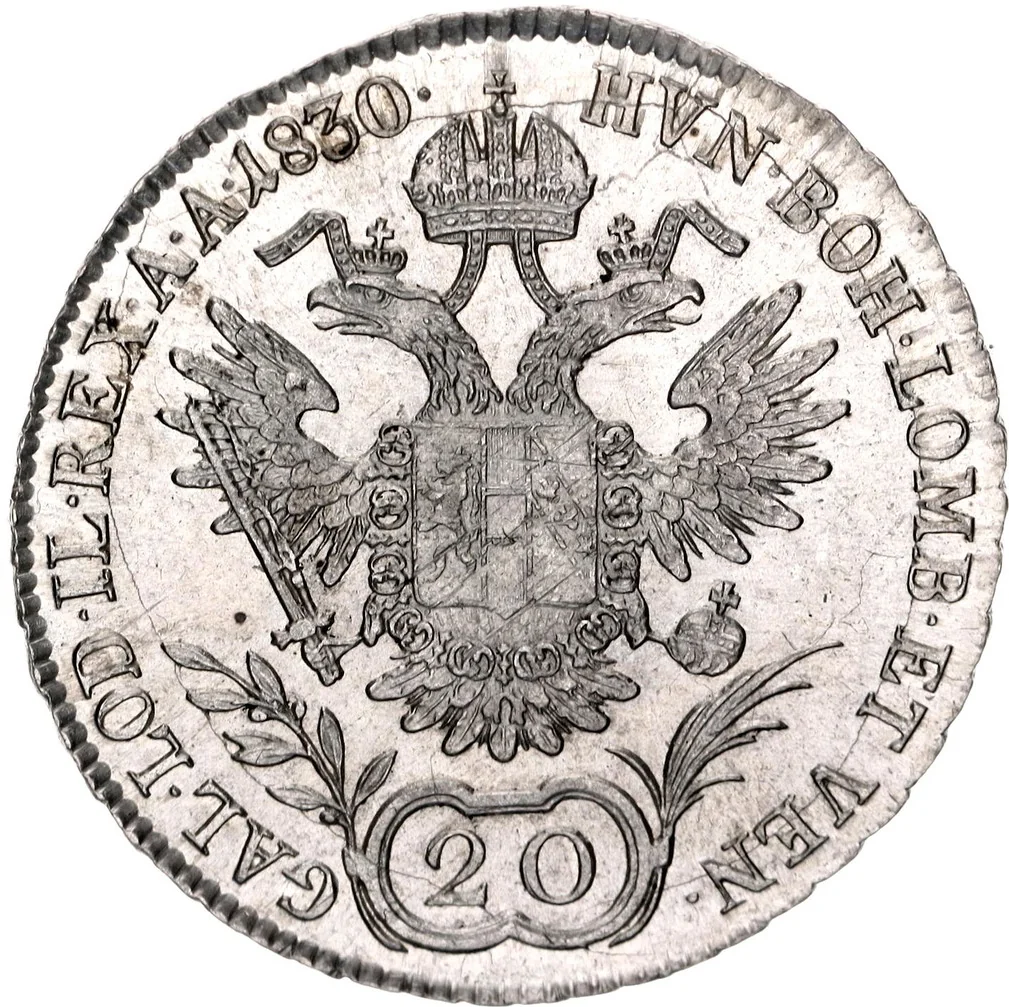
20 Kreuzers – Austrian Empire
Austria
Context
Years: 1829–1830
Country: Austria 
Issuer: Austrian Empire
Ruler: Francis I of Austria
Currency:
(1754—1857)
Demonetized: Yes
Total mintage: 4,073,000
Material
References
KM: #Click to copy to clipboard2145
Numista: #22995
Value
Bullion value: $11.23
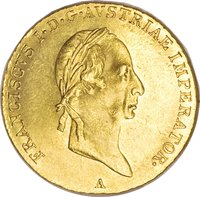
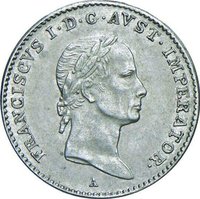
Obverse
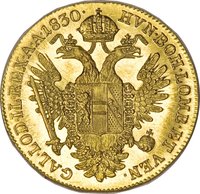
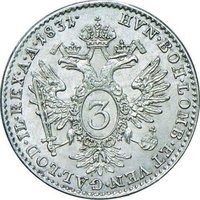
Reverse
Description:
Two-headed eagle.
Inscription:
HVN BOH LOMB ET VEN / GAL LOD IL REX A A date
Script: Latin
Edge
Reeded.
Mints
| Name | Mark |
|---|---|
| Münze Österreich | A |
| Kremnica | B |
| Prague | C |
| Alba Iulia | E |
Mintings
Historical background
In 1829, the Austrian Empire’s currency situation was characterized by a fragile and complex system still recovering from the financial exhaustion of the Napoleonic Wars. The official currency was the Conventionsthaler, but the most common unit of account was the Gulden (Florin), divided into 60 Kreuzer. However, the empire did not have a unified, modern coinage; circulation was a chaotic mix of older silver coins from the pre-1811 period, depreciated paper money (Bancozettel), and new, lighter silver coins minted after the 1811 state bankruptcy. This created a dual system where payments were often specified as being in "Conventionsmünze" (CM) or "Wiener Währung" (WW), with a significant and fluctuating exchange rate between them, complicating all commercial transactions.
The root of this instability lay in the state’s reliance on paper money to finance earlier wars, leading to severe inflation and the aforementioned bankruptcy. While the Vienna Currency Act of 1816 had established the Austrian National Bank (Österreichische Nationalbank) to stabilize finances and gradually redeem the worthless paper, the process was slow. By 1829, confidence in paper was low, and the state treasury, grappling with substantial debt, struggled to maintain a consistent silver standard. Consequently, much everyday trade relied on the physical silver kreuzer coins, but their supply was often insufficient, leading to regional variations and the use of foreign coins.
This monetary disunity reflected the empire’s broader administrative and economic fragmentation. Different crown lands had varying degrees of adherence to the central system, and the cumbersome exchange between units of account acted as a drag on internal trade and economic modernization. While the period was one of relative peace and cautious reform under Chancellor Metternich, the currency chaos of 1829 underscored the Habsburg state’s fundamental weakness: its inability to fully integrate its diverse territories into a single, efficient economic entity, a problem that would persist for decades.
The root of this instability lay in the state’s reliance on paper money to finance earlier wars, leading to severe inflation and the aforementioned bankruptcy. While the Vienna Currency Act of 1816 had established the Austrian National Bank (Österreichische Nationalbank) to stabilize finances and gradually redeem the worthless paper, the process was slow. By 1829, confidence in paper was low, and the state treasury, grappling with substantial debt, struggled to maintain a consistent silver standard. Consequently, much everyday trade relied on the physical silver kreuzer coins, but their supply was often insufficient, leading to regional variations and the use of foreign coins.
This monetary disunity reflected the empire’s broader administrative and economic fragmentation. Different crown lands had varying degrees of adherence to the central system, and the cumbersome exchange between units of account acted as a drag on internal trade and economic modernization. While the period was one of relative peace and cautious reform under Chancellor Metternich, the currency chaos of 1829 underscored the Habsburg state’s fundamental weakness: its inability to fully integrate its diverse territories into a single, efficient economic entity, a problem that would persist for decades.
🌟 Uncommon