

10 Piastres – Egypt
Circulating commemorative coins
Commemoration: Scientists' Day
Egypt
Context
Year: 1981
Islamic (Hijri) Year: 1401
Issuer: Egypt 
Period:
(since 1971)
Currency:
(since 1916)
Demonetized: Yes
Total mintage: 250,000
Material
Diameter: 27 mm
Weight: 6 g
Shape: Round
Composition: Copper-nickel
Technique: Milled
Alignment: Medal alignment
flip
References
KM: #Click to copy to clipboard520
Numista: #22930
Value
Exchange value: 0.10 EGP
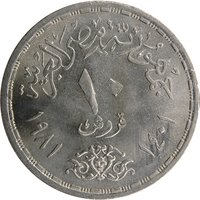
Obverse
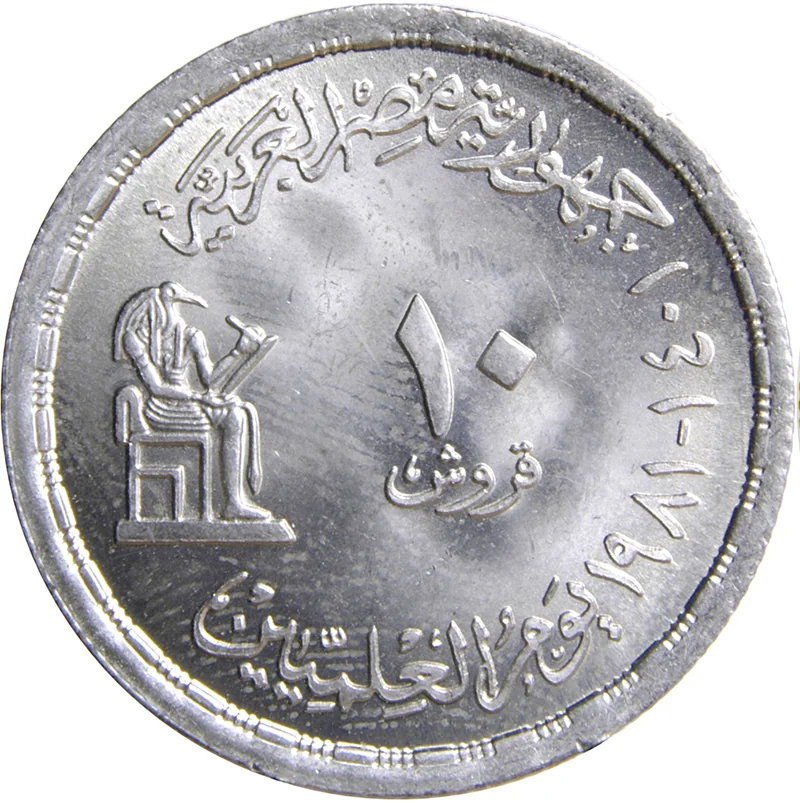
Description:
Seated figure, left.
Inscription:
جمهورية مصر العربية
١٠
قروش
١٤٠١-١٩٨١يوم العلميين
١٠
قروش
١٤٠١-١٩٨١يوم العلميين
Translation:
Arab Republic of Egypt
10
Qirsh
1401-1981 Science Day
10
Qirsh
1401-1981 Science Day
Language: Arabic
Reverse
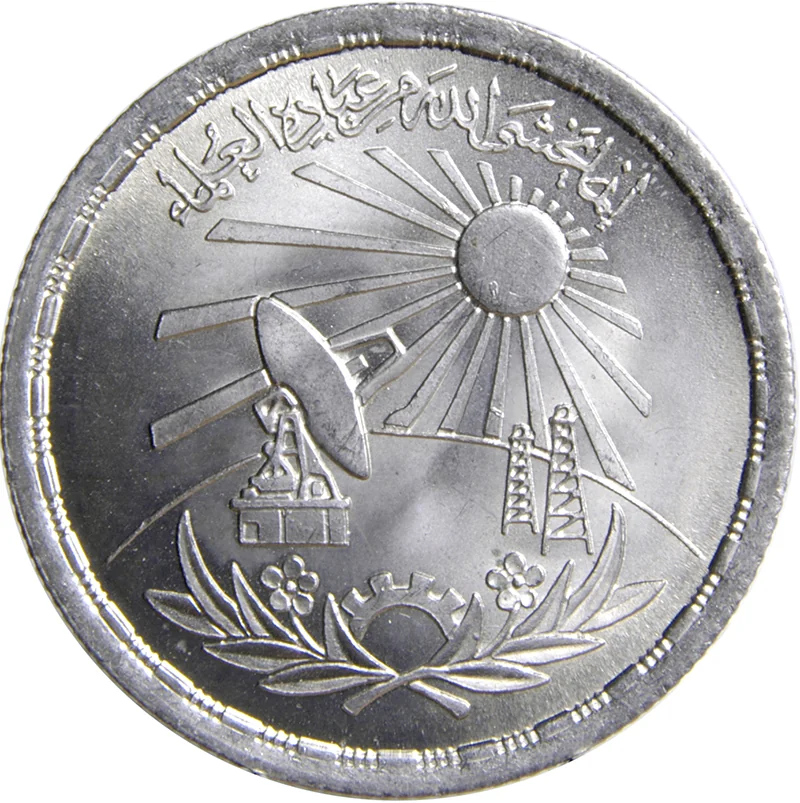
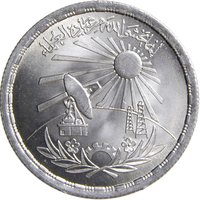
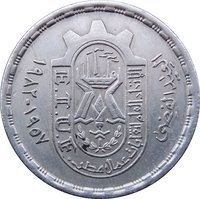
Description:
Spray cogwheel under sun and dish.
Inscription:
"إنما يخشى الله من عباده العلماء"
Translation:
Indeed, only the knowledgeable among His servants fear Allah.
Language: Arabic
Edge
Reeded
Mintings
| Year | Mint Mark | Mintage | Quality | Collection |
|---|---|---|---|---|
| 1981 | — | 250,000 |
Historical background
In 1981, Egypt's currency situation was characterized by a complex and strained system of multiple exchange rates, a legacy of the infitah (economic opening) policies begun under President Anwar Sadat in the 1970s. The official exchange rate was fixed by the Central Bank of Egypt at a highly overvalued level of approximately E£0.70 to the US dollar. This rate was reserved for government transactions, essential imports like food and medicine, and debt servicing. However, a parallel "free market" rate, which reflected true scarcity and demand, operated at nearly E£1.40 to the dollar, effectively creating a 100% premium. This dual system led to significant distortions, encouraging black-market activity, capital flight, and rampant rent-seeking behavior as access to cheap foreign currency at the official rate became a source of privilege and corruption.
The overvalued pound placed severe pressure on Egypt's balance of payments and foreign reserves. It made Egyptian exports uncompetitive on the global market while making imports artificially cheap, discouraging domestic production and leading to a growing trade deficit. Furthermore, the government's heavy subsidies on basic commodities, funded by borrowing and oil revenues, created a massive fiscal burden. The situation was exacerbated by a decline in key foreign currency earners; oil prices had softened from their late-1970s peak, remittances from Egyptian workers abroad were often funneled through the black market, and the tourism sector was still recovering from regional instability.
President Hosni Mubarak, who assumed office in October 1981 following Sadat's assassination, inherited this precarious monetary environment. While immediate, radical reform was politically risky, the unsustainable currency regime was a central concern. The multiple rates and overvaluation were widely recognized by international lenders, including the International Monetary Fund (IMF), as a critical flaw needing correction. Thus, in 1981, Egypt stood on the brink of inevitable economic restructuring, with a major devaluation and a move toward exchange rate unification becoming unavoidable prerequisites for stabilizing the economy and securing vital external financing in the years to follow.
The overvalued pound placed severe pressure on Egypt's balance of payments and foreign reserves. It made Egyptian exports uncompetitive on the global market while making imports artificially cheap, discouraging domestic production and leading to a growing trade deficit. Furthermore, the government's heavy subsidies on basic commodities, funded by borrowing and oil revenues, created a massive fiscal burden. The situation was exacerbated by a decline in key foreign currency earners; oil prices had softened from their late-1970s peak, remittances from Egyptian workers abroad were often funneled through the black market, and the tourism sector was still recovering from regional instability.
President Hosni Mubarak, who assumed office in October 1981 following Sadat's assassination, inherited this precarious monetary environment. While immediate, radical reform was politically risky, the unsustainable currency regime was a central concern. The multiple rates and overvaluation were widely recognized by international lenders, including the International Monetary Fund (IMF), as a critical flaw needing correction. Thus, in 1981, Egypt stood on the brink of inevitable economic restructuring, with a major devaluation and a move toward exchange rate unification becoming unavoidable prerequisites for stabilizing the economy and securing vital external financing in the years to follow.
🌱 Fairly Common