

5 Marks (Weimar Constitution) – Germany
Circulating commemorative coins
Commemoration: 10th Anniversary of the Weimar Constitution
Germany
Obverse
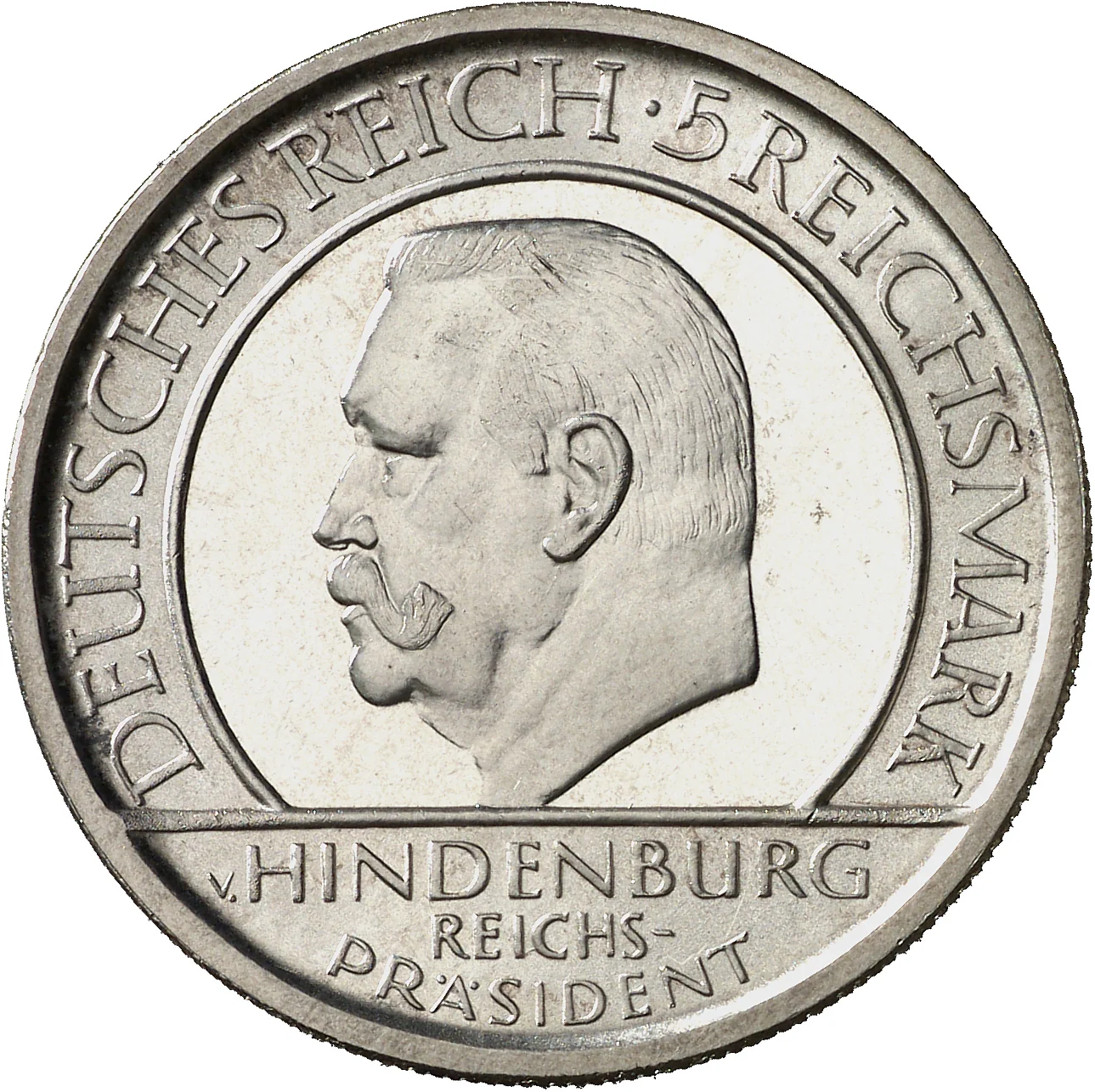
Description:
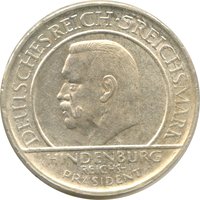
Left, denomination above.
Inscription:
DEUTSCHES REICH·5 REICHSMARK
v.HINDENBERG
REICHS-
PRÄSIDENT
v.HINDENBERG
REICHS-
PRÄSIDENT
Translation:
GERMAN REICH·5 REICHSMARK
v.HINDENBURG
REICH
PRESIDENT
v.HINDENBURG
REICH
PRESIDENT
Script: Latin
Language: German
Engraver: Rudolf Bosselt
Reverse
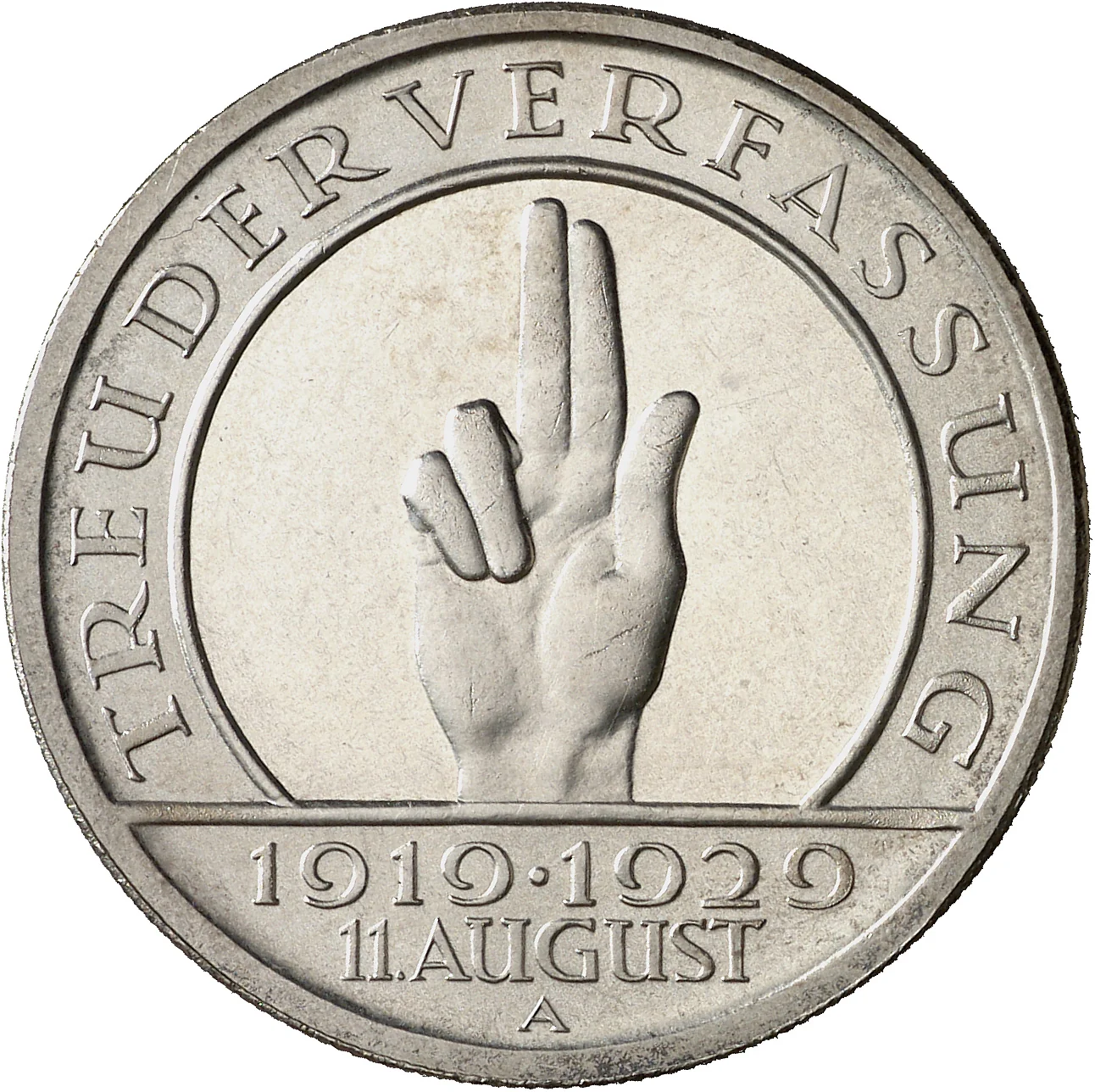
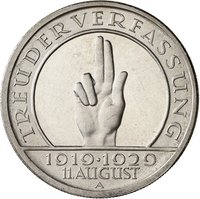
Description:
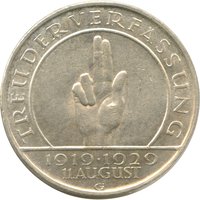
Two fingers up, dates below.
Inscription:
TREU DER VERFASSUNG
1919·1929
11.AUGUST
G
1919·1929
11.AUGUST
G
Script: Latin
Engraver: Rudolf Bosselt
Edge
Lettering:EINIGKEIT UND RECHT UND FREIHEIT
Legend:
EINIGKEIT UND RECHT UND FREIHEIT
Translation:
Unity and Justice and Freedom
Language: German
Mintings
| Year | Mint Mark | Mintage | Quality | Collection |
|---|---|---|---|---|
| 1929 | A | — | Proof | |
| 1929 | D | 84,000 | ||
| 1929 | D | — | Proof | |
| 1929 | E | 45,000 | ||
| 1929 | E | — | Proof | |
| 1929 | F | 60,000 | ||
| 1929 | F | — | Proof | |
| 1929 | A | 325,000 | ||
| 1929 | J | 49,000 | ||
| 1929 | J | — | Proof | |
| 1929 | G | 37,000 | ||
| 1929 | G | — | Proof |
Historical background
By 1929, Germany's currency situation was one of fragile stability built upon foreign debt, a stark contrast to the hyperinflation that had destroyed the Reichsmark just six years earlier. The 1923 crisis had been ended by the introduction of the Rentenmark and then the new Reichsmark, backed by the Dawes Plan of 1924. This American-led initiative provided massive loans to Germany, stabilising the currency and allowing for economic recovery. However, this stability was fundamentally artificial; the German economy and its currency were now propped up by a continuous inflow of short-term American capital, used to pay war reparations and finance industrial expansion.
This dependency created a deeply vulnerable financial structure. The German state, municipalities, and corporations accumulated enormous debts denominated in foreign currencies. The economy appeared healthy on the surface, but it was a brittle prosperity. The Reichsbank's monetary policy was largely constrained by its obligation to maintain gold convertibility, and the entire system relied on the confidence of international investors to continually roll over short-term loans. Any disruption to this flow of capital would expose the underlying weakness.
Consequently, as 1929 progressed, the German currency situation became a ticking clock. The Young Plan, negotiated that year to reduce and reschedule reparations, did not address the core vulnerability: the mountain of volatile foreign debt. When the New York stock market crashed in October 1929, the source of Germany's loans abruptly dried up. Almost overnight, the stability of the Reichsmark was thrown into peril, setting the stage for a banking crisis, deflation, mass unemployment, and the eventual collapse of the Weimar Republic's financial system.
This dependency created a deeply vulnerable financial structure. The German state, municipalities, and corporations accumulated enormous debts denominated in foreign currencies. The economy appeared healthy on the surface, but it was a brittle prosperity. The Reichsbank's monetary policy was largely constrained by its obligation to maintain gold convertibility, and the entire system relied on the confidence of international investors to continually roll over short-term loans. Any disruption to this flow of capital would expose the underlying weakness.
Consequently, as 1929 progressed, the German currency situation became a ticking clock. The Young Plan, negotiated that year to reduce and reschedule reparations, did not address the core vulnerability: the mountain of volatile foreign debt. When the New York stock market crashed in October 1929, the source of Germany's loans abruptly dried up. Almost overnight, the stability of the Reichsmark was thrown into peril, setting the stage for a banking crisis, deflation, mass unemployment, and the eventual collapse of the Weimar Republic's financial system.
🌟 Limited