

5000 meticais – Mozambique
Add to wishlist
Mozambique
Context
Material
References
KM: #
Numista: #2268
Value
Exchange value: 5000 MZM
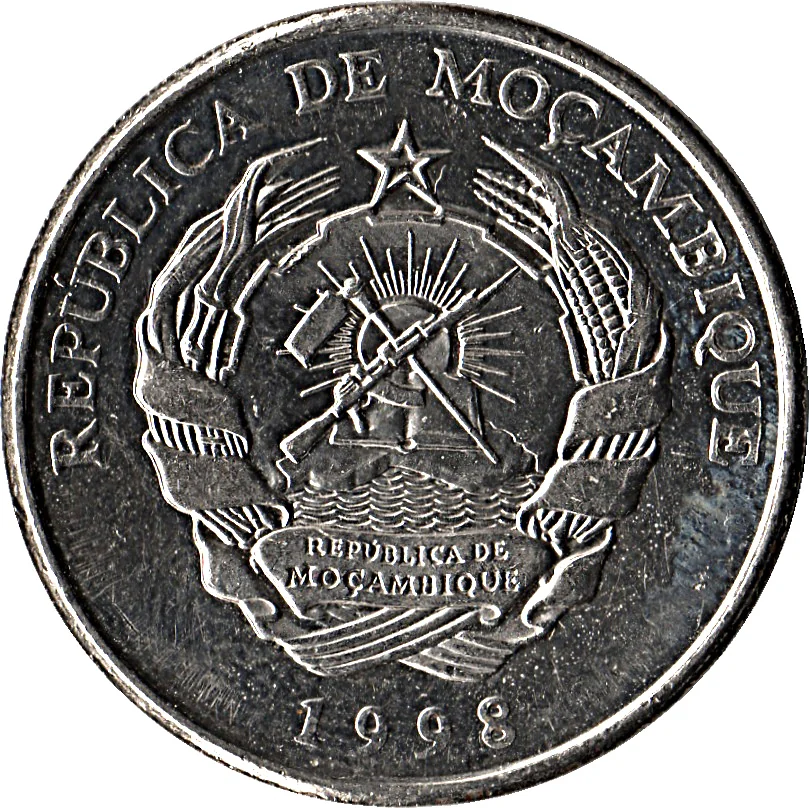
Obverse
Description:
National coat of arms.
Inscription:
REPÚBLICA DE MOÇAMBIQUE
REPÚBLICA DE
MOÇAMBIQUE
1998
REPÚBLICA DE
MOÇAMBIQUE
1998
Translation:
REPUBLIC OF MOZAMBIQUE
REPUBLIC OF
MOZAMBIQUE
1998
REPUBLIC OF
MOZAMBIQUE
1998
Script: Latin
Language: Portuguese
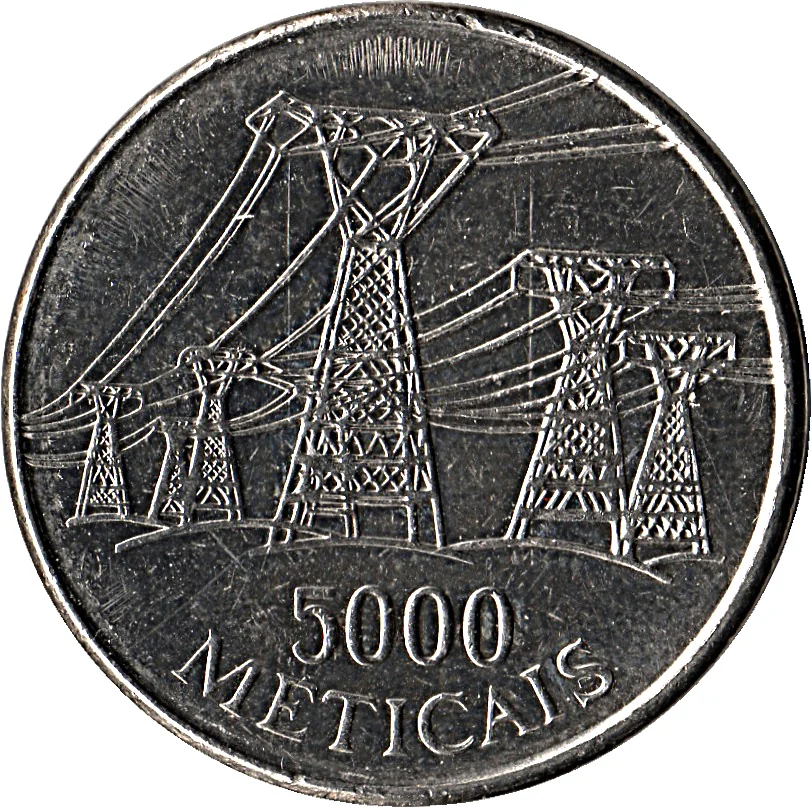
Reverse
Description:
High-voltage power lines.
Inscription:
5000
METICAIS
METICAIS
Script: Latin
Engraver: Robert Elderton
Edge
Reeded
Mints
| Name | Mark |
|---|---|
| Royal Mint | — |
Mintings
| Year | Mint Mark | Mintage | Quality | Collection |
|---|---|---|---|---|
| 1998 | — | — |
Historical background
In 1998, Mozambique was in the early stages of a fragile economic recovery following decades of civil war that ended in 1992. The country was implementing a rigorous Structural Adjustment Programme (SAP) under the guidance of the International Monetary Fund (IMF) and World Bank. A central pillar of this programme was monetary reform, which led to the introduction of a new currency, the metical (MZM), in July 1998, replacing the metical that had been heavily devalued by hyperinflation during the conflict. This redenomination, at a rate of 1 new metical to 1000 old meticais, was a technical measure aimed at restoring public confidence in the national currency and simplifying financial transactions.
The macroeconomic context remained challenging. While inflation had been reduced from wartime highs of over 50% to approximately 2% in 1998—a remarkable achievement—the economy was still vulnerable. The new metical was intended to anchor this stability, but the country's monetary policy was tightly constrained by its dependence on foreign aid and the need to maintain a crawling peg exchange rate system to control inflation. The Central Bank's primary focus was on maintaining strict fiscal discipline and building foreign exchange reserves, with the success of the new currency heavily reliant on continued donor support and political stability.
Overall, the 1998 currency reform symbolized Mozambique's commitment to economic normalization and integration into the global financial system. It was a logistical and symbolic step forward, yet the underlying economy remained underdeveloped and heavily reliant on agriculture. The long-term stability of the new metical was not yet assured, as it depended on sustaining difficult reforms, attracting foreign investment, and translating macroeconomic gains into tangible improvements in living standards for a population still grappling with widespread poverty.
The macroeconomic context remained challenging. While inflation had been reduced from wartime highs of over 50% to approximately 2% in 1998—a remarkable achievement—the economy was still vulnerable. The new metical was intended to anchor this stability, but the country's monetary policy was tightly constrained by its dependence on foreign aid and the need to maintain a crawling peg exchange rate system to control inflation. The Central Bank's primary focus was on maintaining strict fiscal discipline and building foreign exchange reserves, with the success of the new currency heavily reliant on continued donor support and political stability.
Overall, the 1998 currency reform symbolized Mozambique's commitment to economic normalization and integration into the global financial system. It was a logistical and symbolic step forward, yet the underlying economy remained underdeveloped and heavily reliant on agriculture. The long-term stability of the new metical was not yet assured, as it depended on sustaining difficult reforms, attracting foreign investment, and translating macroeconomic gains into tangible improvements in living standards for a population still grappling with widespread poverty.
🌱 Common