

19.18 Euro – Lithuania
Lithuania

Material
Weight: 36.36 g
Silver weight: 33.63 g
Shape: Rectangular
Composition: 92.5% Silver
Magnetic: No
Alignment: Medal alignment
flip
References
KM: #Click to copy to clipboard262
Numista: #225473
Value
Exchange value: 19.18 EUR = $22.66
Bullion value: $94.28
Inflation-adjusted value: 26.91 EUR
Obverse
Description:
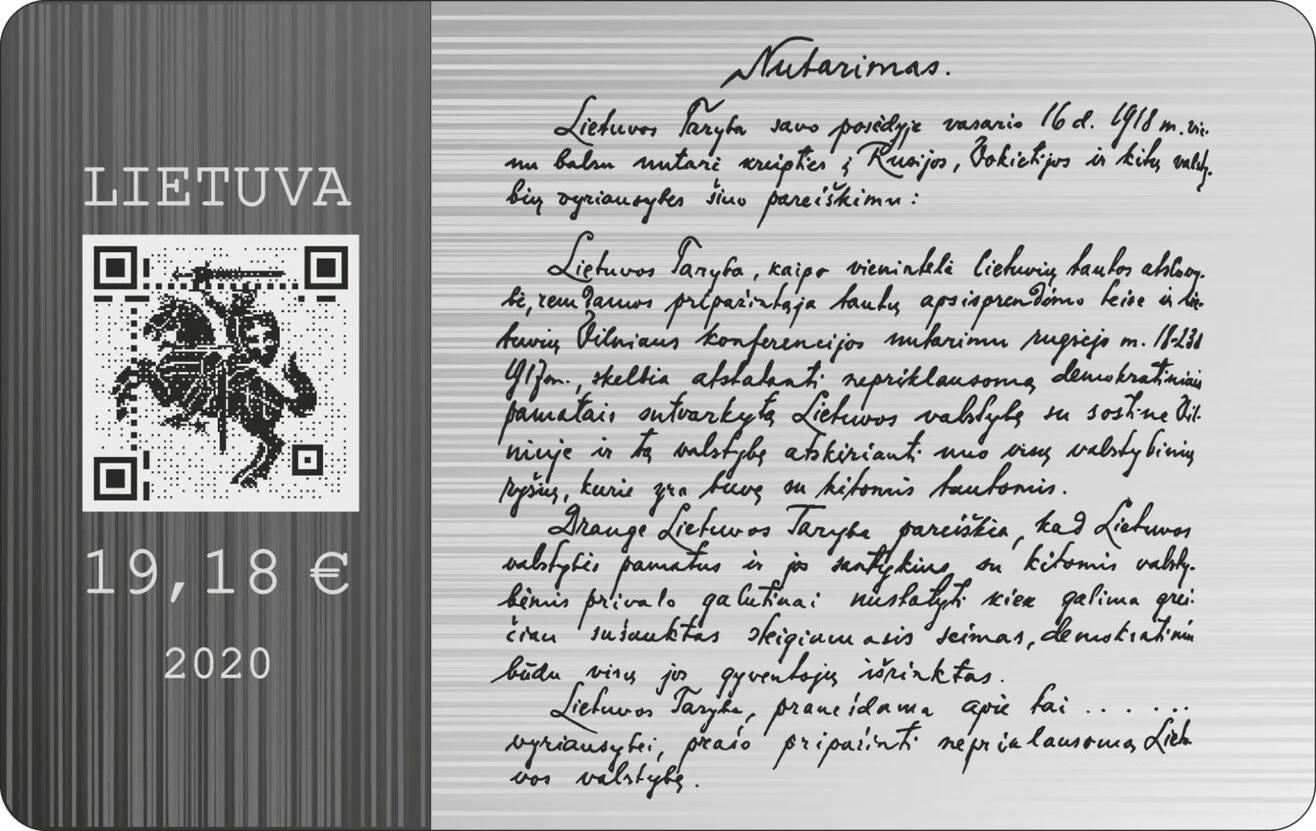
A QR code featuring Lithuania's coat of arms (Vytis) links to the e-shop for the digital tokens offered under the Act.
Inscription:
LIETUVA
19,18 €
2020
Nutarimas.
Lietuvos Taryba savo posėdyje vasario 16 d. 1918 m. vie-
nu balsu nutarė kreiptis: į Rusijos, Vokietijos ir kitų valsty-
bių vyriausybės šiuo pareiškimu:
Lietuvos Taryba, kaipo vienintelė lietuvių tautos atstovy-
bė, remdamos pripažintaja tautų apsisprendimo teise ir lie-
tuvių Vilniaus konferencijos nutarimu rugsėjo mėn. 18-23 d.
1917 metais, skelbia atstatanti nepriklausomą demokratiniais
pamatais sutvarkytą Lietuvos valstybę su sostine Vil-
niuje ir tą valstybę atskirianti nuo visų valstybinių
ryšių, kurie yra buvę su kitomis tautomis.
Drauge Lietuvos Taryba pareiškia, kad Lietuvos
valstybės pamatus ir jos santykius su kitomis valsty-
bėmis privalo galutinai nustatyti kiek galima grai-
čiau sušauktas steigiamasis seimas, demokratiniu
būdu visų jos gyventojų išrinktas.
Lietuvos Taryba pranešdama apie tai . . . . . .
vyriausybei, prašo pripažinti nepriklausomą Lietu-
vos valstybę.
19,18 €
2020
Nutarimas.
Lietuvos Taryba savo posėdyje vasario 16 d. 1918 m. vie-
nu balsu nutarė kreiptis: į Rusijos, Vokietijos ir kitų valsty-
bių vyriausybės šiuo pareiškimu:
Lietuvos Taryba, kaipo vienintelė lietuvių tautos atstovy-
bė, remdamos pripažintaja tautų apsisprendimo teise ir lie-
tuvių Vilniaus konferencijos nutarimu rugsėjo mėn. 18-23 d.
1917 metais, skelbia atstatanti nepriklausomą demokratiniais
pamatais sutvarkytą Lietuvos valstybę su sostine Vil-
niuje ir tą valstybę atskirianti nuo visų valstybinių
ryšių, kurie yra buvę su kitomis tautomis.
Drauge Lietuvos Taryba pareiškia, kad Lietuvos
valstybės pamatus ir jos santykius su kitomis valsty-
bėmis privalo galutinai nustatyti kiek galima grai-
čiau sušauktas steigiamasis seimas, demokratiniu
būdu visų jos gyventojų išrinktas.
Lietuvos Taryba pranešdama apie tai . . . . . .
vyriausybei, prašo pripažinti nepriklausomą Lietu-
vos valstybę.
Translation:
LIETUVA
19,18 €
2020
Resolution.
The Council of Lithuania, in its session of February 16, 1918, unanimously resolved to appeal to the governments of Russia, Germany, and other states with this declaration:
The Council of Lithuania, as the sole representative of the Lithuanian nation, basing itself on the recognized right of national self-determination and on the resolution of the Lithuanian Vilnius Conference of September 18-23, 1917, proclaims the restoration of the independent state of Lithuania, founded on democratic principles, with its capital in Vilnius, and the separation of that state from all state ties which have existed with other nations.
Furthermore, the Council of Lithuania declares that the foundation of the Lithuanian state and its relations with other states must be finally determined by a constituent assembly, to be convened as soon as possible, elected democratically by all its inhabitants.
The Council of Lithuania, in informing the . . . . . . government of this, requests the recognition of the independent state of Lithuania.
19,18 €
2020
Resolution.
The Council of Lithuania, in its session of February 16, 1918, unanimously resolved to appeal to the governments of Russia, Germany, and other states with this declaration:
The Council of Lithuania, as the sole representative of the Lithuanian nation, basing itself on the recognized right of national self-determination and on the resolution of the Lithuanian Vilnius Conference of September 18-23, 1917, proclaims the restoration of the independent state of Lithuania, founded on democratic principles, with its capital in Vilnius, and the separation of that state from all state ties which have existed with other nations.
Furthermore, the Council of Lithuania declares that the foundation of the Lithuanian state and its relations with other states must be finally determined by a constituent assembly, to be convened as soon as possible, elected democratically by all its inhabitants.
The Council of Lithuania, in informing the . . . . . . government of this, requests the recognition of the independent state of Lithuania.
Language: Lithuanian
Engraver: Giedrius Paulauskis
Reverse
Description:
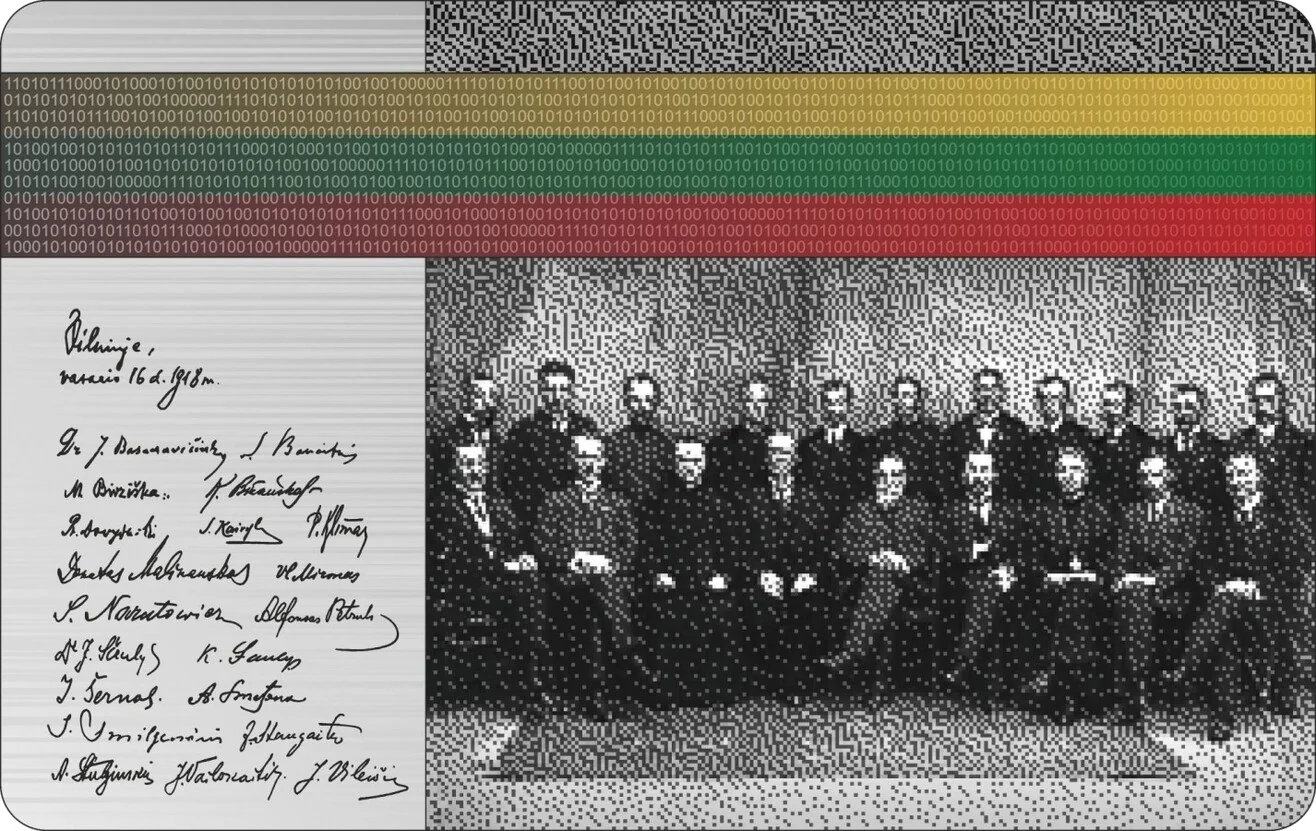
A digitized image of the Council of Lithuania with 36,500+ pixels—one for each day since the Act of Independence. The flag contains the national anthem in binary code. Signatures are at the left.
Inscription:
Vilniuje,
vasario 16 d. 1918 m.
Dr. J. Basanavičius S. Banaitis
M. Biržiška K. Bizauskas
P. Dovydaitis S Kairys P. Klimas
Donatas Malinauskas P. Mironas
S. Narutowicz Alfonsas Petrulis
Dr. J. Šaulys K. Šaulys
J. Šernas A. Smetona
J. Smilgevičius J. Staugaitis
A. Stulginskis J. Vailokaitis J. Vileišis
vasario 16 d. 1918 m.
Dr. J. Basanavičius S. Banaitis
M. Biržiška K. Bizauskas
P. Dovydaitis S Kairys P. Klimas
Donatas Malinauskas P. Mironas
S. Narutowicz Alfonsas Petrulis
Dr. J. Šaulys K. Šaulys
J. Šernas A. Smetona
J. Smilgevičius J. Staugaitis
A. Stulginskis J. Vailokaitis J. Vileišis
Translation:
In Vilnius,
February 16, 1918
The Council of Lithuania
Dr. J. Basanavičius S. Banaitis
M. Biržiška K. Bizauskas
P. Dovydaitis S. Kairys P. Klimas
Donatas Malinauskas A. Mironas
S. Narutowicz Alfonsas Petrulis
Dr. J. Šaulys K. Šaulys
J. Šernas A. Smetona
J. Smilgevičius J. Staugaitis
A. Stulginskis J. Vailokaitis J. Vileišis
February 16, 1918
The Council of Lithuania
Dr. J. Basanavičius S. Banaitis
M. Biržiška K. Bizauskas
P. Dovydaitis S. Kairys P. Klimas
Donatas Malinauskas A. Mironas
S. Narutowicz Alfonsas Petrulis
Dr. J. Šaulys K. Šaulys
J. Šernas A. Smetona
J. Smilgevičius J. Staugaitis
A. Stulginskis J. Vailokaitis J. Vileišis
Language: Lithuanian
Engraver: Giedrius Paulauskis
Edge
Plain
Categories
| Event> Independence |
| Person> Politician |
| Symbol> Flag |
Mintings
| Year | Mint Mark | Mintage | Quality | Collection |
|---|---|---|---|---|
| 2020 | — | — | Proof | |
| 2020 | — | — | Prooflike |
Historical background
In 2020, Lithuania's currency situation was defined by its well-established membership in the Eurozone, having adopted the euro on 1 January 2015. Therefore, the national currency was the euro (€), and monetary policy was set by the European Central Bank (ECB), not by Lithuanian authorities. This provided stability and eliminated exchange rate risk within the Eurozone, which was particularly valuable during the economic turbulence of that year. The primary focus for Lithuania was not on currency management but on navigating the broader economic fallout of the COVID-19 pandemic within the constraints and support mechanisms of the single currency area.
The year was dominated by the severe economic shock caused by the global pandemic. Lithuania's economy, heavily reliant on exports and services, contracted sharply in the second quarter. The government responded with significant fiscal stimulus packages to support businesses and households, leading to a widened budget deficit. From a currency perspective, the euro provided a shield against potential speculative attacks or liquidity crises that might have affected a smaller, independent currency, and ensured continued access to ECB support measures like the Pandemic Emergency Purchase Programme (PEPP).
Consequently, domestic economic discussions in 2020 centered on fiscal policy, healthcare, and sectoral support, not on exchange rates or independent monetary tools. The stability of the euro allowed the government to focus its response entirely on budgetary measures. By the end of 2020, as the initial shock subsided, Lithuania's economy showed signs of a faster-than-expected recovery compared to some Eurozone peers, though the year concluded with the currency's role as a bedrock of macroeconomic stability largely unquestioned in the national debate.
The year was dominated by the severe economic shock caused by the global pandemic. Lithuania's economy, heavily reliant on exports and services, contracted sharply in the second quarter. The government responded with significant fiscal stimulus packages to support businesses and households, leading to a widened budget deficit. From a currency perspective, the euro provided a shield against potential speculative attacks or liquidity crises that might have affected a smaller, independent currency, and ensured continued access to ECB support measures like the Pandemic Emergency Purchase Programme (PEPP).
Consequently, domestic economic discussions in 2020 centered on fiscal policy, healthcare, and sectoral support, not on exchange rates or independent monetary tools. The stability of the euro allowed the government to focus its response entirely on budgetary measures. By the end of 2020, as the initial shock subsided, Lithuania's economy showed signs of a faster-than-expected recovery compared to some Eurozone peers, though the year concluded with the currency's role as a bedrock of macroeconomic stability largely unquestioned in the national debate.

💎 Very Rare