

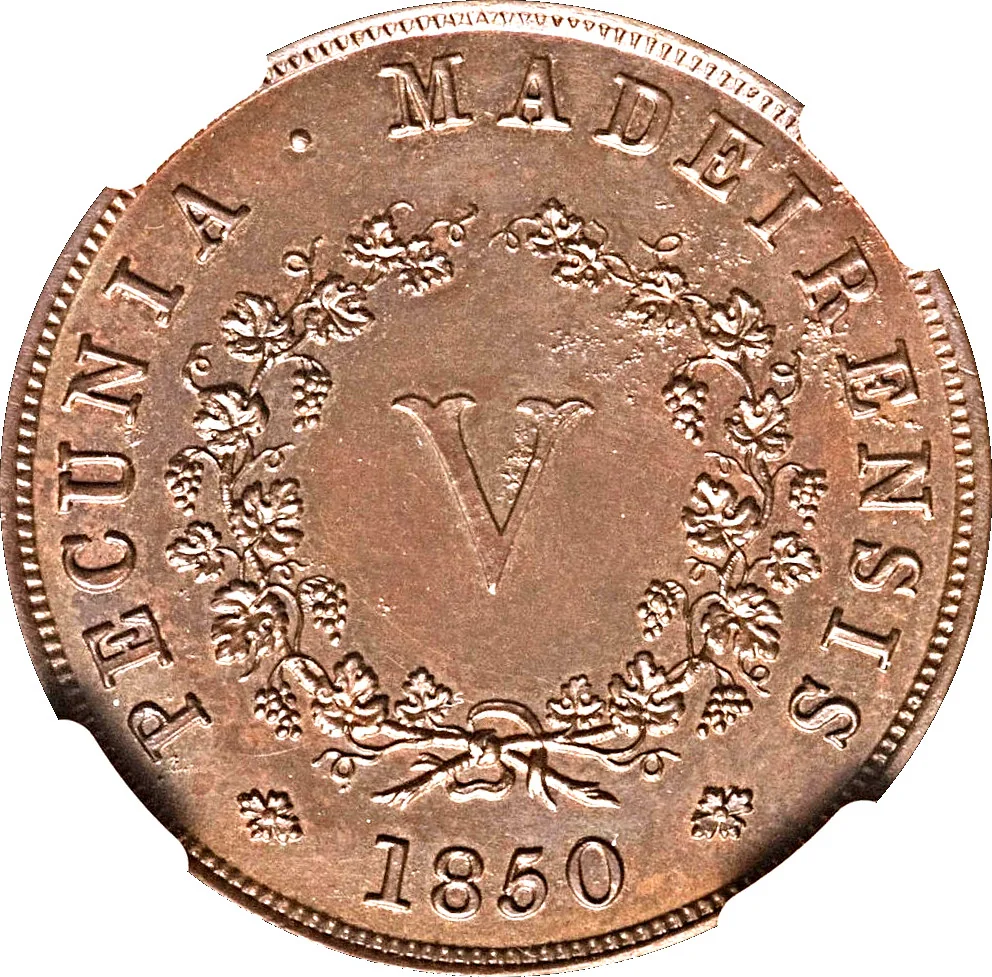
5 réis – Madeira Islands
Add to wishlist
Portugal
Obverse
Description:
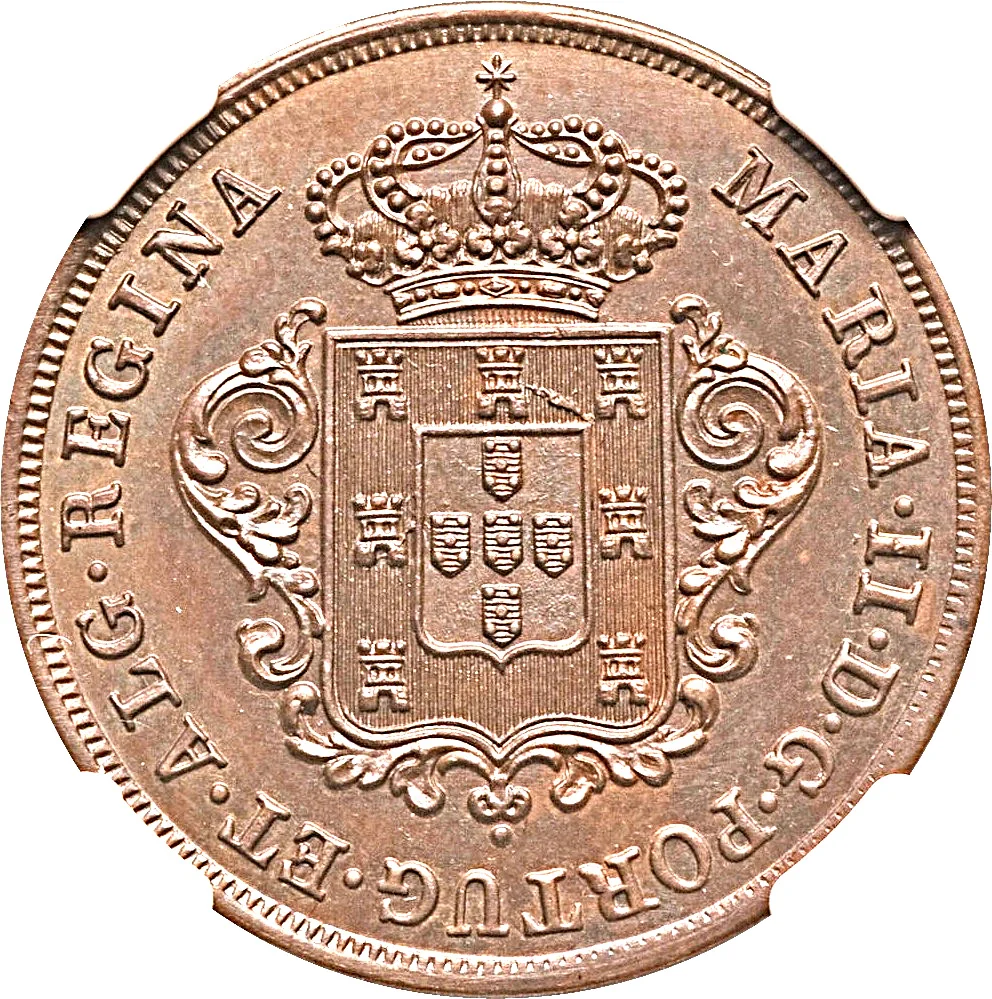
Portuguese coat of arms: A royal crown above a shield. The main shield features seven castles. Within it is a smaller shield with five smaller shields in a cross, each containing five dots. Supporters and a scroll flank the design, all surrounded by lettering.
Inscription:
MARIA·II·D·G·PORTUG·ET·ALG·REGINA
Translation:
Maria II, by the Grace of God, Queen of Portugal and the Algarves
Script: Latin
Languages: Portuguese, Latin
Reverse
Edge
Plain
Mintings
| Year | Mint Mark | Mintage | Quality | Collection |
|---|---|---|---|---|
| 1850 | — | — |
Historical background
In 1850, the currency situation in the Madeira Islands reflected its political status as a Portuguese territory and its economic role as a subtropical Atlantic trading hub. Officially, the Portuguese real was the legal tender, with its value tied to a bimetallic standard of gold and silver. However, the reality in Funchal's port and markets was more complex. Due to extensive trade with Britain (its primary wine customer), as well as commercial links with Brazil, North America, and other European nations, a multitude of foreign coins circulated freely and were essential for business. British gold sovereigns and pounds sterling were particularly prevalent and influential, often used for larger commercial transactions and the island's vital wine exports.
This de facto monetary pluralism created a dynamic where exchange rates between Portuguese currency, British gold, and other foreign silver coins fluctuated based on trade flows and the intrinsic metal value of the coins themselves. Merchants and money changers had to be acutely aware of the varying metallic contents and the international exchange values, as a coin's worth was largely judged by its weight and fineness rather than its face value. The system functioned but was inherently localized and somewhat chaotic, lacking the uniformity of a modern national currency.
The situation was further shaped by Portugal's own broader economic difficulties during this period, including fiscal instability and a debasement of its coinage that would eventually lead to the 1854 adoption of a decimal-based real. While this mainland reform was on the horizon, in 1850 Madeira operated within a pragmatic, merchant-driven monetary environment. Its currency circulation was less defined by Lisbon's decrees and more by the practical needs of an export economy deeply integrated into Atlantic trade networks, relying on a heterogeneous mix of specie to facilitate its commerce.
This de facto monetary pluralism created a dynamic where exchange rates between Portuguese currency, British gold, and other foreign silver coins fluctuated based on trade flows and the intrinsic metal value of the coins themselves. Merchants and money changers had to be acutely aware of the varying metallic contents and the international exchange values, as a coin's worth was largely judged by its weight and fineness rather than its face value. The system functioned but was inherently localized and somewhat chaotic, lacking the uniformity of a modern national currency.
The situation was further shaped by Portugal's own broader economic difficulties during this period, including fiscal instability and a debasement of its coinage that would eventually lead to the 1854 adoption of a decimal-based real. While this mainland reform was on the horizon, in 1850 Madeira operated within a pragmatic, merchant-driven monetary environment. Its currency circulation was less defined by Lisbon's decrees and more by the practical needs of an export economy deeply integrated into Atlantic trade networks, relying on a heterogeneous mix of specie to facilitate its commerce.
💎 Extremely Rare