

12.5 euro (King Leopold II) – Belgium
Add to wishlist
Non-circulating coins
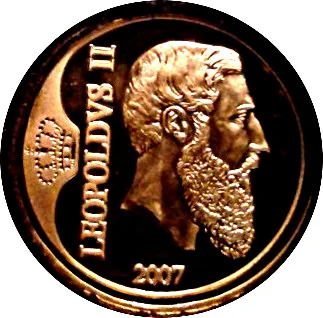
Commemoration: 175th Anniversary of the Belgian royal Dynasty Series - King Leopold II
Belgium
Context
Material
References
KM: #
Numista: #22411
Value
Exchange value: 12.5 EUR
Bullion value: $190.38
Inflation-adjusted value: 19.06 EUR
Obverse
Description:
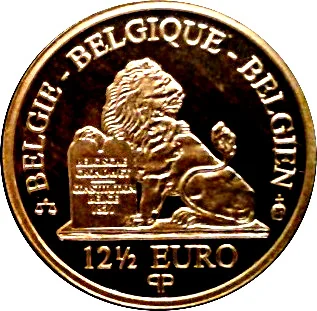
Belgium's lion symbol rests a paw on the "1831 CONSTITUTION," above the value, with the trilingual country name "BELGIE - BELGIQUE - BELGIEN."
Inscription:
BELGIE - BELGIQUE - BELGIEN
BELGISCHE GRONDWET – CONSTITUTION BELGE - 1831
12½ EURO
qp
BELGISCHE GRONDWET – CONSTITUTION BELGE - 1831
12½ EURO
qp
Translation:
Belgium - Belgium - Belgium
Belgian Constitution – Belgian Constitution - 1831
12½ Euro
Belgian Constitution – Belgian Constitution - 1831
12½ Euro
Script: Latin
Engraver: Luc Luycx
Reverse
Edge
Plain.
Mintings
| Year | Mint Mark | Mintage | Quality | Collection |
|---|---|---|---|---|
| 2007 | — | 15,000 | Proof |
Historical background
In 2007, Belgium was a fully integrated member of the Eurozone, having adopted the euro as its official currency on 1 January 1999 (for electronic transactions) and introducing euro banknotes and coins in 2002. The Belgian franc, which had been the national currency since 1832, was completely withdrawn from circulation, and prices were exclusively quoted in euros. This transition was considered a significant success, providing macroeconomic stability, eliminating exchange rate risks with key trading partners, and lowering transaction costs within the Single Market. The European Central Bank (ECB) was responsible for the euro's monetary policy, with the National Bank of Belgium participating in the Eurosystem's decision-making processes.
Domestically, the euro's introduction had lasting effects on price perceptions, with a lingering public belief that the conversion led to a general increase in the cost of living, a phenomenon often referred to as "price rounding-up." Economically, Belgium benefited from the low-interest-rate environment fostered by the ECB, which helped manage the country's high public debt—one of the largest in the Eurozone at over 85% of GDP in 2007. The common currency also facilitated Belgium's role as a hub for international institutions and EU governance, with Brussels hosting key EU bodies.
However, the euro's one-size-fits-all monetary policy also presented challenges. As a small, open economy with high debt and specific industrial strengths, Belgium had to rely solely on national fiscal policy and wage moderation to address economic competitiveness, as it could no longer devalue its currency. This constraint became a point of discussion among economists, especially as the global financial crisis began to unfold in late 2007, foreshadowing the severe tests the Eurozone would face in the coming years. Overall, in 2007, the euro was a settled and irreversible reality in Belgian daily life and economic policy.
Domestically, the euro's introduction had lasting effects on price perceptions, with a lingering public belief that the conversion led to a general increase in the cost of living, a phenomenon often referred to as "price rounding-up." Economically, Belgium benefited from the low-interest-rate environment fostered by the ECB, which helped manage the country's high public debt—one of the largest in the Eurozone at over 85% of GDP in 2007. The common currency also facilitated Belgium's role as a hub for international institutions and EU governance, with Brussels hosting key EU bodies.
However, the euro's one-size-fits-all monetary policy also presented challenges. As a small, open economy with high debt and specific industrial strengths, Belgium had to rely solely on national fiscal policy and wage moderation to address economic competitiveness, as it could no longer devalue its currency. This constraint became a point of discussion among economists, especially as the global financial crisis began to unfold in late 2007, foreshadowing the severe tests the Eurozone would face in the coming years. Overall, in 2007, the euro was a settled and irreversible reality in Belgian daily life and economic policy.
💎 Very Rare