

1 Paisa – Nepal
Non-circulating coins
Commemoration: Coronation
Nepal
Context
Year: 1974
Vikram Samvat Year: 2031
Issuer: Nepal 
Ruler: Birendra Bir Bikram Shah
Currency:
(since 1932)
Total mintage: 1,000
Material
Diameter: 16.1 mm
Weight: 1.66 g
Shape: Round
Composition: Copper-nickel
Technique: Milled
Alignment: Medal alignment
flip
References
KM: #Click to copy to clipboard800a
Numista: #223915
Value
Exchange value: 0.01 NPR
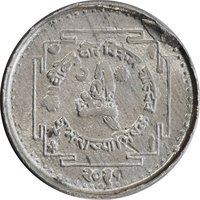
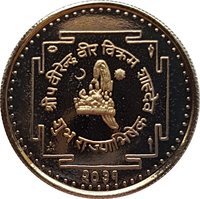
Obverse
Description:
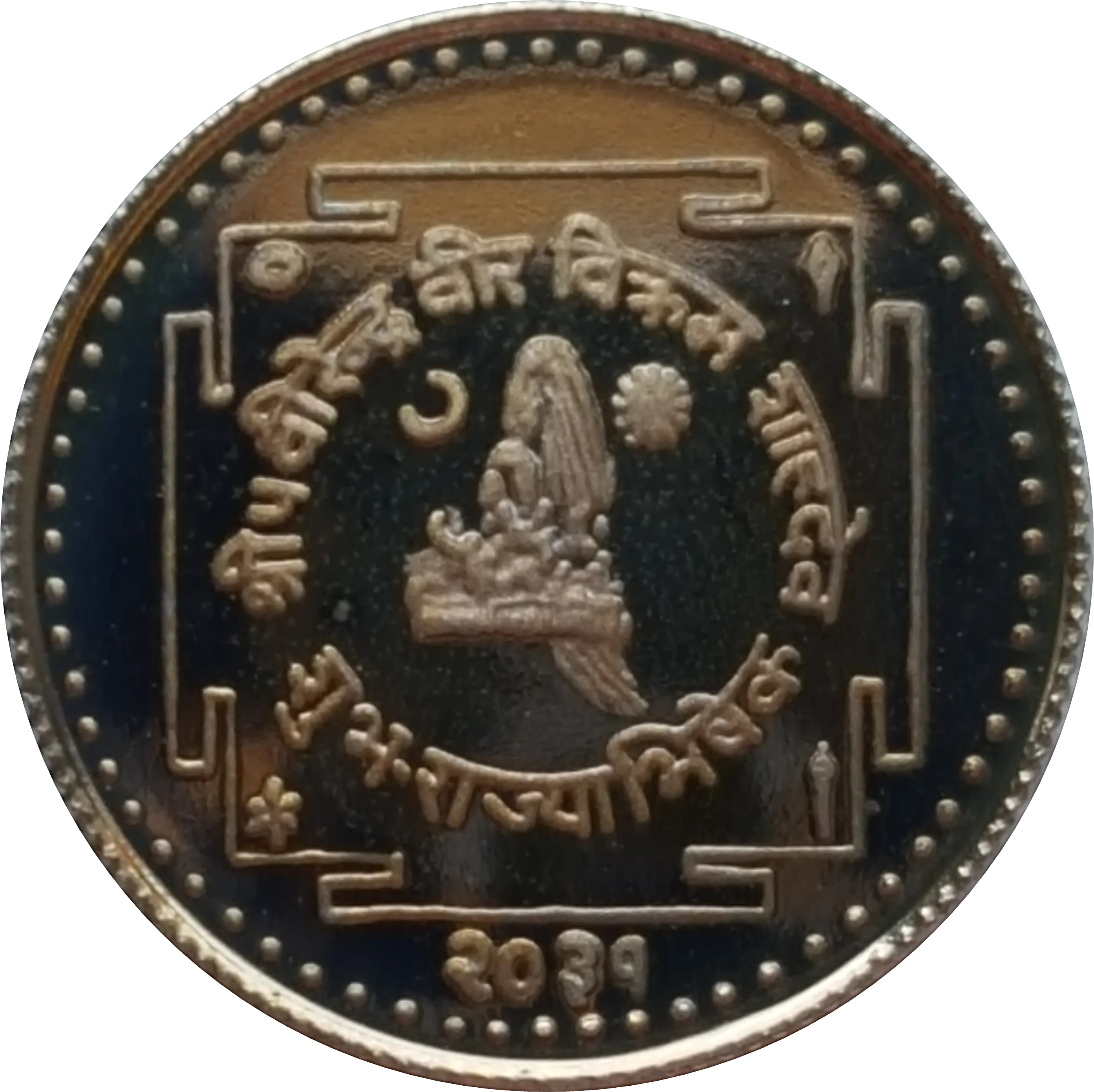
Crown encircled, Devnagari legend: "Shree Pach Birendra Bikram Shah Deva Shub Rajyabhishek 2031."
Inscription:
श्री ५ वीरेन्द्र वीर विक्रम शाहदेव
शुभ राज्याभिषेक
२०३१
शुभ राज्याभिषेक
२०३१
Translation:
Shri 5 Virendra Vir Vikram Shahdev
Auspicious Royal Coronation
2031
Auspicious Royal Coronation
2031
Language: Nepali
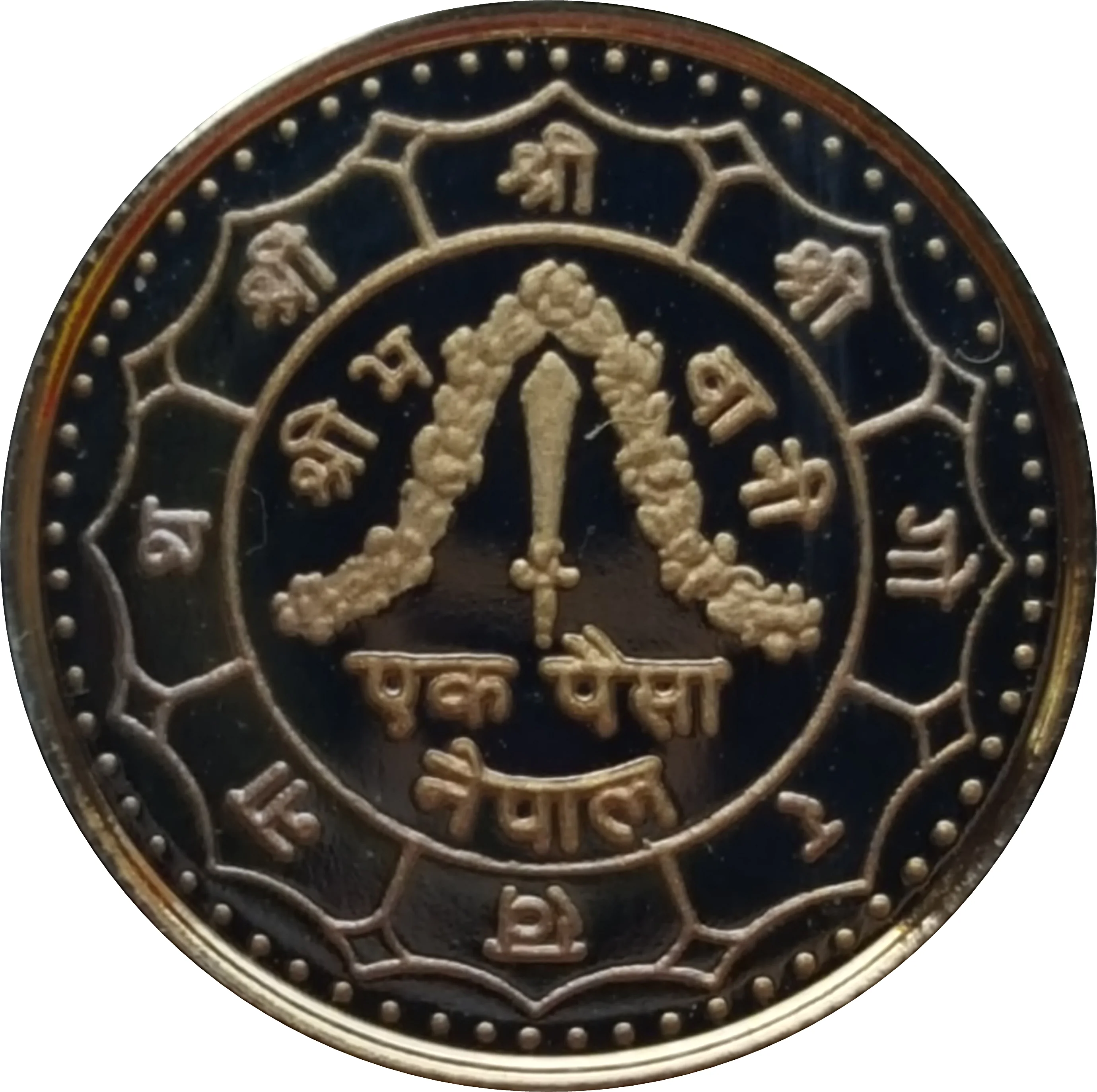
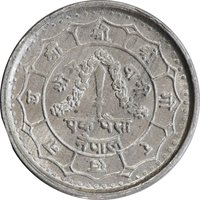
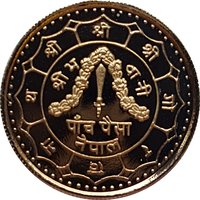
Reverse
Edge
Reeded
Mintings
| Year | Mint Mark | Mintage | Quality | Collection |
|---|---|---|---|---|
| 1974 | — | 1,000 | Proof |
Historical background
In 1974, Nepal's currency situation was fundamentally defined by its fixed exchange rate system and close economic ties with India. The Nepalese rupee (NPR) was pegged to the Indian rupee (INR) at a rate of 1:1.25, a parity established in 1960. This arrangement facilitated extensive cross-border trade but also meant Nepal's monetary policy was heavily influenced by India's economic conditions. The country operated a dual currency system, where the Indian rupee circulated freely alongside the Nepalese rupee, particularly in the southern Terai region, reflecting deep economic integration and a significant reliance on India for trade and transit.
Economically, the early 1970s were a period of planned development under Nepal's Fourth Five-Year Plan (1970-1975), which aimed for economic modernization. However, the currency peg and open border presented challenges for independent monetary management. Inflation in India, driven by the global oil crisis of 1973, easily transmitted into Nepal, eroding purchasing power. Furthermore, the fixed exchange rate sometimes failed to reflect the true economic fundamentals between the two currencies, leading to periodic concerns about currency smuggling and arbitrage.
Administratively, the Nepal Rastra Bank, the central bank, had limited tools to conduct an autonomous monetary policy. The system required maintaining sufficient foreign exchange reserves, largely in Indian rupees, to defend the peg. While this stability was beneficial for trade and investor confidence, it constrained Nepal's ability to use exchange rate adjustments as a tool to manage its own balance of payments. Thus, in 1974, the currency situation was one of managed stability but with inherent vulnerabilities to external shocks and a clear limitation on national monetary sovereignty.
Economically, the early 1970s were a period of planned development under Nepal's Fourth Five-Year Plan (1970-1975), which aimed for economic modernization. However, the currency peg and open border presented challenges for independent monetary management. Inflation in India, driven by the global oil crisis of 1973, easily transmitted into Nepal, eroding purchasing power. Furthermore, the fixed exchange rate sometimes failed to reflect the true economic fundamentals between the two currencies, leading to periodic concerns about currency smuggling and arbitrage.
Administratively, the Nepal Rastra Bank, the central bank, had limited tools to conduct an autonomous monetary policy. The system required maintaining sufficient foreign exchange reserves, largely in Indian rupees, to defend the peg. While this stability was beneficial for trade and investor confidence, it constrained Nepal's ability to use exchange rate adjustments as a tool to manage its own balance of payments. Thus, in 1974, the currency situation was one of managed stability but with inherent vulnerabilities to external shocks and a clear limitation on national monetary sovereignty.
✨ Legendary