


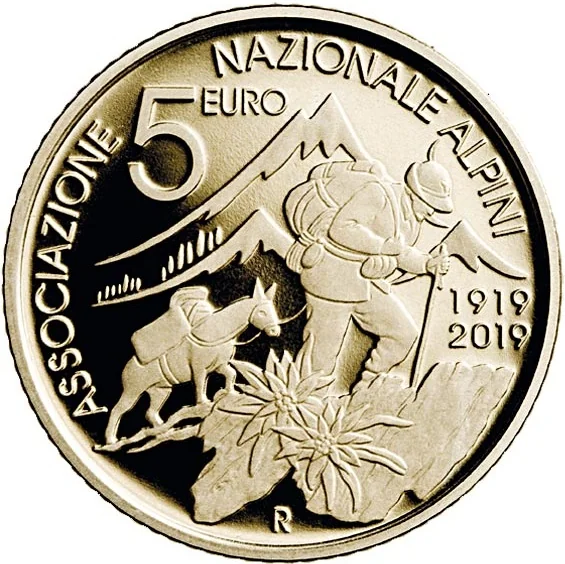
5 euro (Alpine National Association) – Italy
Add to wishlist
Non-circulating coins
Commemoration: Centenary of the Alpine National Association
Italy
Context
Material


References
KM: #
Numista: #223507
Value
Exchange value: 5 EUR
Inflation-adjusted value: 5.90 EUR
Obverse
Description:
Portrait in traditional headdress
Inscription:
REPUBBLICA ITALIANA
PETRASSI
PETRASSI
Translation:
Italian Republic
Petrassi
Petrassi
Script: Latin
Language: Italian
Engraver: Silvia Petrassi
Reverse
Edge
Reeded
Mints
| Name | Mark |
|---|---|
| Rome | R |
Mintings
| Year | Mint Mark | Mintage | Quality | Collection |
|---|---|---|---|---|
| 2019 | — | 10,000 | Proof |
Historical background
In 2019, Italy's currency situation was defined by its continued use of the euro, a decade after the European sovereign debt crisis had severely tested the country's place within the Eurozone. The year was politically charged, with a populist coalition government—comprising the Five Star Movement and the League—frequently clashing with European Union institutions over fiscal policy. This tension fueled ongoing domestic debate about the costs and benefits of the single currency, with some political figures and economists questioning whether Italy would be better off returning to a national currency, the lira, to regain control over monetary policy and devalue its way to greater competitiveness.
Economically, the country faced persistent challenges of low growth, high public debt (exceeding 130% of GDP), and a fragile banking sector burdened by non-performing loans. These structural weaknesses were exacerbated by the strict fiscal rules of the Eurozone, which limited the government's ability to stimulate the economy through spending. Consequently, the euro was seen by many critics as a straitjacket, preventing a robust response to Italy's economic stagnation. However, abandoning the euro was widely recognized as a highly risky proposition, likely to trigger massive capital flight, a sovereign debt crisis, and severe short-term economic pain.
Ultimately, 2019 ended with Italy still firmly, if uneasily, within the Eurozone. While anti-euro rhetoric was a potent political tool, the practical and catastrophic consequences of "Italexit" ensured it remained a fringe policy. The government's focus shifted toward negotiating more flexible budget targets with the European Commission, acknowledging the deep integration of Italy's financial system with the euro. The year underscored the fundamental tension for Italy: the euro provided stability and lower borrowing costs than a standalone lira likely would, but it also removed key policy tools needed to address the nation's long-standing economic frailties.
Economically, the country faced persistent challenges of low growth, high public debt (exceeding 130% of GDP), and a fragile banking sector burdened by non-performing loans. These structural weaknesses were exacerbated by the strict fiscal rules of the Eurozone, which limited the government's ability to stimulate the economy through spending. Consequently, the euro was seen by many critics as a straitjacket, preventing a robust response to Italy's economic stagnation. However, abandoning the euro was widely recognized as a highly risky proposition, likely to trigger massive capital flight, a sovereign debt crisis, and severe short-term economic pain.
Ultimately, 2019 ended with Italy still firmly, if uneasily, within the Eurozone. While anti-euro rhetoric was a potent political tool, the practical and catastrophic consequences of "Italexit" ensured it remained a fringe policy. The government's focus shifted toward negotiating more flexible budget targets with the European Commission, acknowledging the deep integration of Italy's financial system with the euro. The year underscored the fundamental tension for Italy: the euro provided stability and lower borrowing costs than a standalone lira likely would, but it also removed key policy tools needed to address the nation's long-standing economic frailties.



💎 Extremely Rare