

5 Euro (Cluny Abbey) – France
Non-circulating coins
Commemoration: Europa Series - Cluny Abbey, 1100th Anniversary
France
Obverse
Description:
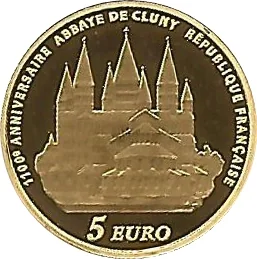
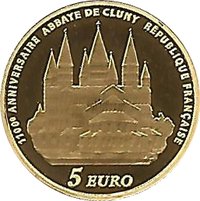
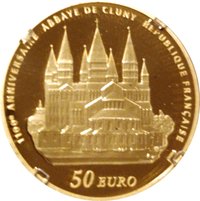
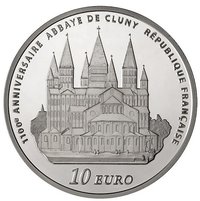
Depiction of Cluny Abbey. Above: "1100e ANNIVERSAIRE ABBAYE DE CLUNY RÉPUBLIQUE FRANÇAISE". Below: "5 EURO".
Inscription:
1100e ANNIVERSAIRE ABBAYE DE CLUNY RÉPUBLIQUE FRANÇAISE
5 EURO
5 EURO
Translation:
1100th Anniversary Abbey of Cluny French Republic
5 Euro
5 Euro
Language: French
Reverse
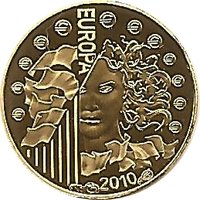
Description:
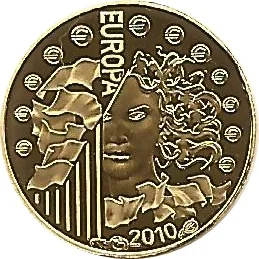
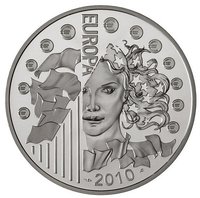
Portrait of Europa with stars in her hair, above an arc of 12 "€" symbols. To her left, European flags on mats.
Inscription:
€ € € € € € € € € € € €
EUROPA
2010
EUROPA
2010
Translation:
EUROPE
2010
2010
Engraver: Fabienne Courtiade
Edge
Plain.
Categories
| Building> Religious building |
Mints
| Name | Mark |
|---|---|
| Monnaie de Paris | — |
Mintings
| Year | Mint Mark | Mintage | Quality | Collection |
|---|---|---|---|---|
| 2010 | — | 19,799 | Proof |
Historical background
In 2010, France was a fully integrated member of the Eurozone, having adopted the euro as its sole legal tender in 2002. The currency situation was therefore defined not by national policy but by the collective monetary framework of the European Central Bank (ECB). The euro provided France with exchange rate stability within the single market and was generally seen as a cornerstone of European integration. However, the context of 2010 was dominated by the aftershocks of the 2008 global financial crisis, which had evolved into the European sovereign debt crisis, placing the entire Eurozone project under severe strain.
The primary concern for France that year was not its own immediate currency stability, but the intense market pressure on the so-called "peripheral" Eurozone countries, particularly Greece, Ireland, and Portugal. There were growing fears of contagion that could threaten the euro's viability. France, alongside Germany, was at the center of contentious debates over how to structure bailouts and enforce fiscal discipline to preserve the currency union. This period highlighted the inherent tension of a shared currency without full fiscal union, as France had to balance its own economic interests with the need for collective Eurozone survival.
Domestically, the strong euro (relative to the US dollar and others) was a double-edged sword. It helped contain inflation and reduced the cost of energy imports, but it also posed challenges for French exporters, particularly in the industrial and agricultural sectors, by making their goods more expensive on the global market. Consequently, French economic policy in 2010 operated within a constrained framework: monetary policy was set by the ECB in Frankfurt, while the government, under President Nicolas Sarkozy, focused on fiscal stimulus and structural reforms to boost competitiveness within the unchangeable reality of the single currency.
The primary concern for France that year was not its own immediate currency stability, but the intense market pressure on the so-called "peripheral" Eurozone countries, particularly Greece, Ireland, and Portugal. There were growing fears of contagion that could threaten the euro's viability. France, alongside Germany, was at the center of contentious debates over how to structure bailouts and enforce fiscal discipline to preserve the currency union. This period highlighted the inherent tension of a shared currency without full fiscal union, as France had to balance its own economic interests with the need for collective Eurozone survival.
Domestically, the strong euro (relative to the US dollar and others) was a double-edged sword. It helped contain inflation and reduced the cost of energy imports, but it also posed challenges for French exporters, particularly in the industrial and agricultural sectors, by making their goods more expensive on the global market. Consequently, French economic policy in 2010 operated within a constrained framework: monetary policy was set by the ECB in Frankfurt, while the government, under President Nicolas Sarkozy, focused on fiscal stimulus and structural reforms to boost competitiveness within the unchangeable reality of the single currency.

💎 Very Rare