

10 Euro (Slovak National Theatre) – Slovakia
Non-circulating coins
Commemoration: 100th anniversary of the Slovak National Theatre.
Slovakia
Context
Material
References
KM: #Click to copy to clipboard171
Numista: #221763
Value
Exchange value: 10 EUR = $11.81
Bullion value: $46.37
Inflation-adjusted value: 13.93 EUR
Obverse
Description:
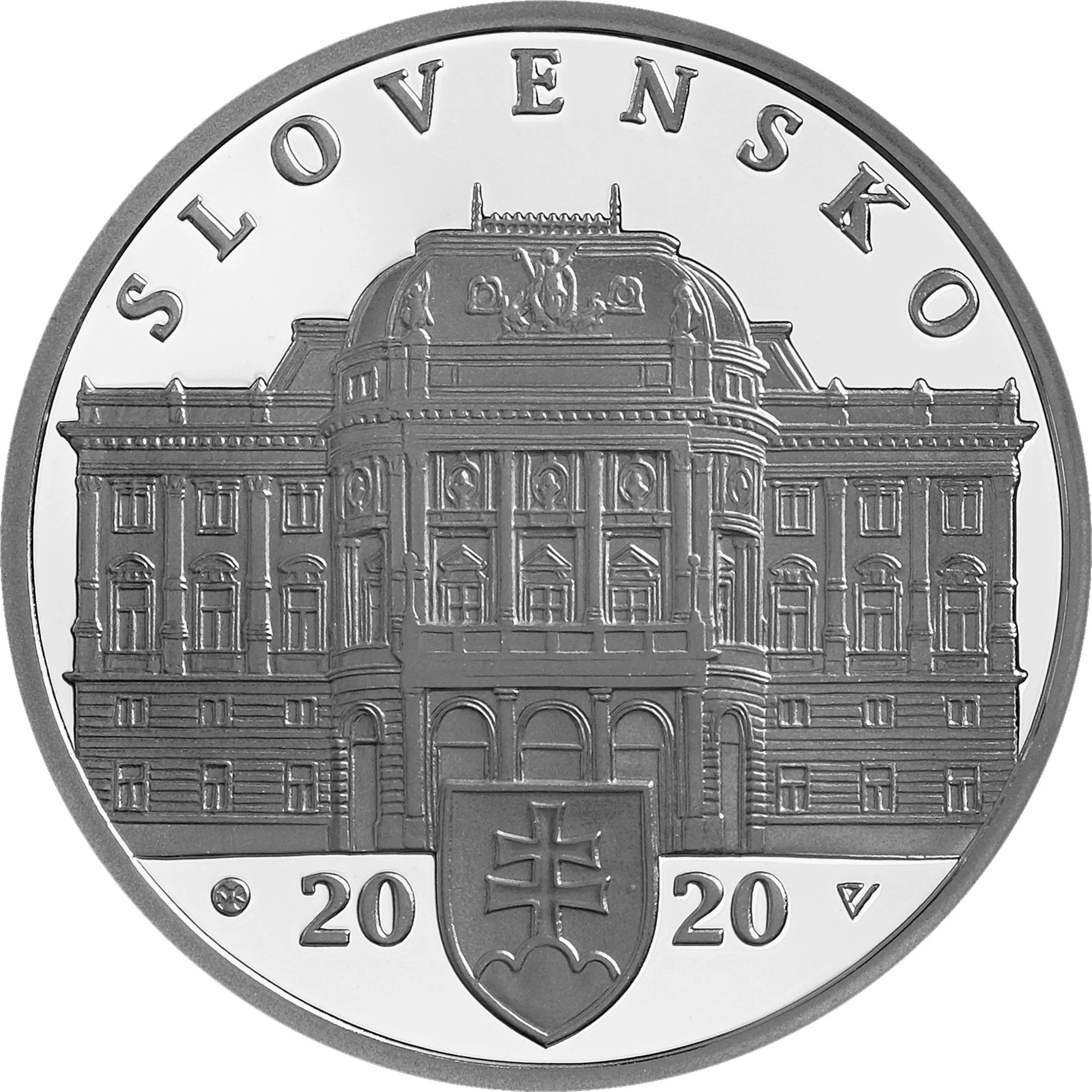
The obverse features the SNT Historical Building, with Slovakia's name above. The Slovak coat of arms at the bottom center splits the year '2020'. To the left is the 'MK' mint mark of the Kremnica Mint, and to the right are the designer's initials 'PV'.
Inscription:
SLOVENSKO
PV
20 20
PV
20 20
Translation:
SLOVAKIA
5
20 20
5
20 20
Script: Latin
Engraver: Dalibor Schmidt
Designer: Peter Valach
Reverse
Description:
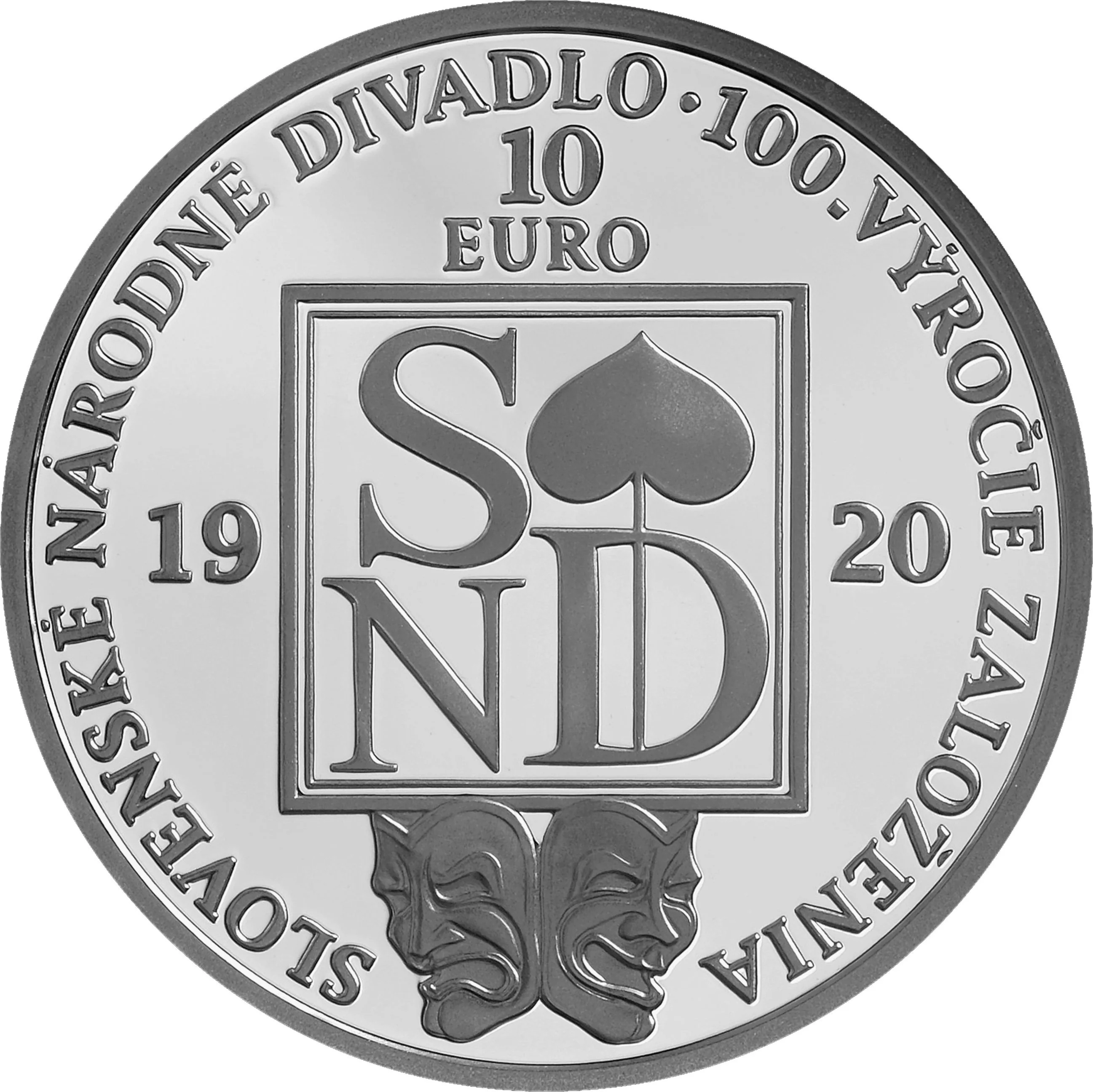
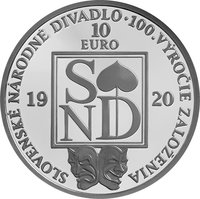
The reverse shows the Slovak National Theatre logo in a square, with comedy and tragedy masks below. '10' and 'EURO' are above the logo. The year '1920' is split on either side. The edge inscription reads 'SLOVENSKÉ NÁRODNÉ DIVADLO • 100. VÝROČIE ZALOŽENIA'.
Inscription:
· 100. VÝROČIE ZALOŽENIA SLOVENSKÉ NARODNÉ DIVALDO
10 EURO
19 20
SND
10 EURO
19 20
SND
Translation:
100th Anniversary of the Founding of the Slovak National Theatre
10 Euro
19 20
SND
10 Euro
19 20
SND
Script: Latin
Language: Slovak
Engraver: Dalibor Schmidt
Designer: Peter Valach
Edge
Lettering
Legend:
• SLOVENSKÉ NÁRODNÉ DIVADLO 1920 – 2020
Translation:
SLOVAK NATIONAL THEATRE 1920 – 2020
Language: Slovak
Categories
| Symbols> Coat of Arms |
| Art> Theatre |
Mints
| Name | Mark |
|---|---|
| Kremnica | — |
Mintings
| Year | Mint Mark | Mintage | Quality | Collection |
|---|---|---|---|---|
| 2020 | — | 3,100 | ||
| 2020 | — | 8,200 | Proof |
Historical background
In 2020, Slovakia was a well-established member of the Eurozone, having adopted the euro as its official currency on January 1, 2009. Therefore, the country did not have an independent national currency policy; its monetary policy was set by the European Central Bank (ECB) in Frankfurt. The primary currency-related discussions within Slovakia that year were not about exchange rates or devaluation, but focused on broader Eurozone fiscal and monetary responses to the economic crisis triggered by the COVID-19 pandemic. Slovak authorities, like their Eurozone partners, were concerned with ensuring sufficient liquidity and supportive measures from the ECB.
The economic shock of the pandemic dominated the financial landscape. Slovakia's GDP contracted significantly, leading to increased public spending to support businesses and households. A key currency-adjacent issue was Slovakia's participation in the EU's recovery fund (NextGenerationEU) and the debate over common European debt issuance, which some Slovak political figures viewed cautiously. Domestically, there were no serious political movements to leave the euro, as the currency was generally seen as providing stability during the global turmoil, shielding the small, open economy from the speculative pressures it might have faced with its former currency, the koruna.
However, the year was not without currency-related events. In 2020, Slovakia began issuing a new series of euro banknotes (the "Europa series") into circulation, a process of modernizing security features that was ongoing across the Eurozone. Furthermore, as a member of the ECB Governing Council, the Governor of the National Bank of Slovakia, Peter Kažimír, was involved in critical decisions, including the launch of the €1.35 trillion Pandemic Emergency Purchase Programme (PEPP) to stabilize the euro area economy. Thus, Slovakia's currency situation in 2020 was characterized by its integrated role in the collective Eurozone effort to mitigate a severe economic downturn.
The economic shock of the pandemic dominated the financial landscape. Slovakia's GDP contracted significantly, leading to increased public spending to support businesses and households. A key currency-adjacent issue was Slovakia's participation in the EU's recovery fund (NextGenerationEU) and the debate over common European debt issuance, which some Slovak political figures viewed cautiously. Domestically, there were no serious political movements to leave the euro, as the currency was generally seen as providing stability during the global turmoil, shielding the small, open economy from the speculative pressures it might have faced with its former currency, the koruna.
However, the year was not without currency-related events. In 2020, Slovakia began issuing a new series of euro banknotes (the "Europa series") into circulation, a process of modernizing security features that was ongoing across the Eurozone. Furthermore, as a member of the ECB Governing Council, the Governor of the National Bank of Slovakia, Peter Kažimír, was involved in critical decisions, including the launch of the €1.35 trillion Pandemic Emergency Purchase Programme (PEPP) to stabilize the euro area economy. Thus, Slovakia's currency situation in 2020 was characterized by its integrated role in the collective Eurozone effort to mitigate a severe economic downturn.
💎 Very Rare