

25 Dollars – Jamaica
Non-circulating coins
Commemoration: Humpback whale protection
Jamaica
Context
Material
References
KM: #Click to copy to clipboard119
Numista: #219086
Value
Exchange value: 25 JMD
Bullion value: $357.82
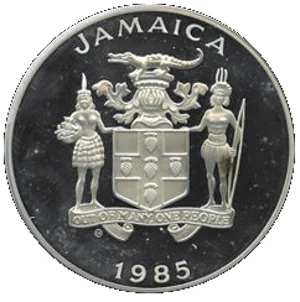
Obverse
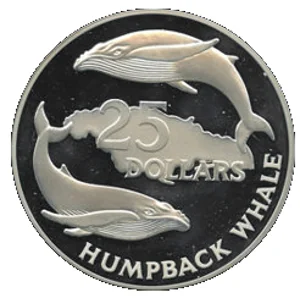
Reverse
Description:
Two humpback whales encircling Jamaica's map.
Inscription:
25 DOLLARS
HUMPBACK WHALE
HUMPBACK WHALE
Script: Latin
Edge
Reeded
Categories
| Animal> Marine mammal |
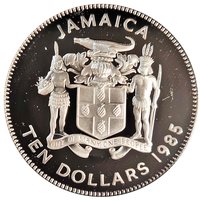
| Symbols> Coat of Arms |
| Map |
Mints
| Name | Mark |
|---|---|
| Valcambi | CHI |
Mintings
| Year | Mint Mark | Mintage | Quality | Collection |
|---|---|---|---|---|
| 1985 | CHI | 2,600 |
Historical background
By 1985, Jamaica's currency situation was defined by a protracted and severe economic crisis, rooted in the oil shocks of the 1970s, high external debt, and the structural adjustment policies of the preceding decade. The country operated under a tightly controlled foreign exchange regime, with the Jamaican dollar (J$) pegged to the U.S. dollar but subject to significant government management. A critical dual-exchange rate system was in place: an official rate (around J$5.50 to US$1) for essential imports like food, medicine, and oil, and a vastly depreciated parallel "bank" or non-official rate (exceeding J$7 to US$1) for other transactions. This system created severe distortions, chronic foreign exchange shortages, and a thriving black market where the currency traded at a steep premium, reflecting its true scarcity and undermining official economic policy.
The economic landscape was dominated by the aftermath of the 1980-84 Stand-By Arrangements with the International Monetary Fund (IMF), which demanded austerity, devaluation, and liberalization. While these measures aimed to correct balance-of-payments deficits, they contributed to soaring inflation, which peaked at over 30% in 1984, and a steep decline in living standards. The government of Prime Minister Edward Seaga, despite its pro-Washington and market-oriented stance, faced immense pressure. By 1985, the economy was stagnating under the weight of debt servicing, which consumed a large portion of export earnings, and the rigid exchange controls were stifling business activity and investment, creating an environment of uncertainty and scarcity.
Consequently, 1985 represented a pivotal moment of transition. Under a new Structural Adjustment Loan from the World Bank, the Seaga government began a cautious and phased liberalization of the foreign exchange market. This involved moving towards a unified, market-driven exchange rate, a process that would fully culminate in 1990 with the establishment of a full float. The immediate situation in 1985 was therefore one of controlled crisis management, characterized by the gradual dismantling of a dysfunctional multi-rate system in a last-ditch effort to attract foreign investment, boost exports, and align the official value of the Jamaican dollar with its stark economic realities.
The economic landscape was dominated by the aftermath of the 1980-84 Stand-By Arrangements with the International Monetary Fund (IMF), which demanded austerity, devaluation, and liberalization. While these measures aimed to correct balance-of-payments deficits, they contributed to soaring inflation, which peaked at over 30% in 1984, and a steep decline in living standards. The government of Prime Minister Edward Seaga, despite its pro-Washington and market-oriented stance, faced immense pressure. By 1985, the economy was stagnating under the weight of debt servicing, which consumed a large portion of export earnings, and the rigid exchange controls were stifling business activity and investment, creating an environment of uncertainty and scarcity.
Consequently, 1985 represented a pivotal moment of transition. Under a new Structural Adjustment Loan from the World Bank, the Seaga government began a cautious and phased liberalization of the foreign exchange market. This involved moving towards a unified, market-driven exchange rate, a process that would fully culminate in 1990 with the establishment of a full float. The immediate situation in 1985 was therefore one of controlled crisis management, characterized by the gradual dismantling of a dysfunctional multi-rate system in a last-ditch effort to attract foreign investment, boost exports, and align the official value of the Jamaican dollar with its stark economic realities.
💎 Extremely Rare