

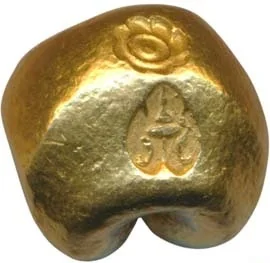
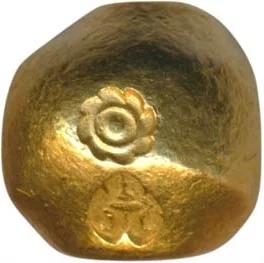
½ tamlung – Thailand
Add to wishlist
Thailand
Context
Year: 1851
Issuer: Thailand
Ruler: Phra Chom Klao
Currency:
(1238—1869)
Demonetization: 27 October 1904
Material
Weight: 30.37 g
Gold Weight:: 30.37 g
Shape: Round bullet
Composition: Gold
Magnetic: No
Technique: Hammered
References
Numista: #219049
Value
Bullion value: $4684.66
Obverse
Description:
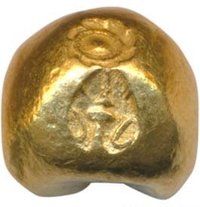
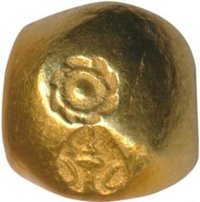
Mongkut, emblem of Rama IV.
Reverse
Description:
Energy centers in the body.
Edge
©Eur-Seree Collecting
Mintings
| Year | Mint Mark | Mintage | Quality | Collection |
|---|---|---|---|---|
| 1851 | — | — |
Historical background
In 1851, as King Mongkut (Rama IV) ascended the throne of Siam, the kingdom's currency system was a complex and fragmented mixture of indigenous and foreign units. The primary medium of exchange was not a state-minted coin but the bullet coin (photduang), a handcrafted, lump-shaped silver token stamped with the royal chakra and other symbols. Its value was determined by its weight in baht (a unit of weight, approximately 15 grams), tical, and fuang, leading to inefficiency and the need for constant cutting and weighing in transactions. Alongside this, a barter economy persisted in rural areas, while Chinese copper cash coins with square holes, strung on cords, circulated for smaller, everyday purchases.
This multi-currency environment was further complicated by vigorous foreign trade, particularly with European powers, China, and neighboring Malay states. Spanish and Mexican silver dollars, Indian rupees, and other foreign silver coins flowed into port cities like Bangkok, used in international commerce. Their exchange against the bullet coin was variable and often problematic, as the purity and weight of Siamese silver were trusted locally but not always precisely aligned with international standards. This created a dynamic, sometimes chaotic, monetary landscape where merchants and officials had to navigate multiple valuation systems.
King Mongkut, a modernizer with extensive knowledge of the West, recognized these monetary inefficiencies as an obstacle to both administrative control and economic development. While major currency reform would not materialize until the reign of his son, King Chulalongkorn, the year 1851 marks a pivotal turning point. The new king's awareness of the need for a standardized, decimalized coinage system—akin to those used by colonial powers in the region—planted the seeds for the eventual modernization of Thai currency, setting the stage for the phasing out of the bullet coin and the introduction of flat, machine-struck coins in the decades to follow.
This multi-currency environment was further complicated by vigorous foreign trade, particularly with European powers, China, and neighboring Malay states. Spanish and Mexican silver dollars, Indian rupees, and other foreign silver coins flowed into port cities like Bangkok, used in international commerce. Their exchange against the bullet coin was variable and often problematic, as the purity and weight of Siamese silver were trusted locally but not always precisely aligned with international standards. This created a dynamic, sometimes chaotic, monetary landscape where merchants and officials had to navigate multiple valuation systems.
King Mongkut, a modernizer with extensive knowledge of the West, recognized these monetary inefficiencies as an obstacle to both administrative control and economic development. While major currency reform would not materialize until the reign of his son, King Chulalongkorn, the year 1851 marks a pivotal turning point. The new king's awareness of the need for a standardized, decimalized coinage system—akin to those used by colonial powers in the region—planted the seeds for the eventual modernization of Thai currency, setting the stage for the phasing out of the bullet coin and the introduction of flat, machine-struck coins in the decades to follow.
✨ Legendary