

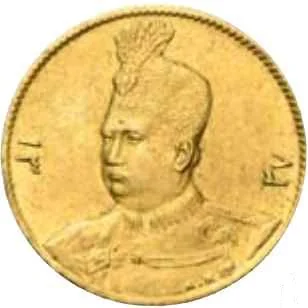
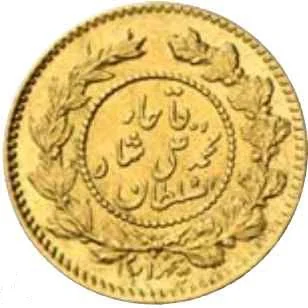
5000 dinars – Iran
Add to wishlist
Iran
Context
Year: 1909
Islamic (Hijri) Year:: 1327
Issuer: Iran
Ruler: Mohammad Ali Shah
Currency:
(1825—1932)
Demonetized: Yes
Material
References
Numista: #217260
Value
Bullion value: $432.91
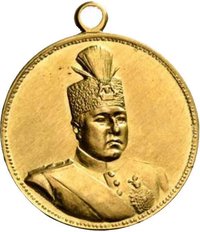
Obverse
Description:
Uniformed bust left divides date.
Inscription:
۱۳۲۷
Designer and engraver: Alphonse Michaux
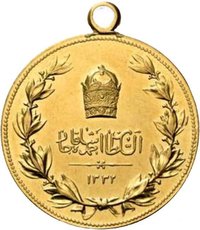
Reverse
Description:
Inscription encircled by beads within a wreath.
Inscription:
السّلطان مُحمّدعلی شاه قاجار
پنجهزاری
پنجهزاری
Translation:
The Sultan Muhammad Ali Shah Qajar
Five Hazari
Five Hazari
Language: Persian
Designer and engraver: Alphonse Michaux
Edge
Mintings
| Year | Mint Mark | Mintage | Quality | Collection |
|---|---|---|---|---|
| 1909 | — | — |
Historical background
By 1909, Iran’s currency system was in a state of profound crisis and confusion, a direct consequence of decades of economic mismanagement and foreign interference. The national currency, the qiran (or kran), was a silver coin, but its value had become severely debased due to the government's chronic budget deficits. To finance its spending, the Qajar state frequently resorted to striking copper fulus for small change and, more destructively, lowering the silver content of newly minted qirans. This practice, combined with the widespread circulation of counterfeit coins, led to a bewildering multiplicity of coins of varying quality, causing significant hardship for ordinary people and disrupting trade.
The situation was exacerbated by intense geopolitical pressure. The 1907 Anglo-Russian Convention had divided Iran into informal spheres of influence, and both powers sought to control the country’s finances. Russia, in particular, had established the Discount and Loan Bank of Persia in 1890, which issued banknotes and lent money to the Qajar court, thereby gaining substantial financial leverage. The government’s reliance on foreign loans, often secured against future customs revenues, drained the treasury and further undermined monetary sovereignty. Internal instability during the Constitutional Revolution (1905-1911), including the 1909 capture of Tehran by constitutionalist forces, meant the central authority was too weak to implement any coherent monetary reform.
Consequently, the bazaar economy operated with a complex and inefficient system where major transactions often relied on foreign gold coins like the British sovereign or the Russian gold ruble, while daily trade was mired in disputes over the legitimacy and weight of silver qirans. The absence of a unified national bank or trusted paper currency meant regional mints operated with little oversight. Thus, in 1909, Iran lacked a stable, standardized monetary system, a critical factor hindering economic development and symbolizing the broader struggle for national sovereignty and modern statehood during the turbulent Constitutional era.
The situation was exacerbated by intense geopolitical pressure. The 1907 Anglo-Russian Convention had divided Iran into informal spheres of influence, and both powers sought to control the country’s finances. Russia, in particular, had established the Discount and Loan Bank of Persia in 1890, which issued banknotes and lent money to the Qajar court, thereby gaining substantial financial leverage. The government’s reliance on foreign loans, often secured against future customs revenues, drained the treasury and further undermined monetary sovereignty. Internal instability during the Constitutional Revolution (1905-1911), including the 1909 capture of Tehran by constitutionalist forces, meant the central authority was too weak to implement any coherent monetary reform.
Consequently, the bazaar economy operated with a complex and inefficient system where major transactions often relied on foreign gold coins like the British sovereign or the Russian gold ruble, while daily trade was mired in disputes over the legitimacy and weight of silver qirans. The absence of a unified national bank or trusted paper currency meant regional mints operated with little oversight. Thus, in 1909, Iran lacked a stable, standardized monetary system, a critical factor hindering economic development and symbolizing the broader struggle for national sovereignty and modern statehood during the turbulent Constitutional era.
✨ Legendary