

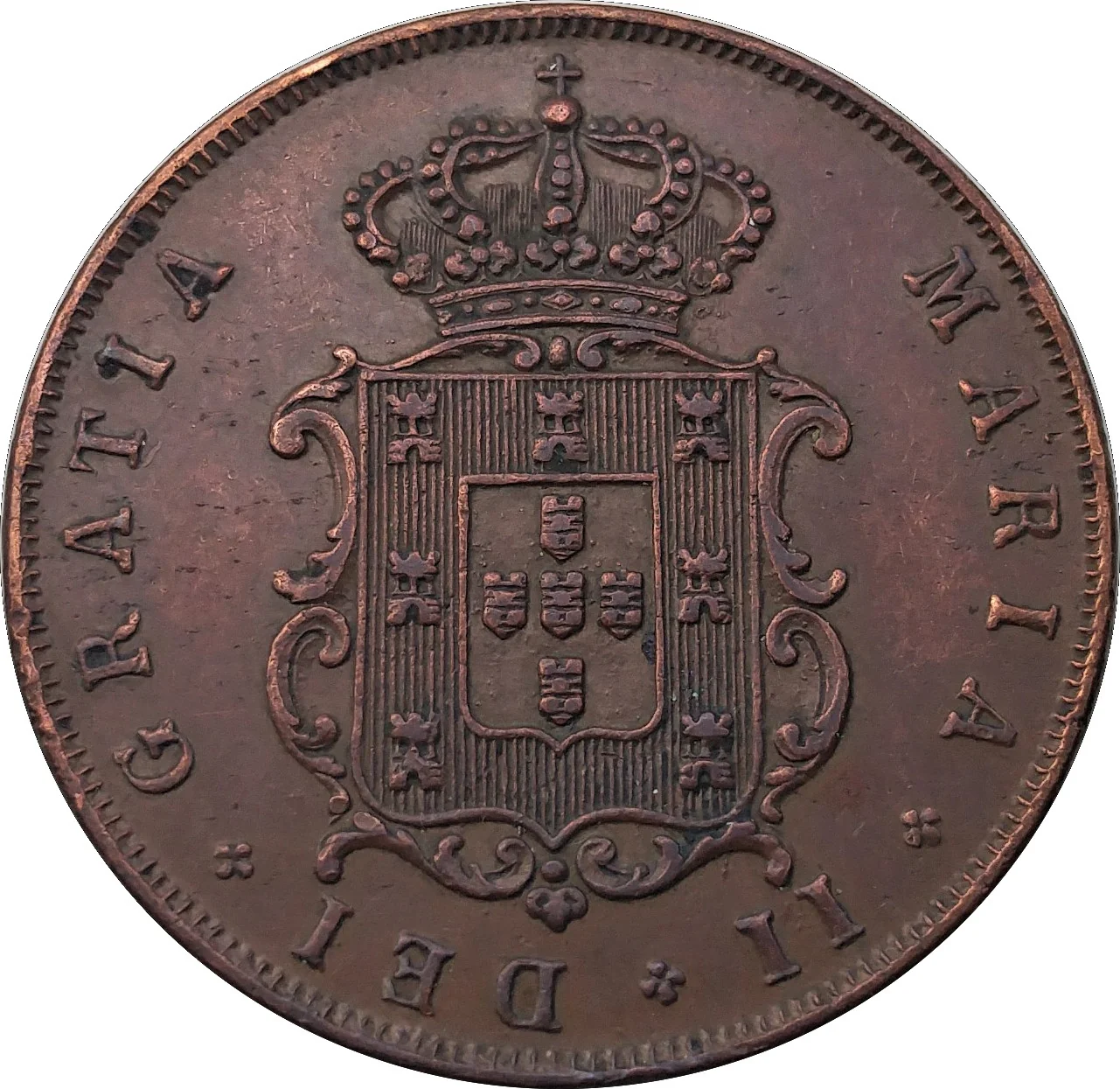

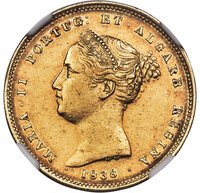
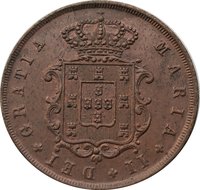
Obverse
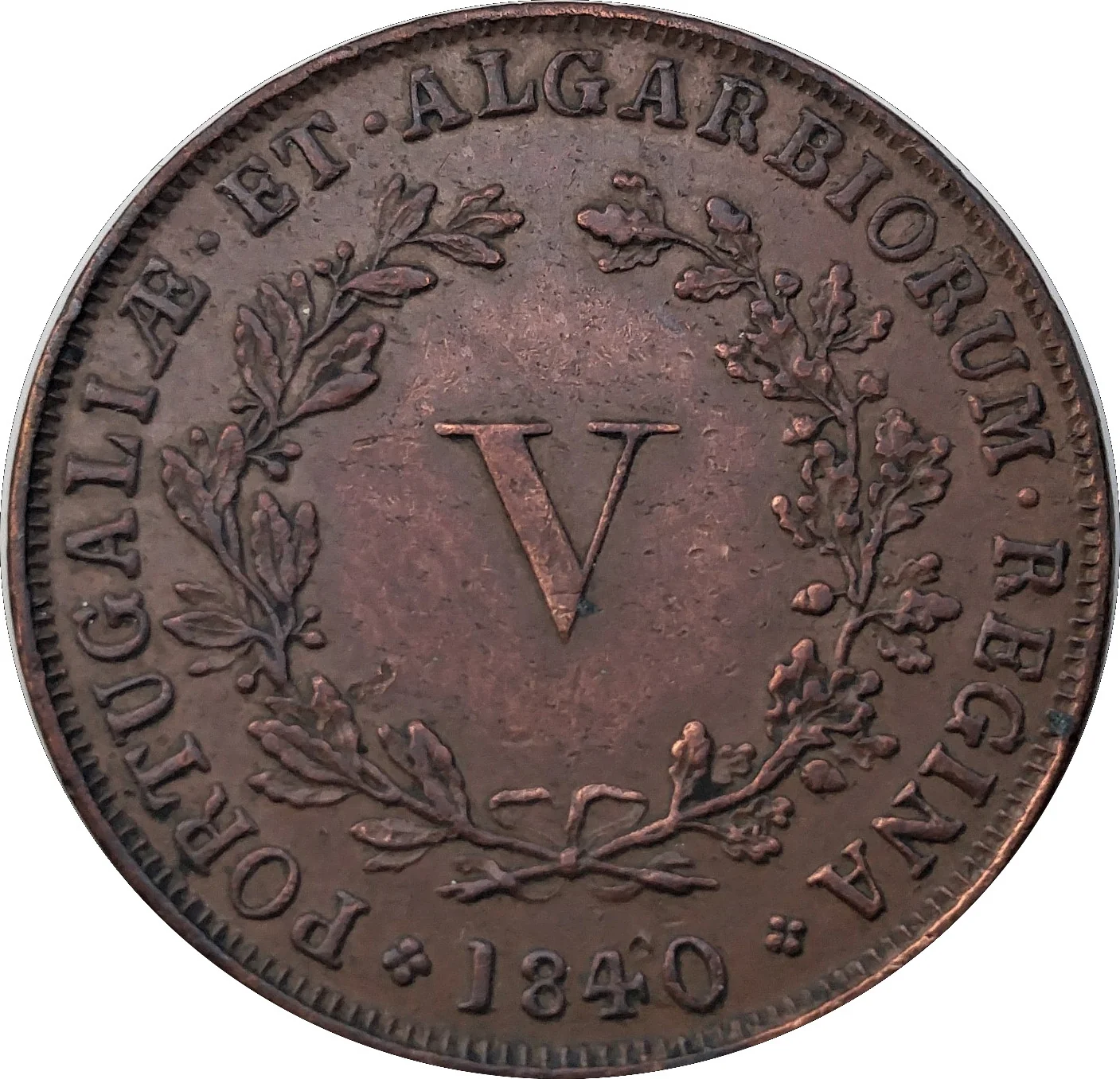
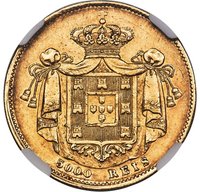
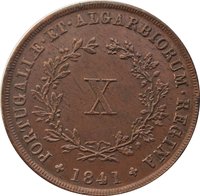
Reverse
Edge
Plain
Mints
| Name | Mark |
|---|---|
| Imprensa Nacional - Casa da Moeda | — |
Mintings
| Year | Mint Mark | Mintage | Quality | Collection |
|---|---|---|---|---|
| 1840 | — | 174,000 | ||
| 1843 | — | 3,621 | ||
| 1848 | — | 147,000 | ||
| 1850 | — | 180,000 | ||
| 1852 | — | 292,000 | ||
| 1853 | — | 97,000 |
Historical background
In 1840, Portugal’s currency situation was characterized by profound instability and complexity, a legacy of the political and economic turmoil following the Liberal Wars (1828-1834). The victorious liberal government, led by Queen Maria II, faced a bankrupt treasury and a fragmented monetary system. The currency in circulation was a chaotic mix of older réis coins from the monarchy, new copper and silver coins minted by the liberal regime, and a vast quantity of depreciated paper money—bilhetes do Tesouro (treasury notes)—issued to finance the war. This resulted in a severe loss of public confidence, with paper notes trading at a steep discount to their face value in metallic coin.
The core of the problem was a chronic shortage of precious metal, especially gold and full-weight silver coins, which were hoarded or exported. Consequently, a dual system existed: everyday transactions were conducted in depreciated copper and paper, while stable foreign coins like British sovereigns and Spanish duros circulated for substantial commerce and international trade. The government’s attempts to stabilize the currency, including a decree in 1837 to define the real as the national unit, were largely ineffective on the ground. Inflation was rampant, and the exchange rate for the Portuguese milréis against the British pound was highly unfavorable, reflecting the country's weak fiscal position and trade deficit.
This monetary confusion severely hampered economic recovery and state-building efforts. It discouraged investment, complicated taxation, and undermined the state's credibility. The situation would only begin to find resolution later in the 1840s, culminating in the important monetary reform of 1854, which introduced the gold standard and finally restored a unified, metallic currency. Thus, the year 1840 represents a point of deep monetary crisis within a longer transitional period toward financial modernization.
The core of the problem was a chronic shortage of precious metal, especially gold and full-weight silver coins, which were hoarded or exported. Consequently, a dual system existed: everyday transactions were conducted in depreciated copper and paper, while stable foreign coins like British sovereigns and Spanish duros circulated for substantial commerce and international trade. The government’s attempts to stabilize the currency, including a decree in 1837 to define the real as the national unit, were largely ineffective on the ground. Inflation was rampant, and the exchange rate for the Portuguese milréis against the British pound was highly unfavorable, reflecting the country's weak fiscal position and trade deficit.
This monetary confusion severely hampered economic recovery and state-building efforts. It discouraged investment, complicated taxation, and undermined the state's credibility. The situation would only begin to find resolution later in the 1840s, culminating in the important monetary reform of 1854, which introduced the gold standard and finally restored a unified, metallic currency. Thus, the year 1840 represents a point of deep monetary crisis within a longer transitional period toward financial modernization.
🌟 Uncommon