

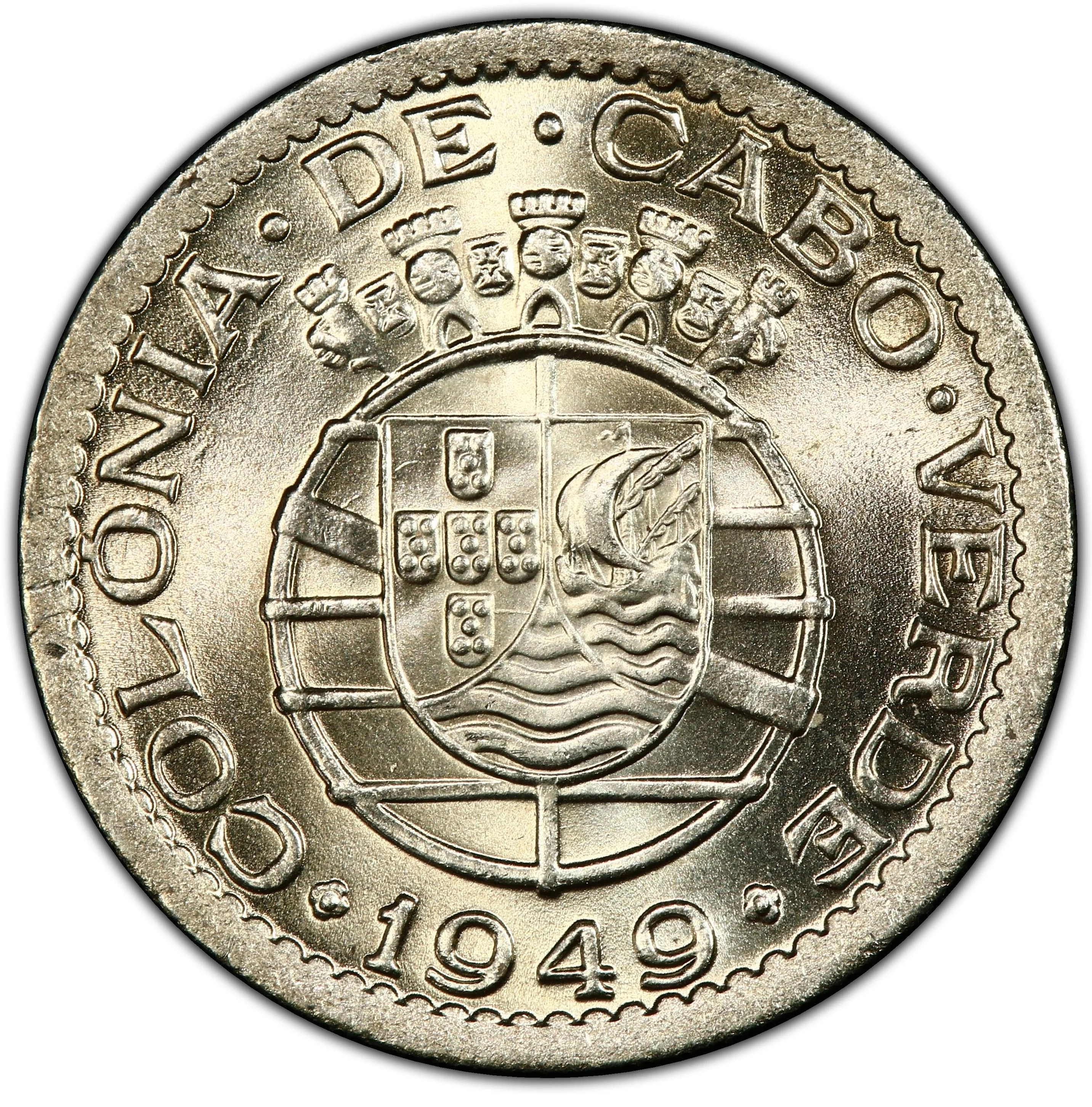
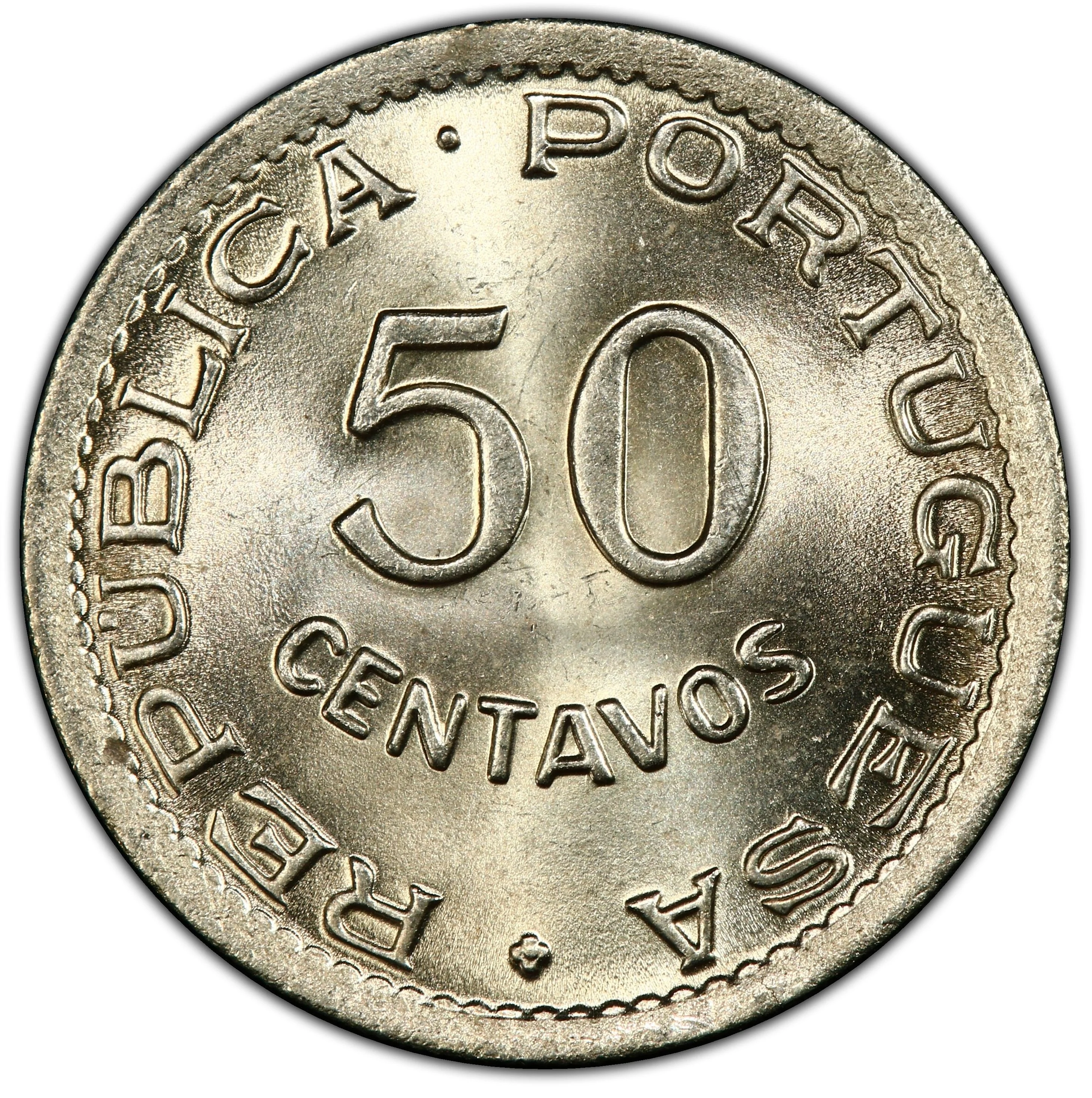
50 centavos – Cape Verde
Add to wishlist
Cape Verde
Context
Year: 1949
Issuer: Cape Verde
Period:
(1910—1951)
Currency:
(since 1914)
Demonetized: Yes
Total mintage: 1,000,000
Material
Diameter: 22.8 mm
Weight: 4.5 g
Thickness: 1.65 mm
Shape: Round
Composition: Nickel brass
Magnetic: No
Technique: Milled
Alignment: Coin alignment
flip
References
KM: #
Numista: #21507
Value
Exchange value: 0.50 CVE
Obverse
Description:
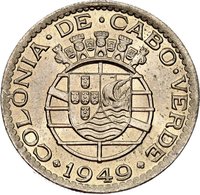
Coat of arms with crown above, date below.
Inscription:
COLONIA·DE·CABO·VERDE
1949
1949
Translation:
Colony of Cape Verde
1949
1949
Script: Latin
Language: Portuguese
Reverse
Inscription:
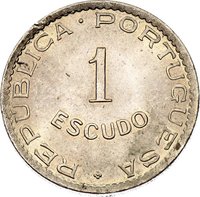
REPUBLICA PORTUGUESA
50
CENTAVOS
50
CENTAVOS
Translation:
Portuguese Republic
50
Cents
50
Cents
Script: Latin
Language: Portuguese
Edge
Reeded
Mintings
| Year | Mint Mark | Mintage | Quality | Collection |
|---|---|---|---|---|
| 1949 | — | 1,000,000 |
Historical background
In 1949, Cape Verde was not an independent nation with its own currency but an overseas province of Portugal, fully integrated into Portugal's monetary system. The official currency was the Portuguese escudo, which had replaced the real in 1911. Banknotes and coins circulating on the islands were issued by the Banco de Portugal, bearing the same design and value as those used on the mainland. This arrangement meant Cape Verde had no autonomous central bank or independent monetary policy; its financial conditions were directly dictated by Lisbon.
The economy of the archipelago in this period was largely underdeveloped and subsistence-based, heavily reliant on agriculture and remittances from Cape Verdeans working abroad, particularly in the United States. A critical feature of the monetary situation was the severe scarcity of physical currency on the islands. This shortage hindered local commerce and daily transactions, a problem exacerbated by the territory's isolation and Portugal's own post-war economic difficulties. Barter and informal credit were common substitutes for cash in many communities.
Furthermore, the escudo's value was pegged to gold and, by extension, influenced by the Bretton Woods system, but its convertibility was tightly controlled. For Cape Verde, this meant limited access to foreign exchange and a dependency on imports priced in stronger currencies, contributing to a persistent trade deficit. The monetary situation of 1949 thus reflected colonial integration, economic vulnerability, and physical scarcity, setting the stage for the eventual creation of a distinct Cape Verdean escudo (later the caboverdiano) following independence in 1975.
The economy of the archipelago in this period was largely underdeveloped and subsistence-based, heavily reliant on agriculture and remittances from Cape Verdeans working abroad, particularly in the United States. A critical feature of the monetary situation was the severe scarcity of physical currency on the islands. This shortage hindered local commerce and daily transactions, a problem exacerbated by the territory's isolation and Portugal's own post-war economic difficulties. Barter and informal credit were common substitutes for cash in many communities.
Furthermore, the escudo's value was pegged to gold and, by extension, influenced by the Bretton Woods system, but its convertibility was tightly controlled. For Cape Verde, this meant limited access to foreign exchange and a dependency on imports priced in stronger currencies, contributing to a persistent trade deficit. The monetary situation of 1949 thus reflected colonial integration, economic vulnerability, and physical scarcity, setting the stage for the eventual creation of a distinct Cape Verdean escudo (later the caboverdiano) following independence in 1975.
🌱 Fairly Common