

50 lire (Kingdom of Italy) – Italy
Add to wishlist
Non-circulating coins
Commemoration: 50th Anniversary of the Kingdom of Italy
Italy
Context
Year: 1911
Issuer: Italy
Ruler: Vittorio Emanuele III
Currency:
(1861—2001)
Demonetized: Yes
Total mintage: 20,000
Material
References
KM: #
Numista: #21251
Value
Exchange value: 50 ITL
Bullion value: $2227.15
Obverse
Description:
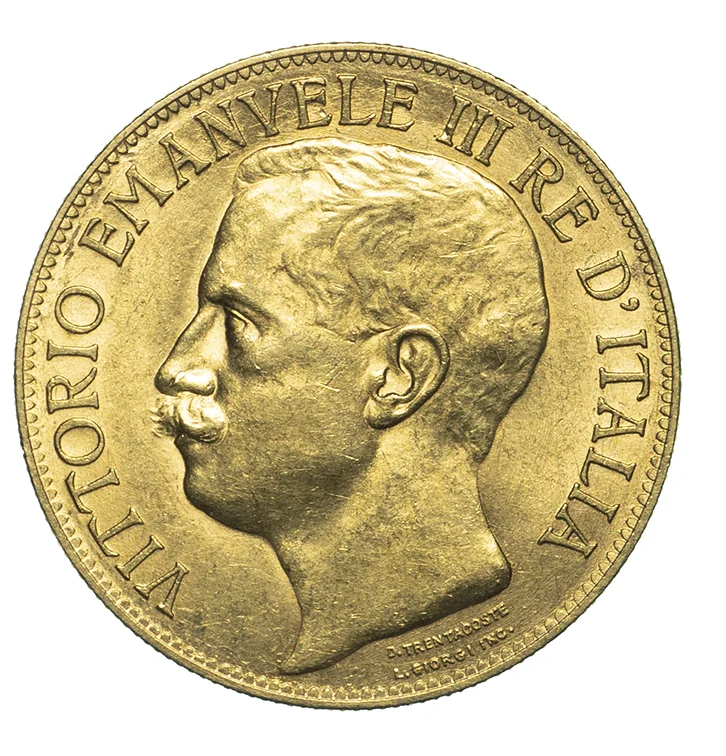
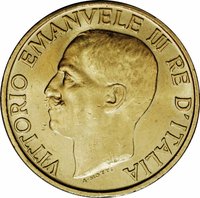
King Vittorio Emanuele III facing left, engraver's name below.
Inscription:
VITTORIO EMANUELE III RE D'ITALIA
D. TRENTACOSTE
L. GIORGI INC.
D. TRENTACOSTE
L. GIORGI INC.
Translation:
Victor Emmanuel III King of Italy
D. Trentacoste
L. Giorgi Engraver
D. Trentacoste
L. Giorgi Engraver
Script: Latin
Language: Italian
Engraver: Domenico Trentacoste
Reverse
Description:
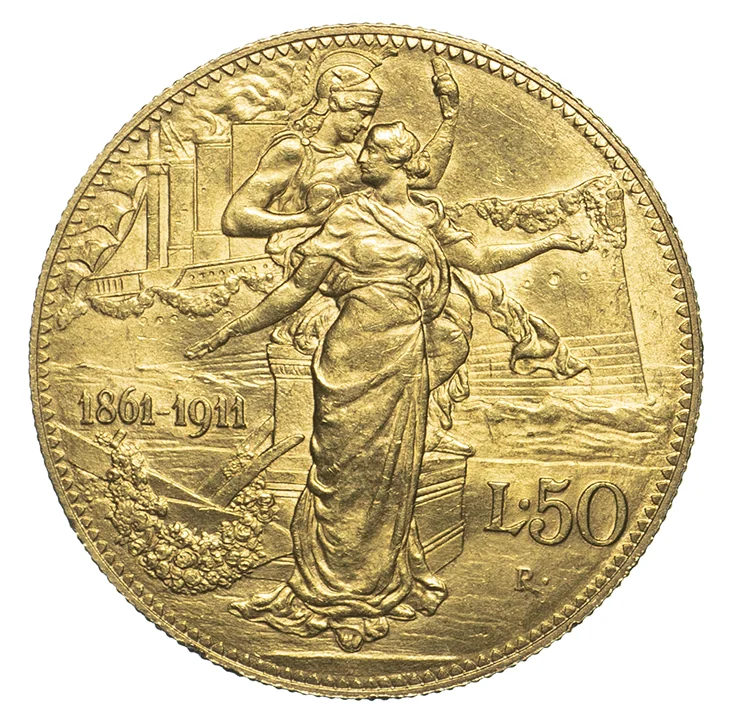
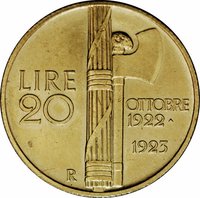
Two figures: a female (Italy) and a male seated on an altar (Rome). Behind them, a large festooned steam warship with the Savoy Shield. Left: a flower-covered plow inscribed "1861-1911". Right: the value and mintmark.
Inscription:
1860-1911
L·50
R·
L·50
R·
Script: Latin
Engraver: Domenico Trentacoste
Edge
Reeded
Categories
| Symbol> Allegory |
| Transportation> Watercraft |
Mints
| Name | Mark |
|---|---|
| Rome | R |
Mintings
| Year | Mint Mark | Mintage | Quality | Collection |
|---|---|---|---|---|
| 1911 | R | 20,000 |
Historical background
In 1911, Italy's currency was firmly embedded within the Classical Gold Standard system, which it had joined in 1883. The national currency was the Italian lira, defined by law as containing 0.2903226 grams of fine gold, making it directly convertible into a fixed amount of the precious metal. This system theoretically guaranteed monetary stability and international confidence, tying the value of the lira to other major currencies like the British pound sterling, the French franc, and the German mark through their shared gold benchmarks.
However, this official stability belied underlying economic fragility. Italy was a nation of pronounced regional divides, with a rapidly industrializing North and an impoverished, agricultural South. The government frequently ran large budget deficits, primarily to fund military expansion and colonial ambitions, such as the ongoing war with the Ottoman Empire over Libya in 1911 itself. These deficits were often financed by borrowing from the Banca d'Italia, which risked undermining the gold reserves needed to back the currency. Consequently, while convertibility was maintained in law, the lira often traded at a slight discount on international markets, reflecting investor concerns about the country's fiscal discipline and political risks.
The monetary authorities, led by the Banca d'Italia, were thus engaged in a constant balancing act. Their primary goal was to defend the gold peg to maintain Italy's standing in the global financial system and ensure access to foreign capital. This required maintaining adequate gold reserves, often through foreign loans, while attempting to manage government spending pressures. The tension between the demands of a modernizing economy, imperial ventures, and the strict discipline of the Gold Standard defined Italy's pre-war currency situation, creating a veneer of solidity over a foundation of considerable strain.
However, this official stability belied underlying economic fragility. Italy was a nation of pronounced regional divides, with a rapidly industrializing North and an impoverished, agricultural South. The government frequently ran large budget deficits, primarily to fund military expansion and colonial ambitions, such as the ongoing war with the Ottoman Empire over Libya in 1911 itself. These deficits were often financed by borrowing from the Banca d'Italia, which risked undermining the gold reserves needed to back the currency. Consequently, while convertibility was maintained in law, the lira often traded at a slight discount on international markets, reflecting investor concerns about the country's fiscal discipline and political risks.
The monetary authorities, led by the Banca d'Italia, were thus engaged in a constant balancing act. Their primary goal was to defend the gold peg to maintain Italy's standing in the global financial system and ensure access to foreign capital. This required maintaining adequate gold reserves, often through foreign loans, while attempting to manage government spending pressures. The tension between the demands of a modernizing economy, imperial ventures, and the strict discipline of the Gold Standard defined Italy's pre-war currency situation, creating a veneer of solidity over a foundation of considerable strain.
💎 Very Rare