

5 Lire – Italy
Circulating commemorative coins
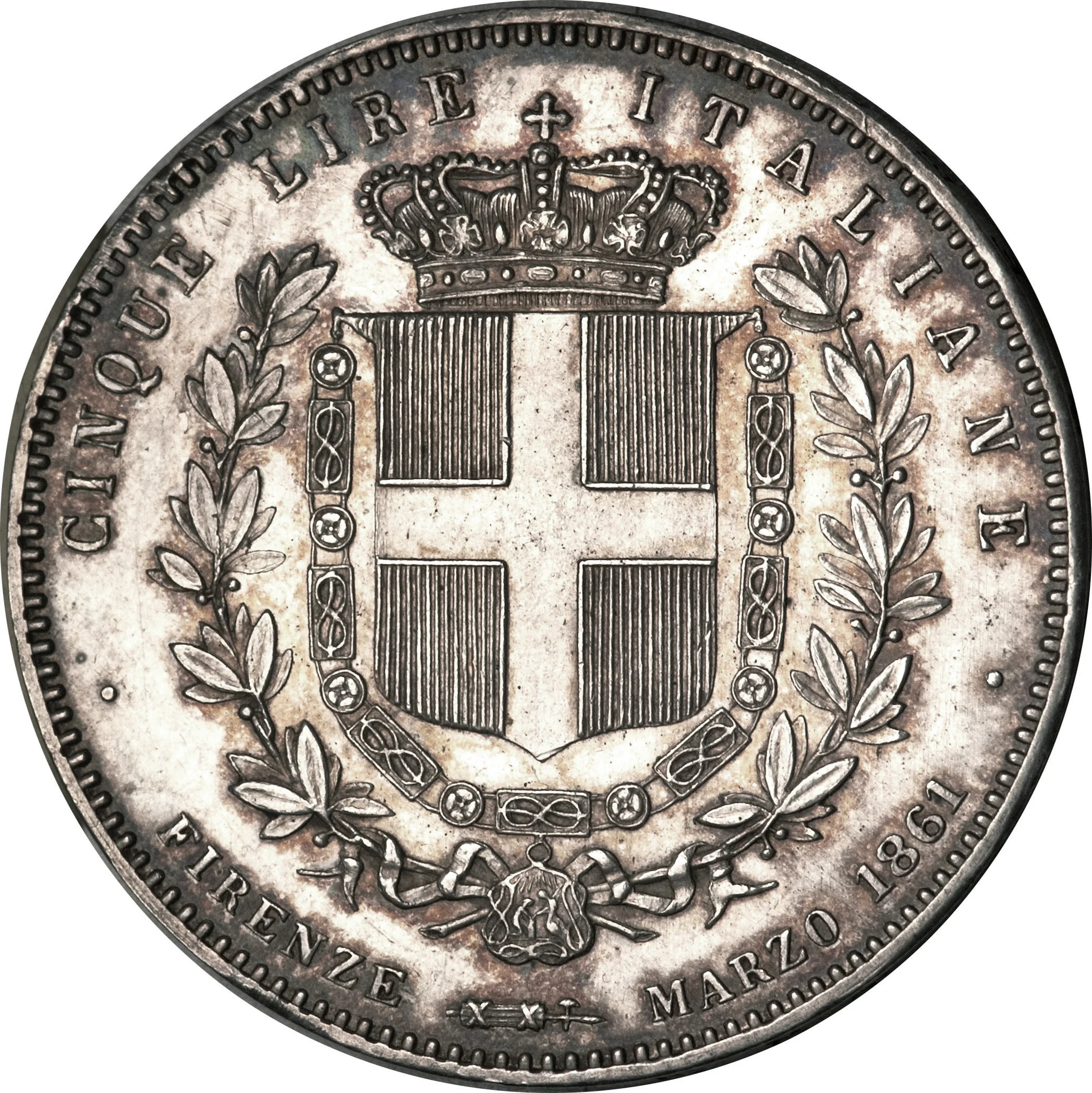
Commemoration: Proclamation of the Kingdom of Italy
Italy
Context
Year: 1861
Issuer: Italy 
Ruler: Vittorio Emanuele II
Currency:
(1861—2001)
Demonetized: Yes
Total mintage: 21,472
Material
References
KM: #Click to copy to clipboard7
Numista: #21244
Value
Exchange value: 5 ITL
Bullion value: $64.40
Obverse
Description:
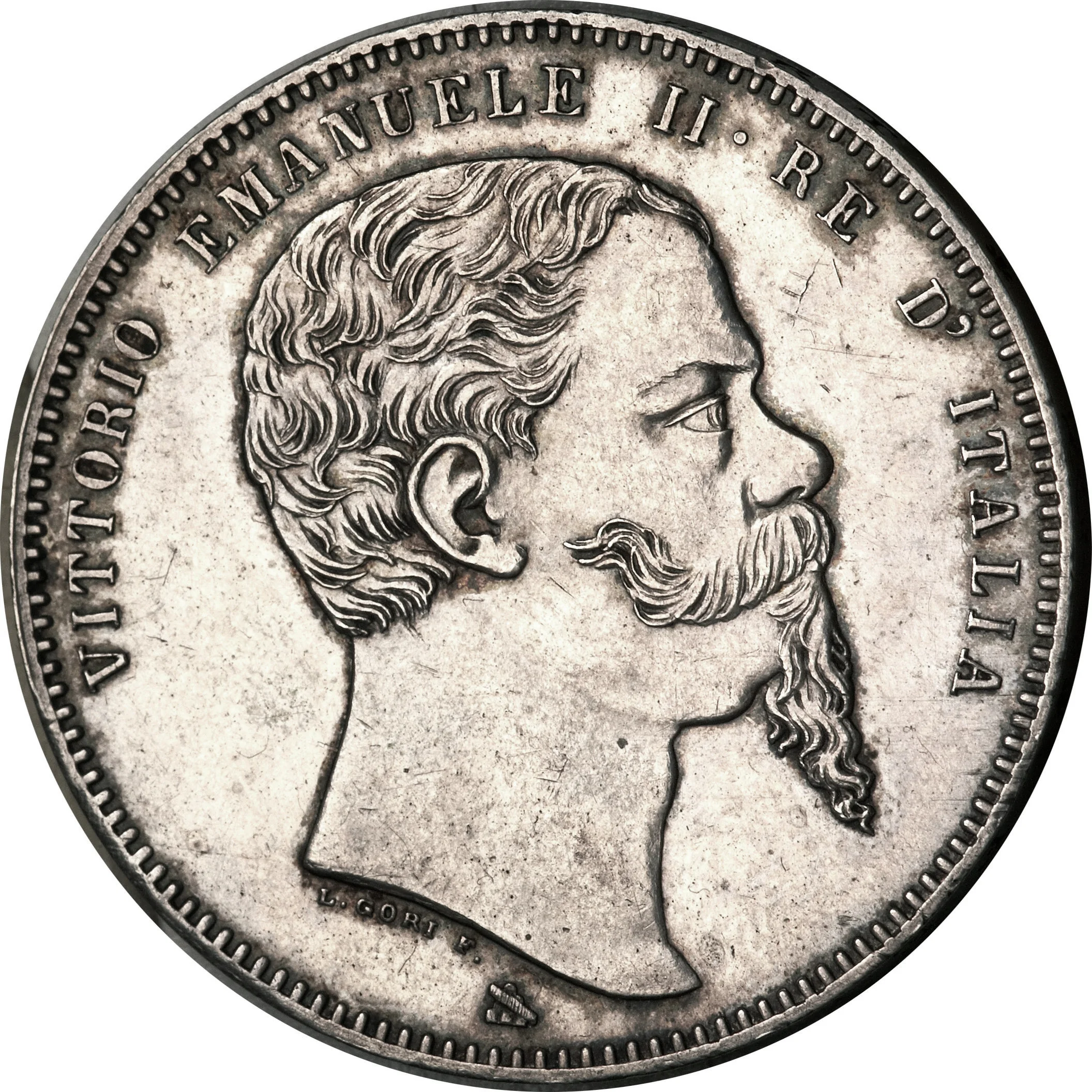
King Vittorio Emanuele II, right-facing portrait.
Inscription:
VITTORIO EMANUELE II RE D'ITALIA
L. GORI F.
L. GORI F.
Translation:
Victor Emmanuel II King of Italy
L. Gori Engraver
L. Gori Engraver
Script: Latin
Language: Italian
Engraver: L. Gori F.
Reverse
Edge
Mintings
| Year | Mint Mark | Mintage | Quality | Collection |
|---|---|---|---|---|
| 1861 | — | 21,472 |
Historical background
Upon unification in 1861, the Kingdom of Italy inherited a complex and fragmented monetary landscape, a direct legacy of its constituent former states. At least eight different currency systems were in circulation, from the Piedmontese lira to the Neapolitan ducat, the Roman scudo, and the Tuscan fiorino. Each had its own metallic standards, denominations, and values, creating severe obstacles to internal trade, taxation, and national economic integration. This monetary mosaic was a tangible symbol of the peninsula's political divisions and a major practical challenge for the new state.
The immediate task fell to Quintino Sella, the Minister of Finance, who championed a policy of monetary unification based on the decimal system of the French franc. The chosen vehicle was the Piedmontese lira, which became the "Italian lira" (lira italiana) by the law of August 24, 1862. This established a bimetallic standard, defining the lira as equivalent to 4.5 grams of fine silver or 0.290322 grams of fine gold, aligning it precisely with the Latin Monetary Union standards. The process, however, was one of gradual absorption rather than overnight change.
Consequently, the situation in 1861 was one of transition and legal duality. While the new lira was proclaimed the sole legal tender, the old regional coins remained in circulation for several years, being slowly withdrawn and recoined. This period was marked by significant economic strain, as the government faced the costs of unification, war debts, and the expense of the recoinage itself, leading to inflationary pressures and a growing public debt that would shape Italy's early fiscal policy.
The immediate task fell to Quintino Sella, the Minister of Finance, who championed a policy of monetary unification based on the decimal system of the French franc. The chosen vehicle was the Piedmontese lira, which became the "Italian lira" (lira italiana) by the law of August 24, 1862. This established a bimetallic standard, defining the lira as equivalent to 4.5 grams of fine silver or 0.290322 grams of fine gold, aligning it precisely with the Latin Monetary Union standards. The process, however, was one of gradual absorption rather than overnight change.
Consequently, the situation in 1861 was one of transition and legal duality. While the new lira was proclaimed the sole legal tender, the old regional coins remained in circulation for several years, being slowly withdrawn and recoined. This period was marked by significant economic strain, as the government faced the costs of unification, war debts, and the expense of the recoinage itself, leading to inflationary pressures and a growing public debt that would shape Italy's early fiscal policy.
💎 Extremely Rare