

5 kopecks – Russian Empire
Add to wishlist
Russia
Context
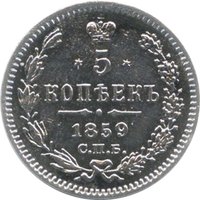
Years: 1858–1867
Country: Russia
Issuer: Russian Empire
Ruler: Alexander II
Currency:
(1700—1917)
Demonetized: Yes
Total mintage: 199,287,680
Material
References
Y: #
Numista: #21240
Obverse
Description:
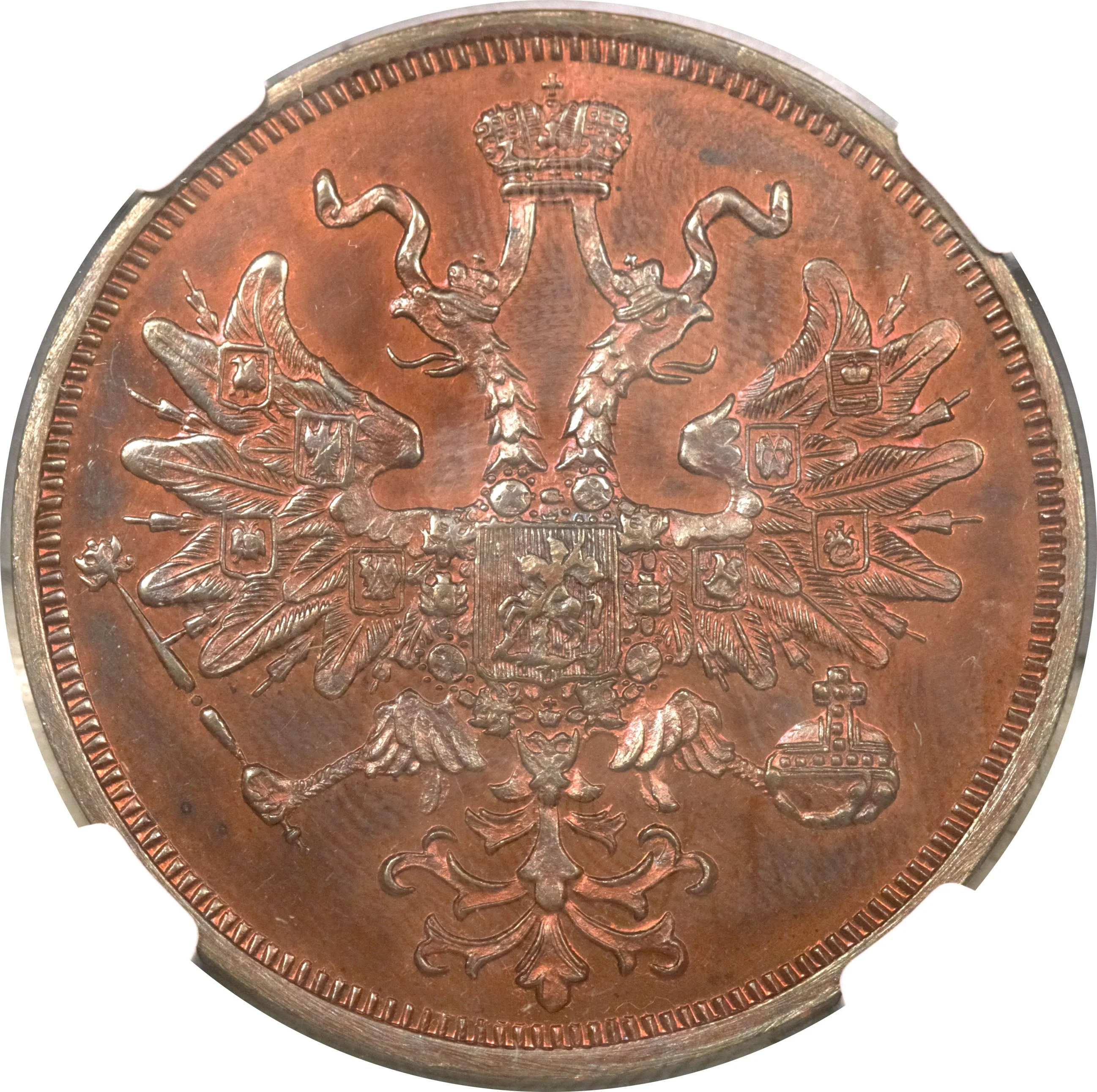
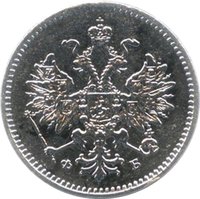
Crowned arms with ribbons.
Reverse
Edge
Plain
Mints
| Name | Mark |
|---|---|
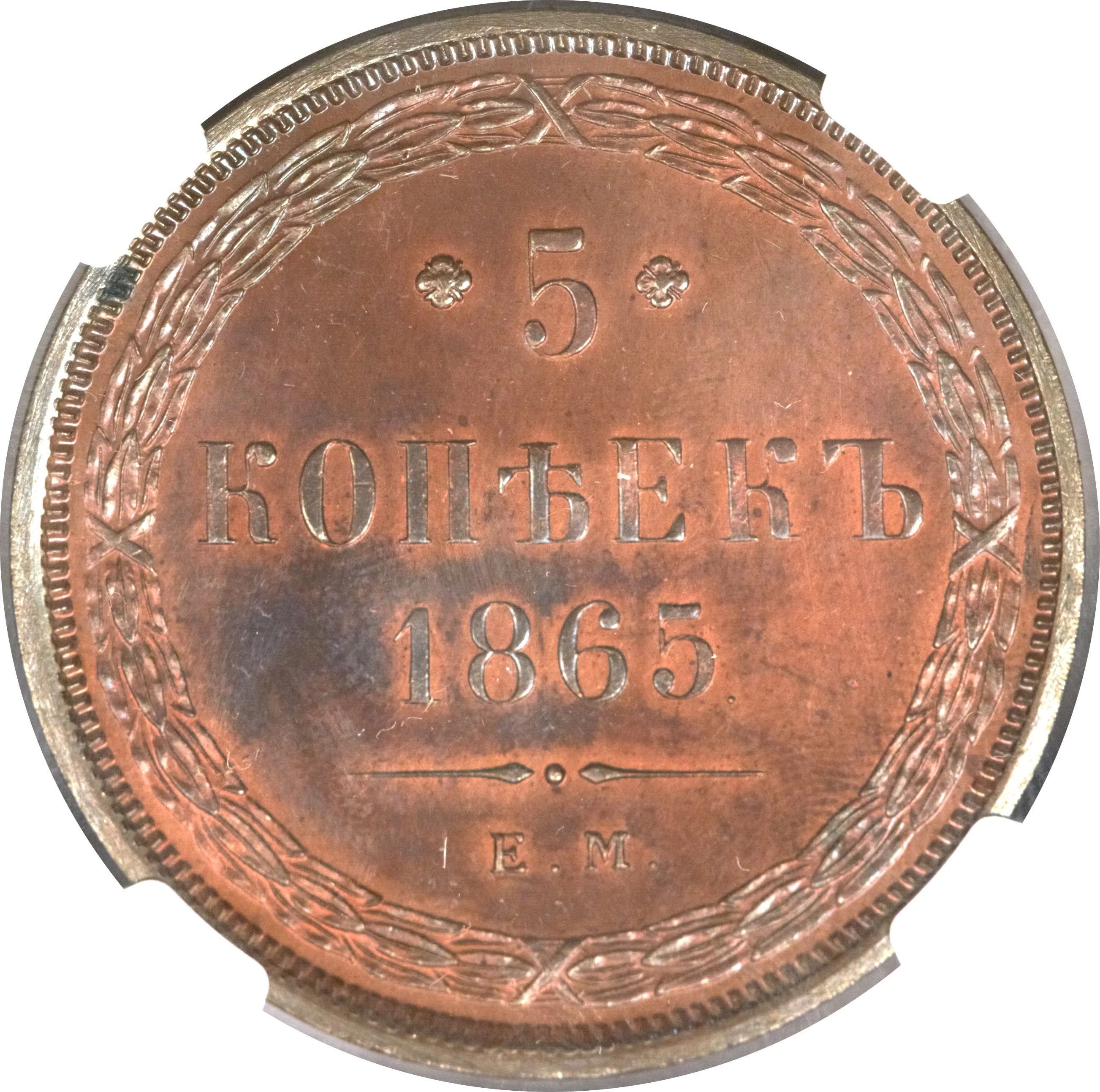
| Ekaterinburg Mint | Е.М. |
Mintings
Historical background
By 1858, the Russian Empire's currency system was in a state of significant strain, primarily due to the financial demands of the recently concluded Crimean War (1853-1856). The war had been catastrophically expensive, forcing the government of Alexander II to finance the conflict through extensive borrowing and, most damagingly, the mass printing of paper money known as assignatsii. This led to severe inflation and a dramatic divergence between the value of the paper assignat ruble and the silver ruble, with the paper currency trading at a deep discount. The state budget was in chronic deficit, and public confidence in the paper currency was low, undermining both domestic trade and international financial credibility.
The core of the problem was Russia's longstanding commitment to a bi-metallic (silver and gold) standard, which existed in theory but had collapsed in practice. Since the reign of Catherine the Great, the government had issued increasing volumes of assignats to cover expenses, creating a dual system where all state accounting and international trade were conducted in silver rubles, while the depreciated paper assignats circulated domestically. By 1858, the exchange rate was unstable, and the Treasury's silver reserves were depleted, making it impossible to guarantee conversion. This monetary disorder acted as a major brake on economic modernization, complicating investment, railway construction, and the state's ability to manage its debt.
Recognizing this crisis as an obstacle to his broader reform agenda, including the impending Emancipation of the Serfs, Tsar Alexander II and his Finance Minister, Aleksandr Knyazhevich, were actively seeking solutions. The year 1858 itself saw a pivotal policy shift: the government stopped borrowing from the State Commercial Bank and instead began offering incentives for private deposits, aiming to attract silver coinage back into the financial system. This marked the beginning of a protracted, fifteen-year process of monetary reform that would ultimately culminate in the establishment of a stable gold standard under Finance Minister Sergei Witte in the 1890s, but in 1858, the situation remained one of precarious instability and urgent transition.
The core of the problem was Russia's longstanding commitment to a bi-metallic (silver and gold) standard, which existed in theory but had collapsed in practice. Since the reign of Catherine the Great, the government had issued increasing volumes of assignats to cover expenses, creating a dual system where all state accounting and international trade were conducted in silver rubles, while the depreciated paper assignats circulated domestically. By 1858, the exchange rate was unstable, and the Treasury's silver reserves were depleted, making it impossible to guarantee conversion. This monetary disorder acted as a major brake on economic modernization, complicating investment, railway construction, and the state's ability to manage its debt.
Recognizing this crisis as an obstacle to his broader reform agenda, including the impending Emancipation of the Serfs, Tsar Alexander II and his Finance Minister, Aleksandr Knyazhevich, were actively seeking solutions. The year 1858 itself saw a pivotal policy shift: the government stopped borrowing from the State Commercial Bank and instead began offering incentives for private deposits, aiming to attract silver coinage back into the financial system. This marked the beginning of a protracted, fifteen-year process of monetary reform that would ultimately culminate in the establishment of a stable gold standard under Finance Minister Sergei Witte in the 1890s, but in 1858, the situation remained one of precarious instability and urgent transition.
🌱 Common