

50 forint (Liberation) – Hungary
Add to wishlist
Non-circulating coins
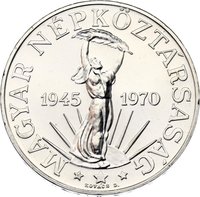
Commemoration: 25th Anniversary of Liberation
Hungary
Obverse
Description:
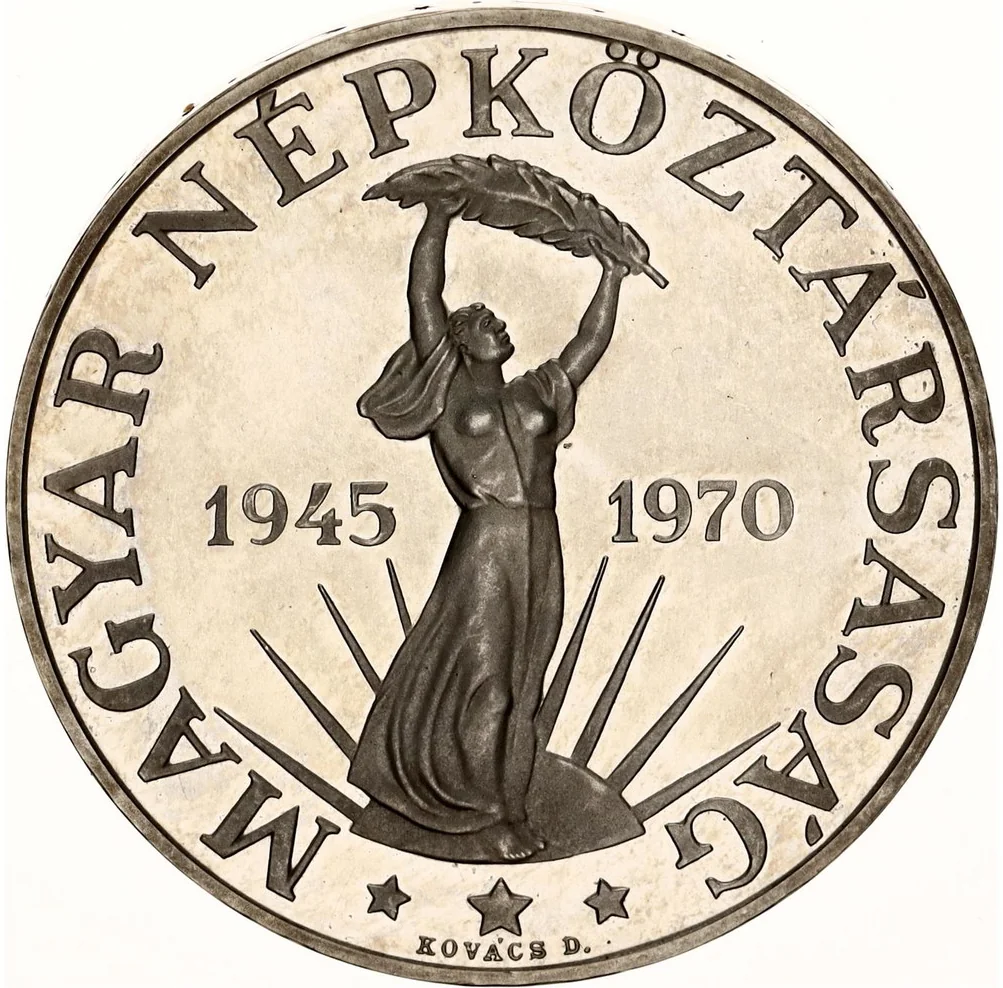
Budapest's Statue of Liberty marks historical eras.
Inscription:
MAGYAR NÉPKÖZTÁRSASÁG
1945 1970
KOVÁCS D.
1945 1970
KOVÁCS D.
Translation:
Hungarian People's Republic
1945 1970
D. Kovács
1945 1970
D. Kovács
Script: Latin
Language: Hungarian
Designer: Dezső Kovács
Reverse
Edge
Patterned
Categories
| Event> Revolution |
Mints
| Name | Mark |
|---|---|
| Hungarian mint | BP. |
Historical background
In 1970, Hungary operated under the constraints of a centrally planned economy and the "transferable ruble" system of the Council for Mutual Economic Assistance (COMECON), which governed trade within the Soviet bloc. Domestically, the Hungarian forint (HUF) was a non-convertible currency with an official exchange rate set by the state, bearing little relation to its actual market value. Strict currency controls were enforced, separating domestic economic activity from the hard currency reserves needed for trade with Western nations, creating a classic dual monetary environment.
This period fell within the broader era of the New Economic Mechanism (NEM), introduced in 1968, which cautiously introduced market-style reforms. While the NEM allowed for greater enterprise autonomy and responsiveness to domestic demand, the fundamental architecture of the currency regime remained rigid. The state maintained a monopoly on foreign exchange, allocating scarce US dollars and Deutsche Marks primarily to strategic industries for importing vital Western technology, while consumer access to hard currency or imported goods was severely limited.
Consequently, a significant black market for foreign currency existed, where the forint traded at a fraction of its official rate against Western currencies. This disparity highlighted the growing tension between the reformist ambitions of the NEM and the inflexible, politically controlled monetary system. The currency situation of 1970 thus reflected a transitional economy, where underlying pressures for convertibility and realistic pricing were building beneath the surface of state control, foreshadowing the deeper financial crises and reforms that would characterize the following decades.
This period fell within the broader era of the New Economic Mechanism (NEM), introduced in 1968, which cautiously introduced market-style reforms. While the NEM allowed for greater enterprise autonomy and responsiveness to domestic demand, the fundamental architecture of the currency regime remained rigid. The state maintained a monopoly on foreign exchange, allocating scarce US dollars and Deutsche Marks primarily to strategic industries for importing vital Western technology, while consumer access to hard currency or imported goods was severely limited.
Consequently, a significant black market for foreign currency existed, where the forint traded at a fraction of its official rate against Western currencies. This disparity highlighted the growing tension between the reformist ambitions of the NEM and the inflexible, politically controlled monetary system. The currency situation of 1970 thus reflected a transitional economy, where underlying pressures for convertibility and realistic pricing were building beneath the surface of state control, foreshadowing the deeper financial crises and reforms that would characterize the following decades.
🌟 Limited