

1 dollar – Canada
Add to wishlist
Non-circulating coins
Commemoration: British Columbia Centennial
Canada
Context
Material
References
KM: #
Numista: #21111
Value
Exchange value: 1 CAD
Bullion value: $28.77
Inflation-adjusted value: 7.96 CAD
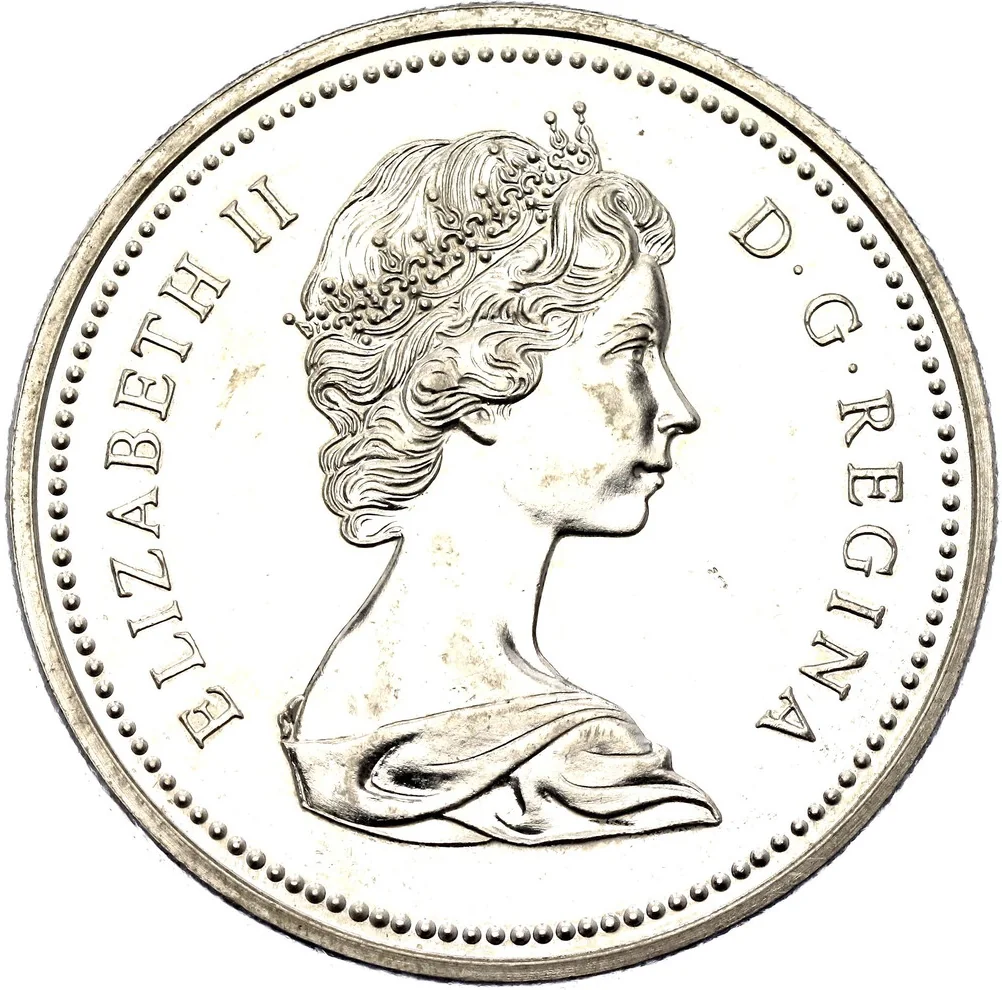
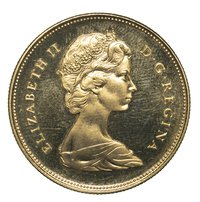
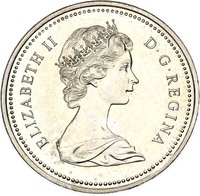
Obverse
Description:
Bust of Queen Elizabeth II at age 37, wearing a tiara and facing right.
Inscription:
ELIZABETH II D·G·REGINA
Translation:
Elizabeth II, by the Grace of God, Queen
Script: Latin
Language: Latin
Engraver: Patrick Brindley
Designer: Arnold Machin
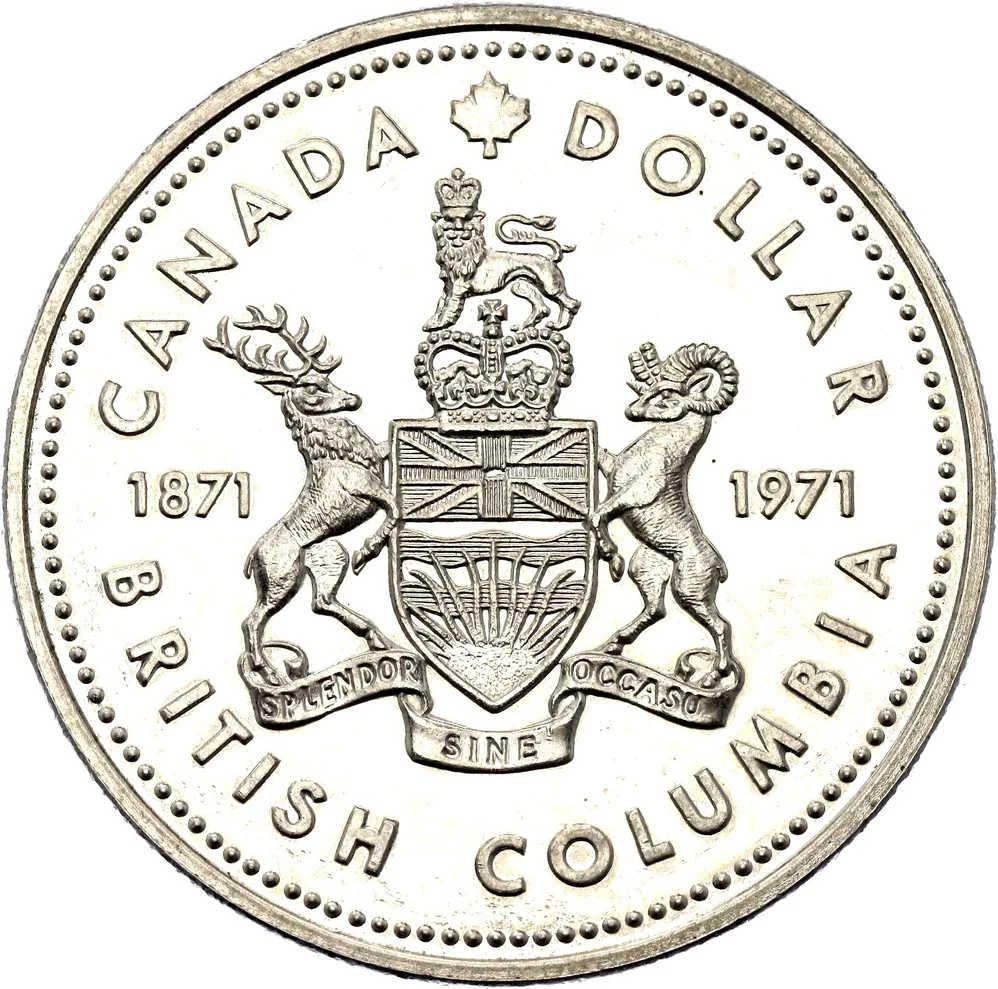
Reverse
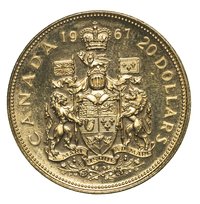
Description:
British Columbia's coat of arms features a wapiti stag on the left and a golden-horned bighorn sheep on the right.
Inscription:
CANADA DOLLAR
1871 1971
BRITISH COLUMBIA
1871 1971
BRITISH COLUMBIA
Translation:
CANADA DOLLAR
1871 1971
BRITISH COLUMBIA
1871 1971
BRITISH COLUMBIA
Script: Latin
Language: English
Engraver: Patrick Brindley
Edge
Reeded
Mints
| Name | Mark |
|---|---|
| Royal Canadian Mint of Ottawa | — |
Mintings
| Year | Mint Mark | Mintage | Quality | Collection |
|---|---|---|---|---|
| 1971 | — | — |
Historical background
In 1971, Canada’s currency situation was dominated by the global monetary crisis triggered by the United States' decision to suspend the convertibility of the US dollar into gold, effectively ending the Bretton Woods system of fixed exchange rates. As a major trading partner with the US, Canada faced immediate and profound pressure. The Canadian dollar, which had been floating independently since 1970—a rare move among major economies at the time—was already unpegged from the US dollar. This existing float provided Canada with a crucial buffer, allowing the exchange rate to absorb some of the international shock rather than forcing the Bank of Canada to engage in a desperate defence of a fixed parity.
Domestically, the situation was complex. The floating Canadian dollar appreciated significantly following the US "Nixon Shock," rising from approximately US$0.96 in early 1971 to near parity by year's end. This strength was driven by strong demand for Canada's commodity exports and high interest rates relative to the US. However, this appreciation worried exporters and policymakers, as it made Canadian goods more expensive for key foreign markets. The Bank of Canada intervened heavily in foreign exchange markets throughout the year, buying US dollars to try to temper the Canadian dollar's rise and protect export competitiveness, while also grappling with persistent inflationary pressures.
Ultimately, 1971 was a transitional year that validated Canada's earlier decision to float its currency. While the crisis destabilized the global monetary order, Canada's flexible exchange rate acted as an automatic stabilizer. The experience reinforced a policy path distinct from that of the US, setting a precedent for a managed float that would characterize Canada's approach for decades. The year concluded with the Smithsonian Agreement in December, which attempted to patch the Bretton Woods system with new fixed parities, but Canada notably chose to maintain its independent float, a decision that would become permanent.
Domestically, the situation was complex. The floating Canadian dollar appreciated significantly following the US "Nixon Shock," rising from approximately US$0.96 in early 1971 to near parity by year's end. This strength was driven by strong demand for Canada's commodity exports and high interest rates relative to the US. However, this appreciation worried exporters and policymakers, as it made Canadian goods more expensive for key foreign markets. The Bank of Canada intervened heavily in foreign exchange markets throughout the year, buying US dollars to try to temper the Canadian dollar's rise and protect export competitiveness, while also grappling with persistent inflationary pressures.
Ultimately, 1971 was a transitional year that validated Canada's earlier decision to float its currency. While the crisis destabilized the global monetary order, Canada's flexible exchange rate acted as an automatic stabilizer. The experience reinforced a policy path distinct from that of the US, setting a precedent for a managed float that would characterize Canada's approach for decades. The year concluded with the Smithsonian Agreement in December, which attempted to patch the Bretton Woods system with new fixed parities, but Canada notably chose to maintain its independent float, a decision that would become permanent.
🌱 Common