

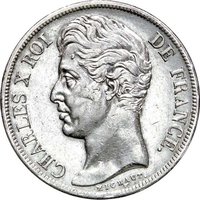
Obverse
Description:
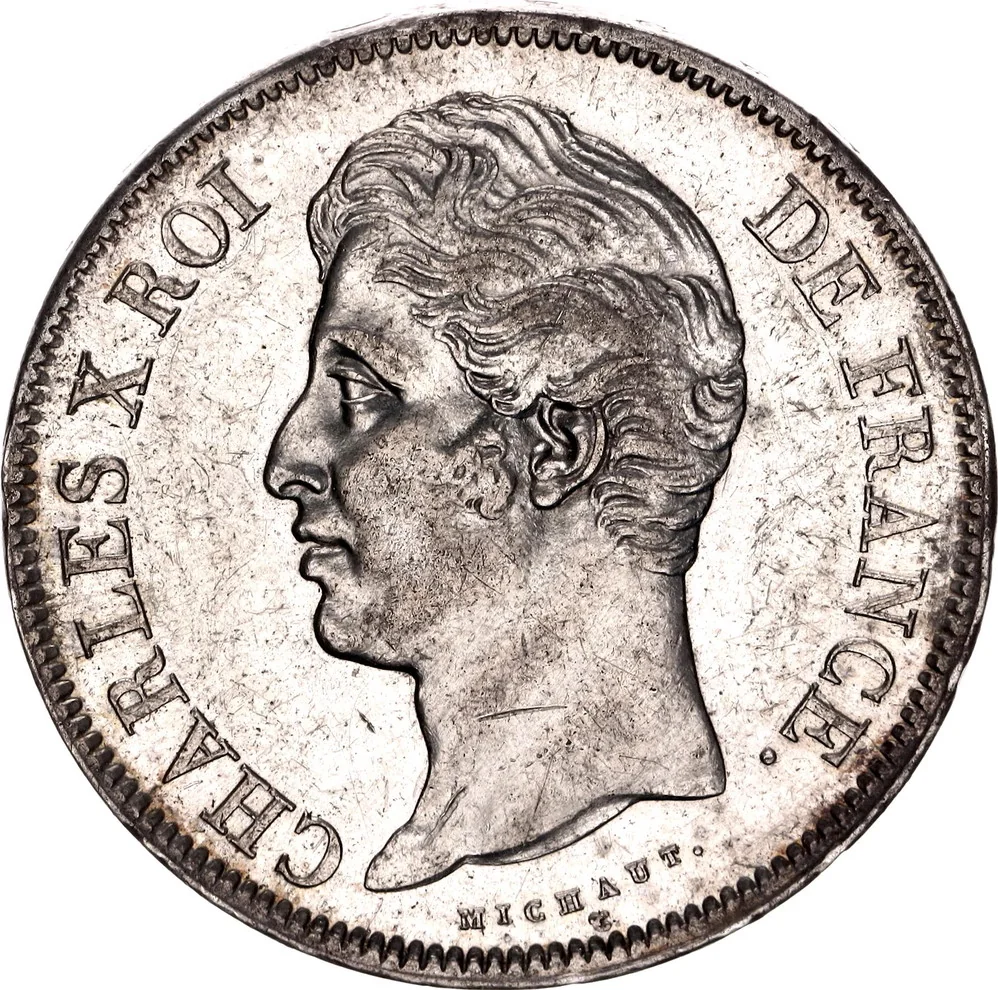
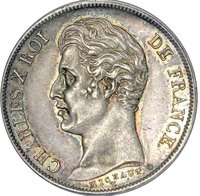
Charles X's bare head, left; signed "MICHAUT" with cursive "T" below.
Inscription:
CHARLES X ROI DE FRANCE.
MICHAUT.
MICHAUT.
Translation:
Charles X King of France.
Michaut.
Michaut.
Script: Latin
Language: French
Engraver: Auguste-François Michaut
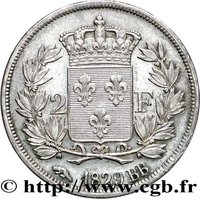
Reverse
Description:
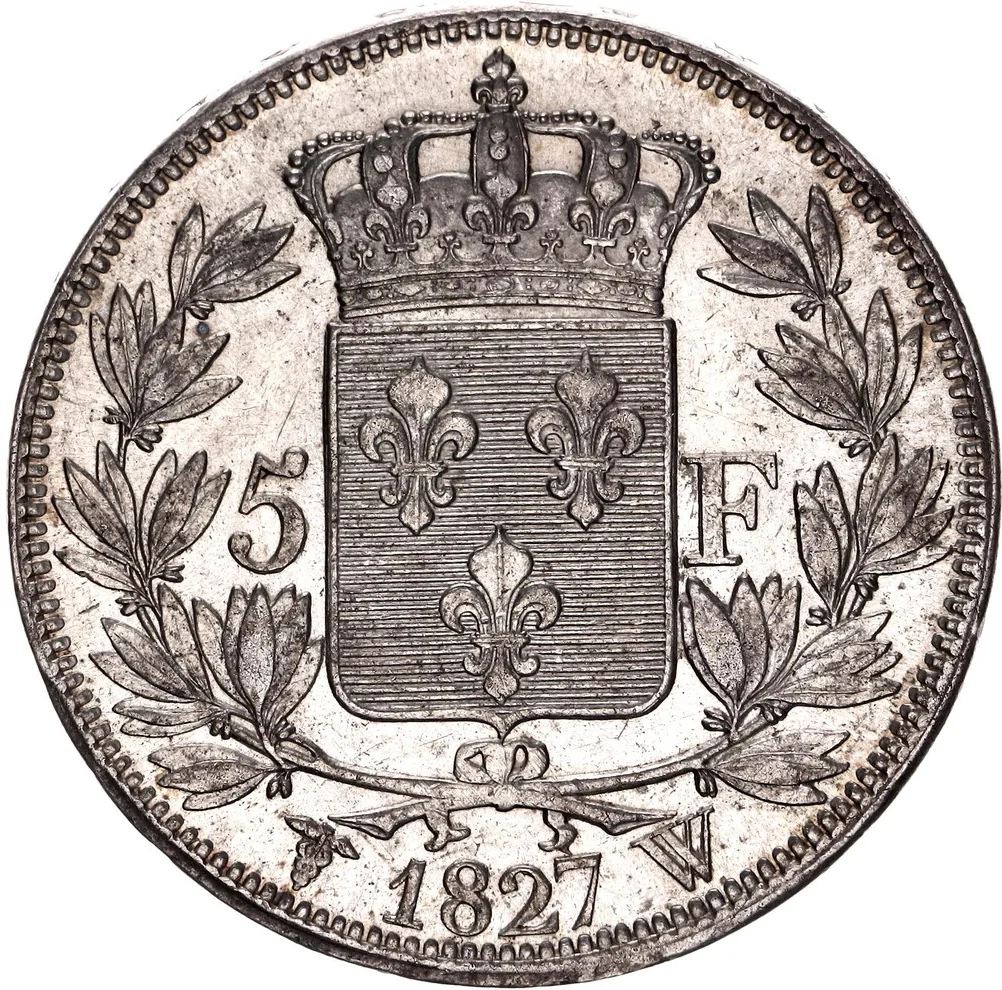
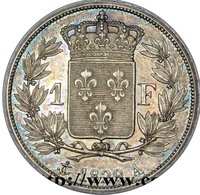
Shield of France crowned, flanked by olive branches.
Inscription:
5 F
1827 W (LILLE)
1827 W (LILLE)
Script: Latin
Engraver: Auguste-François Michaut
Edge
Inscribed in hollow
Legend:
♣ DOMINE SALVUM FAC REGEM
Mints
| Name | Mark |
|---|---|
| Monnaie de Paris | A |
| Rouen | B |
| Strasbourg | BB |
| Lyon | D |
| La Rochelle | H |
| Limoges | I |
| Bordeaux | K |
| Bayonne | L |
| Toulouse | M |
| Marseille | MA |
| Perpignan | Q |
| Nantes | T |
| Lille | W |
Mintings
| Year | Mint Mark | Mintage | Quality | Collection |
|---|---|---|---|---|
| 1827 | A | — | ||
| 1827 | B | 2,790,408 | ||
| 1827 | BB | 392,507 | ||
| 1827 | D | 1,650,505 | ||
| 1827 | H | 418,711 | ||
| 1827 | L | 1,143,499 | ||
| 1827 | M | 805,704 | ||
| 1827 | MA | 1,529,852 | ||
| 1827 | Q | 483,756 | ||
| 1827 | T | 863,871 | ||
| 1827 | W | — | ||
| 1827 | I | 334,750 | ||
| 1827 | K | 1,146,453 | ||
| 1828 | Q | 393,624 | ||
| 1828 | T | 931,850 | ||
| 1828 | W | 9,606,941 | ||
| 1828 | A | 8,800,342 | ||
| 1828 | B | 1,896,557 | ||
| 1828 | BB | 697,784 | ||
| 1828 | D | 2,741,425 | ||
| 1828 | H | 489,884 | ||
| 1828 | K | 1,630,917 | ||
| 1828 | L | 1,081,826 | ||
| 1828 | M | 1,816,511 | ||
| 1828 | MA | 1,200,114 | ||
| 1828 | I | 124,288 | ||
| 1829 | A | 4,826,072 | ||
| 1829 | B | 2,832,406 | ||
| 1829 | BB | 547,111 | ||
| 1829 | D | 1,606,889 | ||
| 1829 | H | 1,153,393 | ||
| 1829 | I | 474,038 | ||
| 1829 | K | 1,010,973 | ||
| 1829 | L | 856,768 | ||
| 1829 | M | 872,741 | ||
| 1829 | MA | 1,256,340 | ||
| 1829 | Q | 359,169 | ||
| 1829 | T | 887,400 | ||
| 1829 | W | 3,233,976 | ||
| 1830 | W | 4,132,848 | ||
| 1830 | M | 495,902 | ||
| 1830 | MA | 1,802,267 | ||
| 1830 | Q | 150,722 | ||
| 1830 | T | 136,805 | ||
| 1830 | A | 6,327,141 | ||
| 1830 | B | 2,909,005 | ||
| 1830 | BB | 111,282 | ||
| 1830 | D | 630,726 | ||
| 1830 | H | 572,885 | ||
| 1830 | I | 66,546 | ||
| 1830 | K | 712,125 | ||
| 1830 | L | 398,110 |
Historical background
In 1827, France operated under a bimetallic monetary system, as formally established by the Franc Germinal law of 1803 under Napoleon Bonaparte. This system fixed the value of the franc to specific quantities of both gold and silver, setting an official exchange ratio of 15.5 ounces of silver to 1 ounce of gold. The currency, known for its stability, was highly regarded internationally, and the country minted both gold napoléons and silver écus that circulated widely. This "franc germinal" provided a period of monetary stability and confidence, which was crucial for post-Revolution and post-Empire economic recovery during the Bourbon Restoration.
However, this apparent stability masked underlying tensions. The fixed mint ratio between gold and silver often diverged from the fluctuating market ratios, leading to the phenomenon described by Gresham's Law: "bad money drives out good." When the market value of one metal rose above its official mint price, those coins would be hoarded or exported, leaving the less valuable metal in circulation. In the 1820s, an influx of silver from newly independent Latin American mines generally made silver cheaper on the global market, which, under the fixed 15.5:1 ratio, made gold coins relatively undervalued at the mint. Consequently, gold tended to be withdrawn from domestic circulation for international exchange or melting, creating practical shortages.
The monetary situation in 1827 thus existed in a fragile equilibrium. While the franc itself was a strong and trusted unit of account, the mechanics of bimetallism were increasingly strained by global bullion flows. This period preceded the great European "silver famine" of the 1850s and the eventual continent-wide shift to the gold standard. For the French government and the Banque de France, the challenge was to maintain sufficient coinage in circulation for daily commerce while adhering to the rigid bimetallic law, a balancing act that would grow more difficult in the subsequent decades.
However, this apparent stability masked underlying tensions. The fixed mint ratio between gold and silver often diverged from the fluctuating market ratios, leading to the phenomenon described by Gresham's Law: "bad money drives out good." When the market value of one metal rose above its official mint price, those coins would be hoarded or exported, leaving the less valuable metal in circulation. In the 1820s, an influx of silver from newly independent Latin American mines generally made silver cheaper on the global market, which, under the fixed 15.5:1 ratio, made gold coins relatively undervalued at the mint. Consequently, gold tended to be withdrawn from domestic circulation for international exchange or melting, creating practical shortages.
The monetary situation in 1827 thus existed in a fragile equilibrium. While the franc itself was a strong and trusted unit of account, the mechanics of bimetallism were increasingly strained by global bullion flows. This period preceded the great European "silver famine" of the 1850s and the eventual continent-wide shift to the gold standard. For the French government and the Banque de France, the challenge was to maintain sufficient coinage in circulation for daily commerce while adhering to the rigid bimetallic law, a balancing act that would grow more difficult in the subsequent decades.
🌱 Common