

20 Cents – Jamaica
Circulating commemorative coins
Commemoration: World Food Day
Jamaica
Context
Years: 1981–1988
Issuer: Jamaica 
Ruler: Elizabeth II
Currency:
(since 1969)
Demonetization: 1995
Total mintage: 7,518,000
Material
Diameter: 28.5 mm
Weight: 11.3 g
Thickness: 2.4 mm
Shape: Round
Composition: Copper-nickel
Technique: Milled
Alignment: Medal alignment
flip
References
KM: #Click to copy to clipboard120
Numista: #10934
Value
Exchange value: 0.20 JMD
Obverse
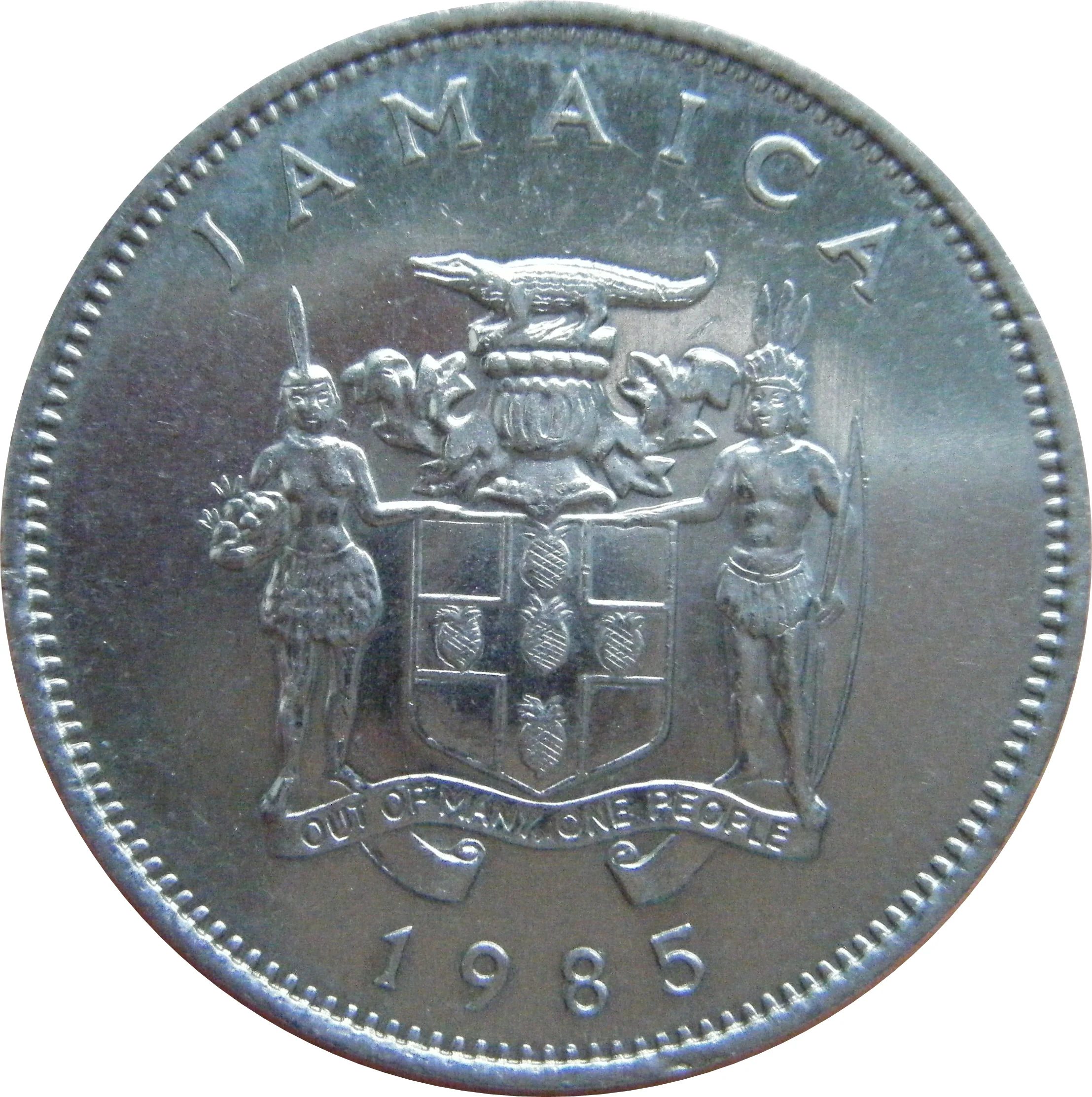
Reverse
Description:
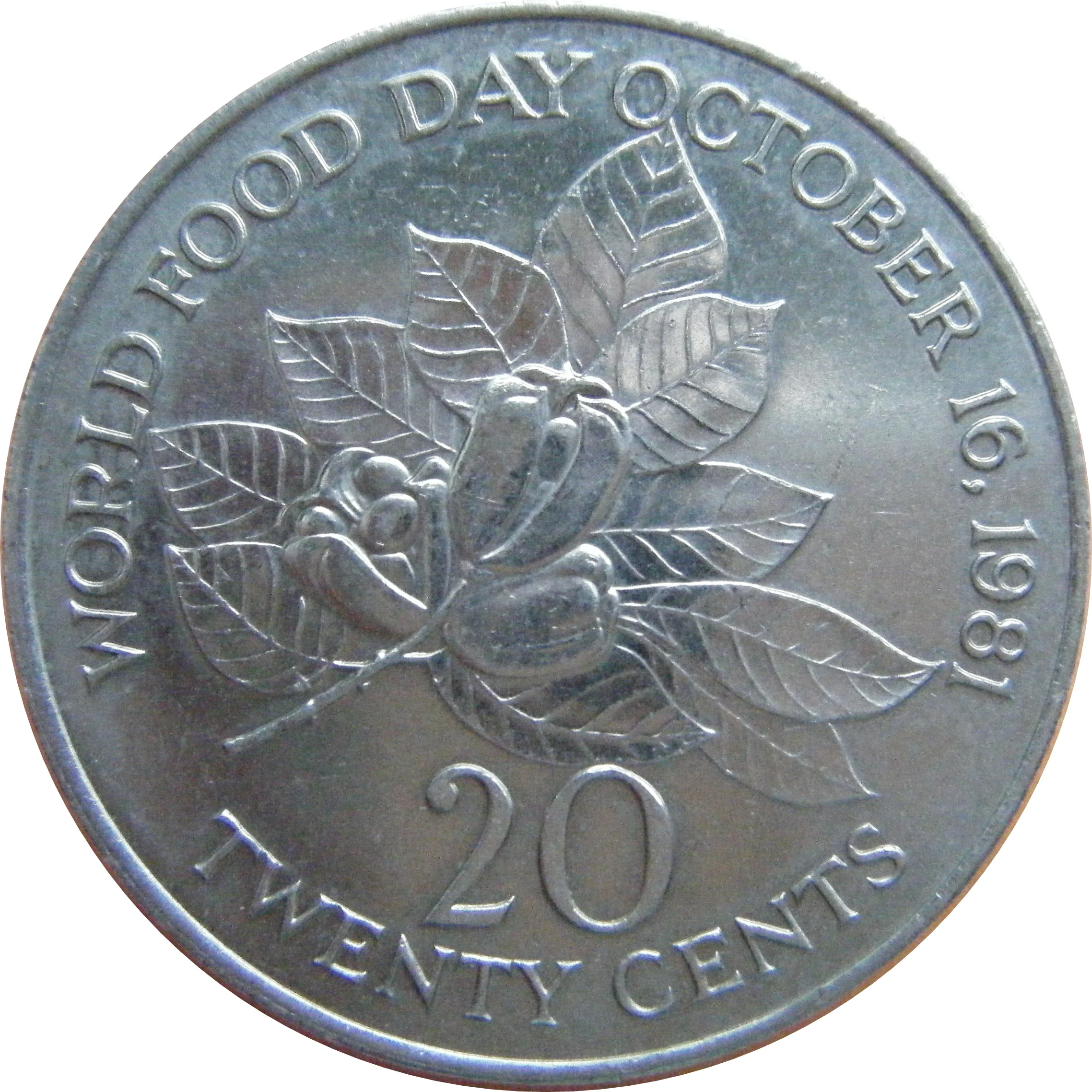
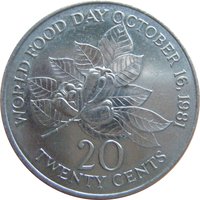
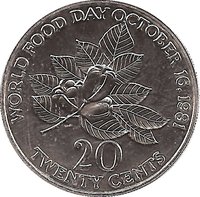
Fig branch with leaves and fruit.
Inscription:
WORLD FOOD DAY OCTOBER 16, 1981
20
TWENTY CENTS
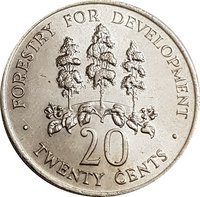
20
TWENTY CENTS
Script: Latin
Edge
Milled
Categories
| Symbols> Coat of Arms |
| Organization> FAO |
Mints
| Name | Mark |
|---|---|
| Royal Mint | — |
Mintings
| Year | Mint Mark | Mintage | Quality | Collection |
|---|---|---|---|---|
| 1981 | — | — | ||
| 1984 | — | 2,000,000 | ||
| 1985 | — | — | Proof | |
| 1985 | — | 2,988,000 | ||
| 1986 | — | 2,530,000 | ||
| 1988 | — | — |
Historical background
In 1981, Jamaica was in the midst of a severe economic crisis, deeply rooted in the oil shocks of the 1970s and the socialist-oriented policies of Prime Minister Michael Manley's People's National Party (1972-1980). The nation was burdened by massive external debt, rampant inflation (exceeding 25% annually), and chronic balance of payments deficits. Manley's government had maintained a fixed exchange rate for the Jamaican dollar, supported by stringent exchange controls, but this led to a significant overvaluation. The resulting scarcity of foreign currency crippled imports of essential goods, giving rise to widespread shortages and a booming black market where the dollar traded at a fraction of its official value.
The situation began a pivotal shift following the 1980 election victory of Edward Seaga's pro-United States and pro-International Monetary Fund (IMF) Jamaica Labour Party. In 1981, Seaga's government was actively negotiating a new structural adjustment programme with the IMF, which would mandate austerity measures, trade liberalisation, and crucially, a devaluation of the currency. While the formal devaluation occurred in 1983, the groundwork was laid in 1981 as the government moved to dismantle the system of controls. This created a period of intense uncertainty, as the official economy strained under an unsustainable peg while expectations of a major devaluation dictated financial decisions.
Consequently, the currency situation in 1981 was one of transition and mounting pressure. The overvalued Jamaican dollar in the official market stifled formal trade and investment, while the pervasive black market highlighted the loss of confidence and the severe disequilibrium. The year was defined by the stark contrast between the old controlled system and the impending liberalisation, setting the stage for the painful but decisive economic reforms that would characterise the rest of the decade under IMF supervision.
The situation began a pivotal shift following the 1980 election victory of Edward Seaga's pro-United States and pro-International Monetary Fund (IMF) Jamaica Labour Party. In 1981, Seaga's government was actively negotiating a new structural adjustment programme with the IMF, which would mandate austerity measures, trade liberalisation, and crucially, a devaluation of the currency. While the formal devaluation occurred in 1983, the groundwork was laid in 1981 as the government moved to dismantle the system of controls. This created a period of intense uncertainty, as the official economy strained under an unsustainable peg while expectations of a major devaluation dictated financial decisions.
Consequently, the currency situation in 1981 was one of transition and mounting pressure. The overvalued Jamaican dollar in the official market stifled formal trade and investment, while the pervasive black market highlighted the loss of confidence and the severe disequilibrium. The year was defined by the stark contrast between the old controlled system and the impending liberalisation, setting the stage for the painful but decisive economic reforms that would characterise the rest of the decade under IMF supervision.
🌱 Common