

15 Ngultrums – Bhutan
Non-circulating coins
Commemoration: FAO - Food for all
Bhutan
Context
Material
References
KM: #Click to copy to clipboard42
Numista: #21023
Value
Exchange value: 15 BTN
Bullion value: $31.91
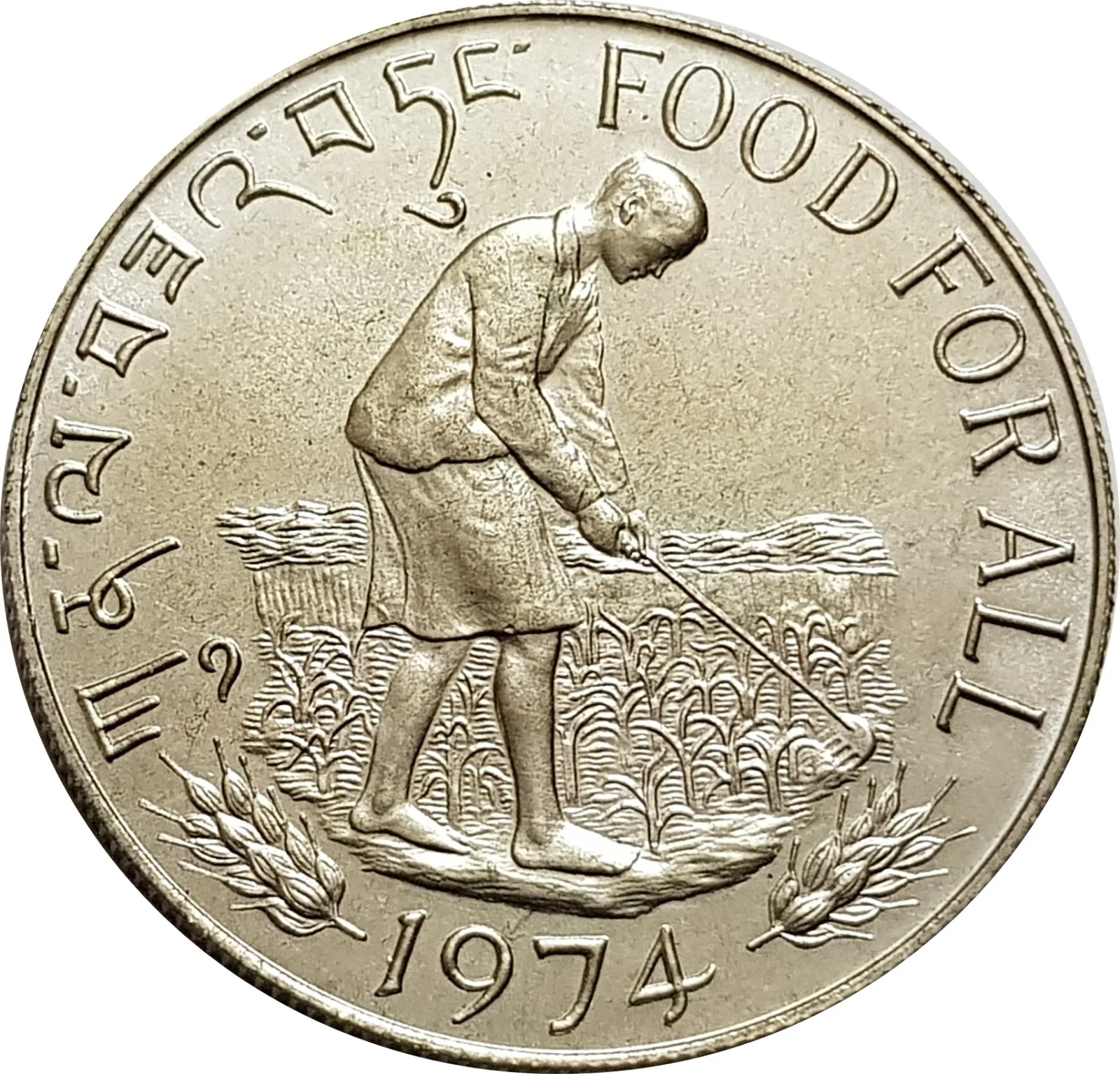
Obverse
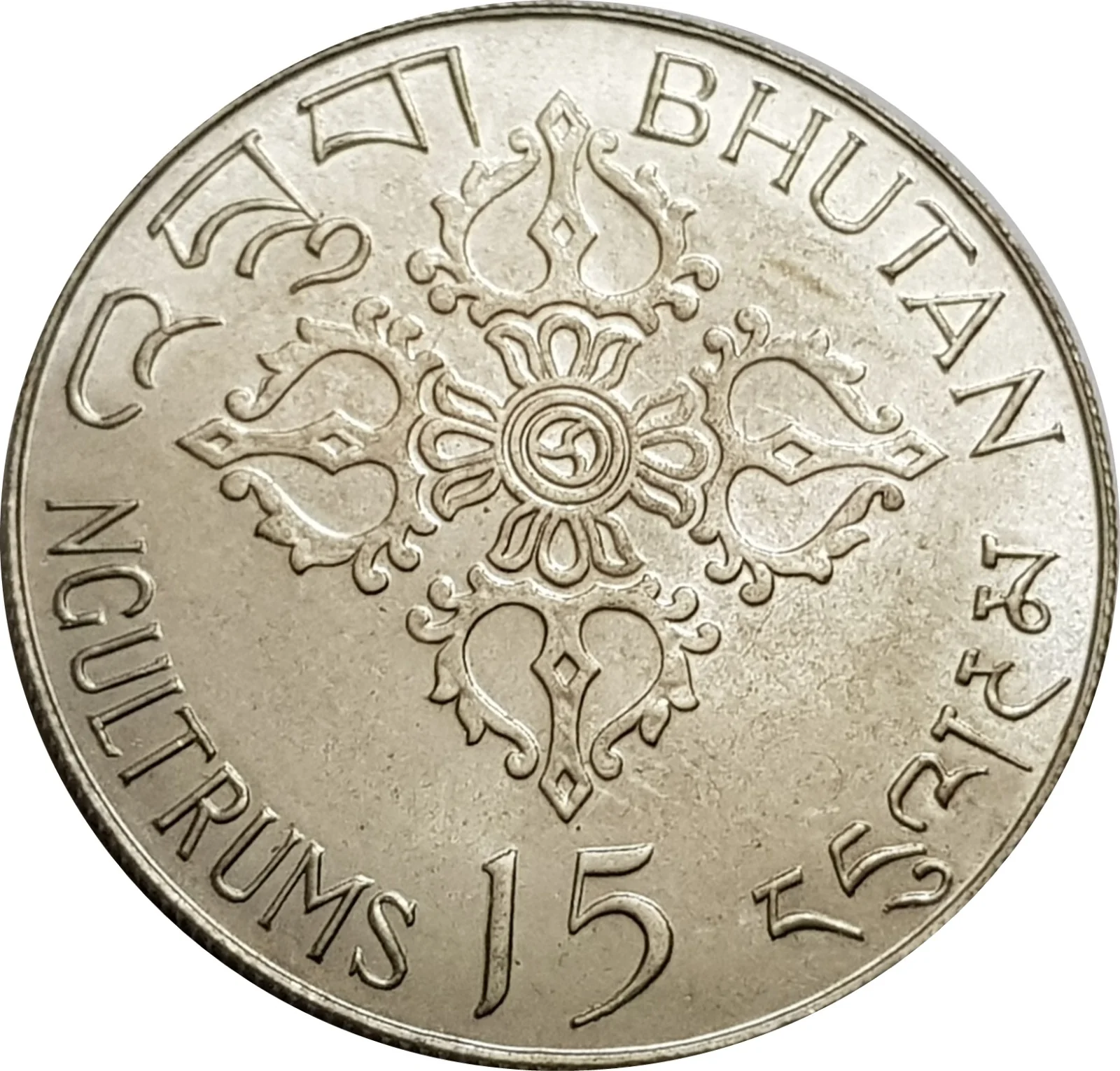
Reverse
Description:
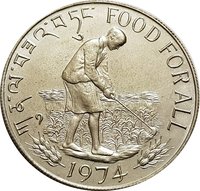
A farmer.
Inscription:
FOOD FOR ALL
1974
1974
Edge
Milled
Categories
| Organization> FAO |
Mints
| Name | Mark |
|---|---|
| Mumbai / Bombay | — |
Mintings
| Year | Mint Mark | Mintage | Quality | Collection |
|---|---|---|---|---|
| 1974 | — | — | In sets | |
| 1974 | — | 30,000 | ||
| 1974 | — | — | Prooflike | |
| 1974 | — | 1,000 | Proof |
Historical background
In 1974, Bhutan's currency situation was defined by its close monetary integration with India, a relationship formalized by the 1949 Treaty of Friendship. The Indian rupee was the dominant legal tender within the kingdom, circulating freely alongside the nascent national currency, the Ngultrum (Nu.), which had been introduced in 1974. The Ngultrum was pegged at par with the Indian rupee, a fixed 1:1 exchange rate that facilitated seamless trade and economic stability but also meant Bhutan’s monetary policy was effectively set by the Reserve Bank of India.
This arrangement was pragmatic for a small, landlocked nation beginning to cautiously engage with the modern world, notably with the coronation of the Fourth King, Jigme Singye Wangchuck, and the opening to tourism in 1974. The Indian rupee provided a stable and internationally recognized currency, crucial for financing imports, as India remained (and remains) Bhutan's primary trading partner. However, it also reflected a degree of economic dependency, limiting Bhutan's independent control over its money supply and exchange rate mechanisms.
Thus, the currency landscape in 1974 was in a state of deliberate duality: the symbolic launch of the Ngultrum asserted national identity and sovereignty, while the continued circulation and parity with the Indian rupee ensured practical economic security. This system provided the stable financial foundation needed for the early stages of Bhutan's planned development, setting a precedent for monetary management that would persist for decades.
This arrangement was pragmatic for a small, landlocked nation beginning to cautiously engage with the modern world, notably with the coronation of the Fourth King, Jigme Singye Wangchuck, and the opening to tourism in 1974. The Indian rupee provided a stable and internationally recognized currency, crucial for financing imports, as India remained (and remains) Bhutan's primary trading partner. However, it also reflected a degree of economic dependency, limiting Bhutan's independent control over its money supply and exchange rate mechanisms.
Thus, the currency landscape in 1974 was in a state of deliberate duality: the symbolic launch of the Ngultrum asserted national identity and sovereignty, while the continued circulation and parity with the Indian rupee ensured practical economic security. This system provided the stable financial foundation needed for the early stages of Bhutan's planned development, setting a precedent for monetary management that would persist for decades.
🌱 Fairly Common