

50 centimes – France
Add to wishlist
France
Context
Years: 1845–1848
Issuer: France
Ruler: Louis Philippe I
Currency:
(1795—1959)
Demonetization: 17 June 1868
Total mintage: 10,141,185
Material
References
KM: #
Numista: #2100
Value
Bullion value: $5.73
Obverse
Description:
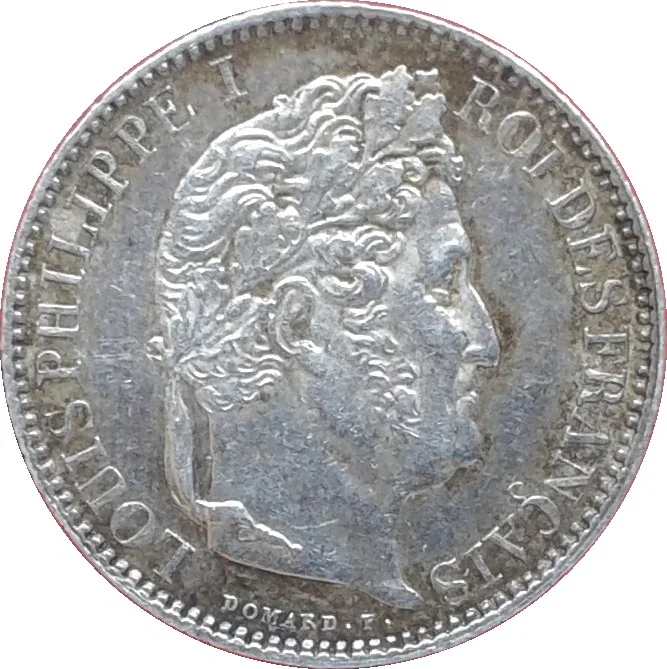
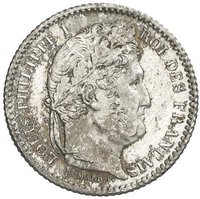
Laureate head of Louis-Philippe right.
Inscription:
LOUIS PHILIPPE I ROI DES FRANÇAIS
Translation:
LOUIS PHILIPPE I KING OF THE FRENCH
Script: Latin
Language: French
Engraver: Joseph-François Domard
Reverse
Description:
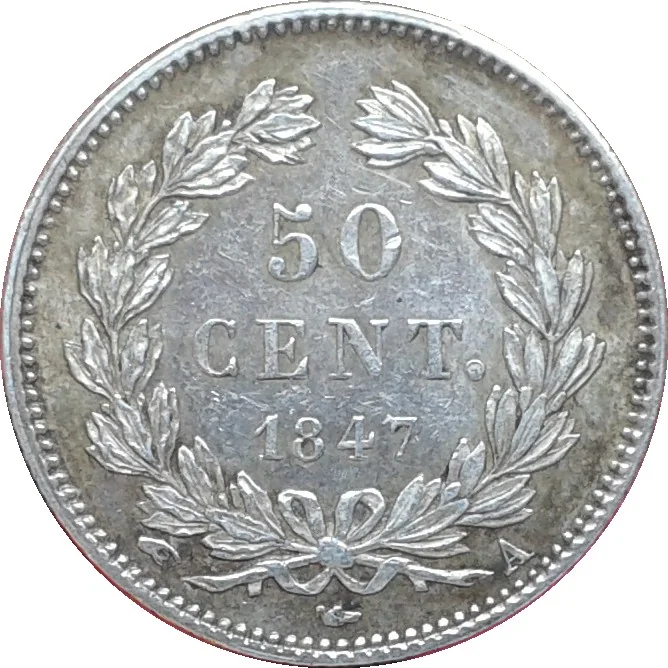
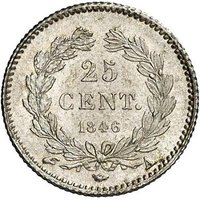
50¢ between laurel branches tied with a ribbon.
Inscription:
50
CENT.
1846
CENT.
1846
Script: Latin
Engraver: Joseph-François Domard
Edge
Milled
Mints
| Name | Mark |
|---|---|
| Monnaie de Paris | A |
| Rouen | B |
| Strasbourg | BB |
| Bordeaux | K |
| Lille | W |
Mintings
Historical background
In 1845, France operated under a bimetallic monetary system, as established by the Franc Germinal law of 1803. This system fixed the value of the franc to both gold and silver at a legally defined ratio of 1:15.5, meaning one gram of gold was valued as equal to 15.5 grams of silver. The system aimed to provide stability and facilitate international trade by allowing the free minting of both gold and silver coins, which were legal tender for all payments. This "double standard" had functioned reasonably well for decades, underpinning a period of economic expansion.
However, by the 1840s, the system was under growing strain due to global market fluctuations in the relative value of the two metals. The fixed mint ratio began to diverge from the market ratio, creating an arbitrage opportunity. Following the discoveries of rich silver deposits, the market value of silver fell relative to gold. Consequently, it became profitable to exchange gold for silver on the open market and then bring the silver to the French mint for coinage, leading to an outflow of gold from France. This process, known as Gresham's Law ("bad money drives out good"), meant gold coins were increasingly hoarded or exported, leaving a circulating medium increasingly dominated by silver.
This currency situation contributed to a sense of underlying financial vulnerability as France approached the late 1840s. While not an immediate crisis in 1845, the creeping instability of bimetallism worried economists and bankers. The government, under King Louis-Philippe, was reluctant to alter the sacred Franc Germinal, but the pressures foreshadowed future monetary debates. These economic tensions, combined with poor harvests and industrial discontent, would form part of the backdrop for the wider political and social upheavals that culminated in the Revolution of 1848.
However, by the 1840s, the system was under growing strain due to global market fluctuations in the relative value of the two metals. The fixed mint ratio began to diverge from the market ratio, creating an arbitrage opportunity. Following the discoveries of rich silver deposits, the market value of silver fell relative to gold. Consequently, it became profitable to exchange gold for silver on the open market and then bring the silver to the French mint for coinage, leading to an outflow of gold from France. This process, known as Gresham's Law ("bad money drives out good"), meant gold coins were increasingly hoarded or exported, leaving a circulating medium increasingly dominated by silver.
This currency situation contributed to a sense of underlying financial vulnerability as France approached the late 1840s. While not an immediate crisis in 1845, the creeping instability of bimetallism worried economists and bankers. The government, under King Louis-Philippe, was reluctant to alter the sacred Franc Germinal, but the pressures foreshadowed future monetary debates. These economic tensions, combined with poor harvests and industrial discontent, would form part of the backdrop for the wider political and social upheavals that culminated in the Revolution of 1848.
🌱 Fairly Common