

5 cents – Kiau Chau
Add to wishlist
China
Context
Year: 1909
Country: China
Issuer: Kiau Chau
Issuing organization: Deutsch Asiatische Bank
Ruler: William II
Currency:
(1907—1914)
Demonetization: 7 November 1914
Total mintage: 610,000
Material
References
KM: #
Numista: #20877
Obverse
Description:
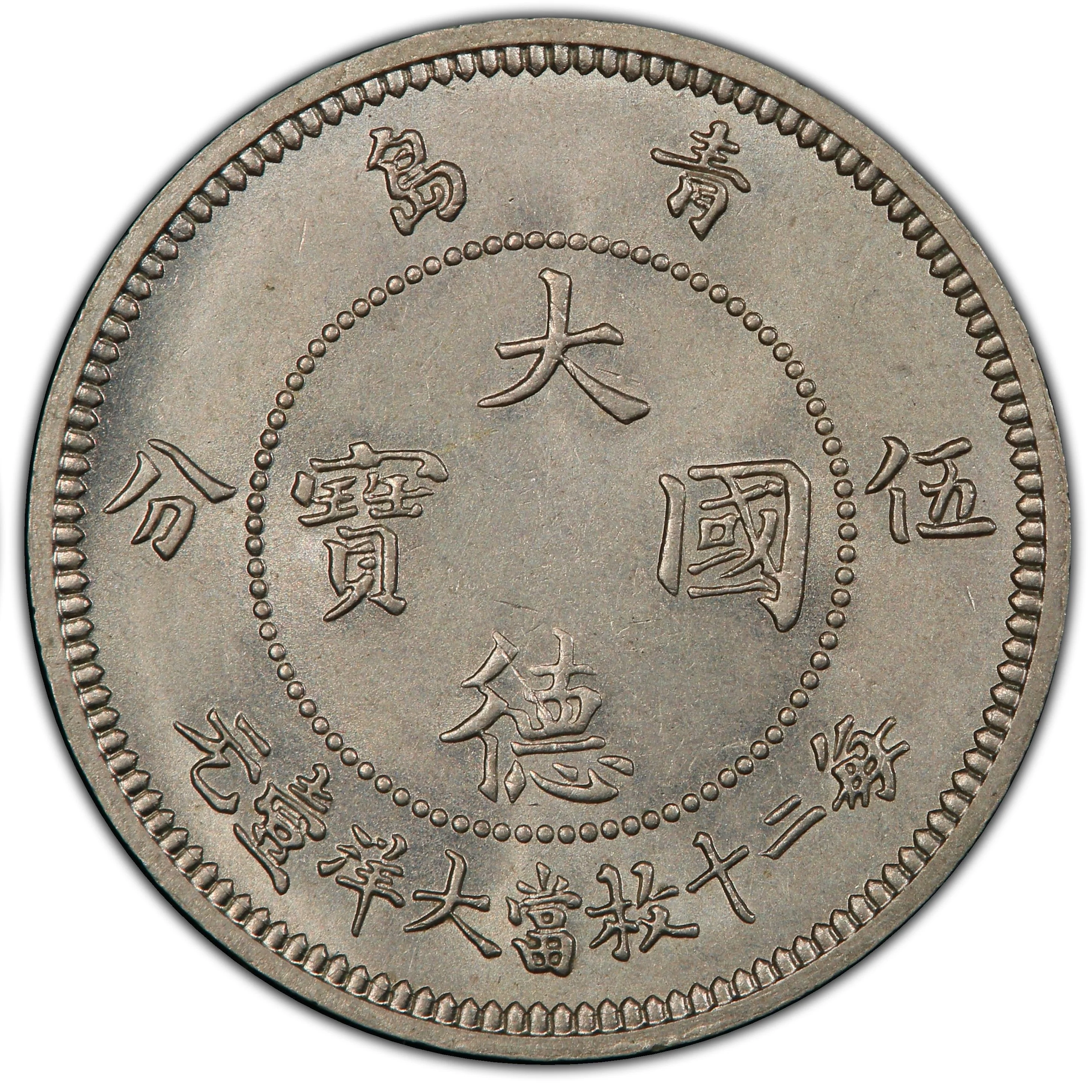
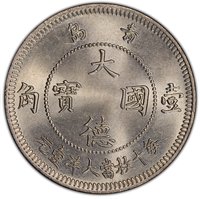
Four Chinese characters in a beaded circle, encircled by more characters.
Inscription:
島青
大
寶國
德
分伍
元壹洋大當枚十二每
大
寶國
德
分伍
元壹洋大當枚十二每
Translation:
Island of Youth
Great
Treasure Nation
Virtue
Five Cents
One Dollar Silver, Valid for Twelve Large Coins Each.
Great
Treasure Nation
Virtue
Five Cents
One Dollar Silver, Valid for Twelve Large Coins Each.
Scripts: Chinese (traditional, regular script)
Language: Chinese
Engraver: Paul Sturm
Reverse
Description:
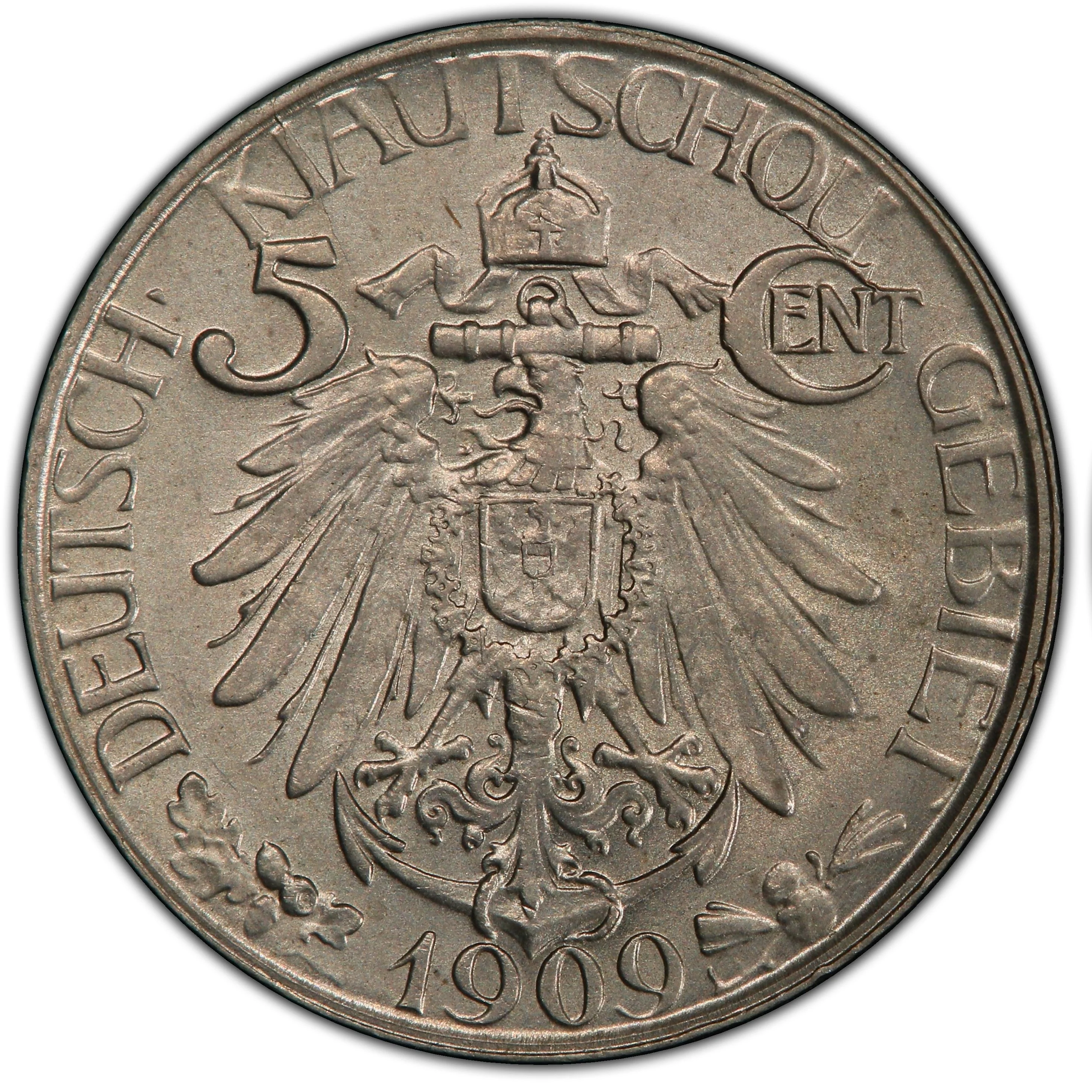
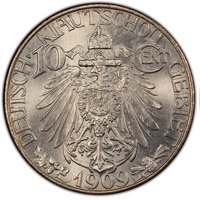
Imperial German coat-of-arms with anchor between value and legend.
Inscription:
DEUTSCH· KIAUTSCHOU GEBIET
5 CENT
1909
5 CENT
1909
Translation:
GERMAN· KIAUTSCHOU TERRITORY
5 CENT
1909
5 CENT
1909
Script: Latin
Language: German
Engraver: Otto Schultz
Edge
Plain
Mints
| Name | Mark |
|---|---|
| Berlin | — |
Mintings
| Year | Mint Mark | Mintage | Quality | Collection |
|---|---|---|---|---|
| 1909 | — | 610,000 | ||
| 1909 | — | — | Proof |
Historical background
In 1909, the currency situation in Kiautschou Bay (Jiaozhou) was a unique and complex reflection of its status as a German colonial leasehold. The German administration, established in 1898, had introduced the German Goldmark as the official currency. However, it did not fully displace the existing Chinese monetary systems. Consequently, the colony operated on a de facto dual-currency system. Alongside the Goldmark, Chinese silver currencies—particularly the Mexican Silver Dollar and its regional equivalents—remained in widespread daily use among the local population and for trade with the Shandong hinterland. The German authorities fixed an official exchange rate between the silver dollar and the gold-based Mark to facilitate government transactions and trade.
This monetary duality created practical challenges. The German government required taxes and official fees to be paid in Marks, which necessitated constant conversion and exposed users to exchange rate fluctuations between silver and gold. Furthermore, while the German East Asiatic Bank issued banknotes denominated in Marks, their circulation was largely confined to the colonial administration, German businesses, and infrastructure projects within the port city of Tsingtau (Qingdao). The vast majority of local commerce and wages continued to be conducted in silver, creating a stratified financial environment where the European and Chinese economies operated in parallel with different monetary standards.
The situation in 1909 thus represented a transitional and imperfect system. The German colonial aim of economically integrating the territory into the German Empire through its gold currency was only partially successful. The persistent use of silver underscored the enduring strength of local economic patterns and China's broader silver-based economy. This hybrid system would persist until the outbreak of the First World War, after which the Japanese occupation in 1914 introduced a new monetary order, ending the German experiment in currency integration.
This monetary duality created practical challenges. The German government required taxes and official fees to be paid in Marks, which necessitated constant conversion and exposed users to exchange rate fluctuations between silver and gold. Furthermore, while the German East Asiatic Bank issued banknotes denominated in Marks, their circulation was largely confined to the colonial administration, German businesses, and infrastructure projects within the port city of Tsingtau (Qingdao). The vast majority of local commerce and wages continued to be conducted in silver, creating a stratified financial environment where the European and Chinese economies operated in parallel with different monetary standards.
The situation in 1909 thus represented a transitional and imperfect system. The German colonial aim of economically integrating the territory into the German Empire through its gold currency was only partially successful. The persistent use of silver underscored the enduring strength of local economic patterns and China's broader silver-based economy. This hybrid system would persist until the outbreak of the First World War, after which the Japanese occupation in 1914 introduced a new monetary order, ending the German experiment in currency integration.
🌟 Limited