

100 Francs (La Fayette) – France
Non-circulating coins
Commemoration: 230th Anniversary of the birth of La Fayette
France

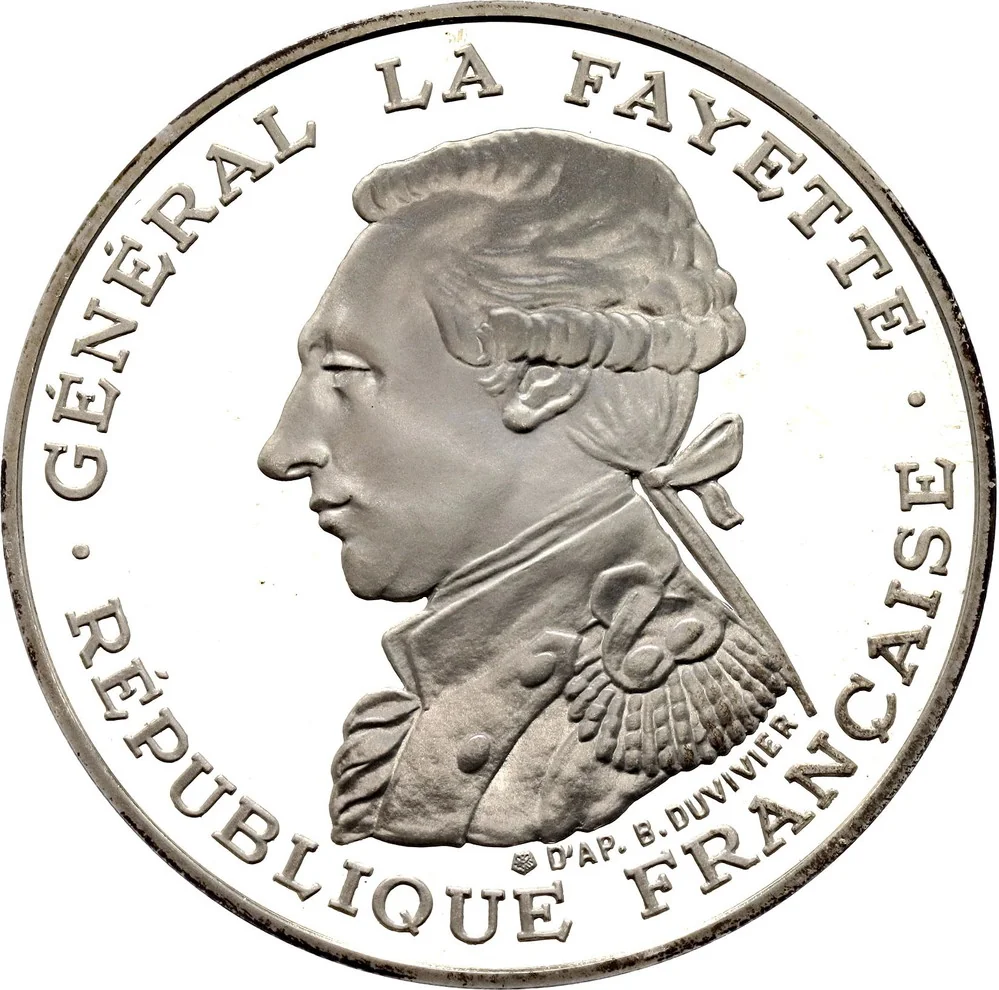
Obverse
Description:
Left turn.
Inscription:
· GÉNÉRAL LA FAYETTE ·
RÉPUBLIQUE FRANÇAISE
RÉPUBLIQUE FRANÇAISE
Translation:
GENERAL LAFAYETTE
FRENCH REPUBLIC
FRENCH REPUBLIC
Script: Latin
Language: French
Designer: Pierre-Benjamin Duvivier
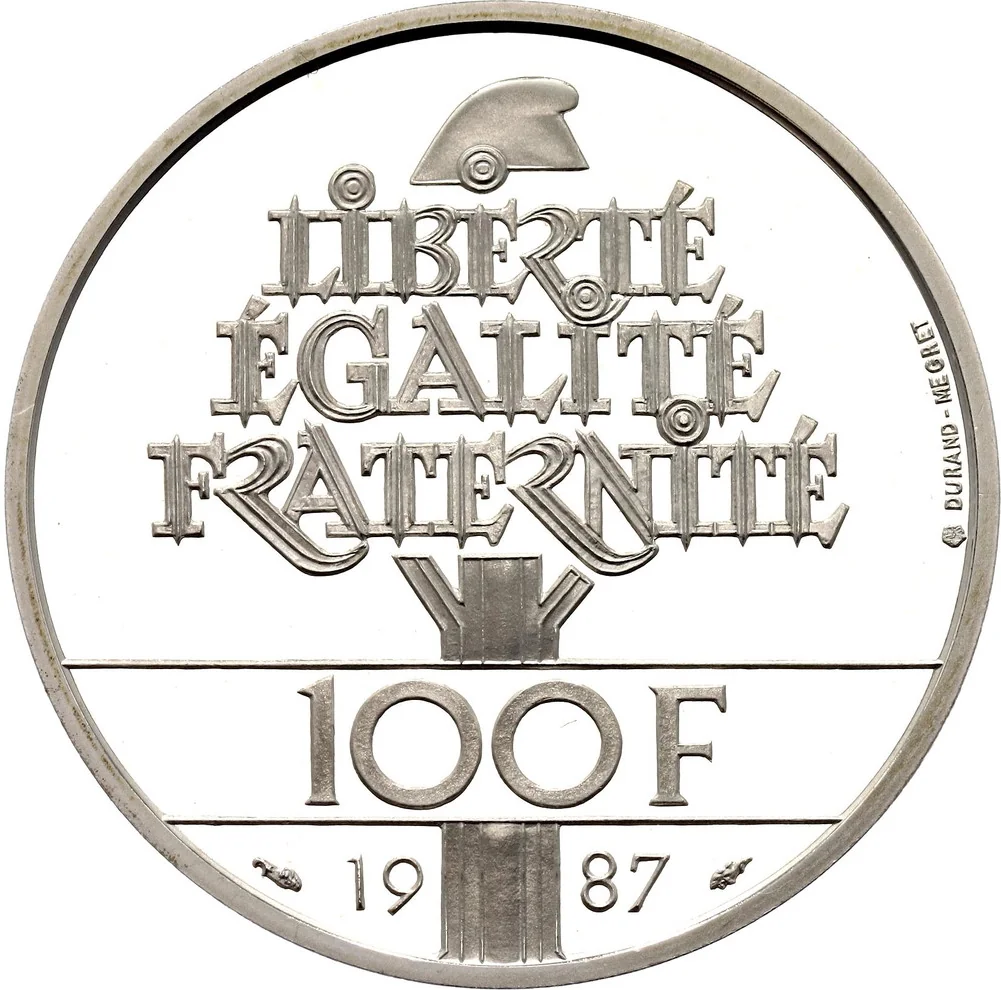
Reverse
Description:
Liberty cap above inscription, date below.
Inscription:
LIBERTÉ
ÉGALITÉ
FRATERNITÉ
100F
19 87 DURAND-MEGRET
ÉGALITÉ
FRATERNITÉ
100F
19 87 DURAND-MEGRET
Translation:
LIBERTY
EQUALITY
FRATERNITY
100F
19 87 DURAND-MEGRET
EQUALITY
FRATERNITY
100F
19 87 DURAND-MEGRET
Script: Latin
Language: French
Engraver: Michel Durand-Mégret
Edge
Plain
Categories
| Event> Birth anniversary |
Mints
| Name | Mark |
|---|---|
| Monnaie de Paris | — |
Mintings
| Year | Mint Mark | Mintage | Quality | Collection |
|---|---|---|---|---|
| 1987 | — | 30,000 | Proof |
Historical background
In 1987, France's currency situation was defined by its pivotal role within the European Monetary System (EMS), established in 1979. The core of the EMS was the Exchange Rate Mechanism (ERM), which aimed to reduce exchange rate variability and achieve monetary stability in Europe by pegging national currencies, including the French franc, within agreed fluctuation bands against a basket currency, the European Currency Unit (ECU). For France, a strong and stable franc—the "franc fort" policy—was a cornerstone of economic strategy, driven by President François Mitterrand's government and its Finance Minister, Édouard Balladur. This policy prioritized fighting inflation and aligning with the Deutsche Mark to anchor credibility, even at the cost of higher interest rates and slower growth.
Domestically, this commitment created significant tension. Maintaining the franc's strict parity within the ERM required high interest rates set by the Banque de France, which constrained economic expansion and contributed to persistently high unemployment, a chronic issue throughout the 1980s. The government faced a difficult balancing act: using monetary policy to defend the currency's international value while under pressure to stimulate the domestic economy. This period was characterized by a "competitive disinflation" strategy, where wage growth was suppressed to restore corporate profitability and external competitiveness without devaluing the currency.
The relative calm of 1987 followed the turbulence of multiple franc devaluations in the early 1980s and preceded the major ERM crises of the early 1990s. It was a year of consolidation under the Basel-Nyborg agreements, which strengthened the EMS by allowing greater flexibility in intra-marginal interventions. However, the underlying asymmetry of the system, where the Bundesbank's anti-inflationary policy effectively set the tone for all members, meant France had limited independent monetary tools. Thus, 1987 represents a period of fragile stability, where France's currency policy was firmly locked into the European project, setting the stage for the deeper economic and monetary integration that would lead to the Maastricht Treaty and the eventual adoption of the euro.
Domestically, this commitment created significant tension. Maintaining the franc's strict parity within the ERM required high interest rates set by the Banque de France, which constrained economic expansion and contributed to persistently high unemployment, a chronic issue throughout the 1980s. The government faced a difficult balancing act: using monetary policy to defend the currency's international value while under pressure to stimulate the domestic economy. This period was characterized by a "competitive disinflation" strategy, where wage growth was suppressed to restore corporate profitability and external competitiveness without devaluing the currency.
The relative calm of 1987 followed the turbulence of multiple franc devaluations in the early 1980s and preceded the major ERM crises of the early 1990s. It was a year of consolidation under the Basel-Nyborg agreements, which strengthened the EMS by allowing greater flexibility in intra-marginal interventions. However, the underlying asymmetry of the system, where the Bundesbank's anti-inflationary policy effectively set the tone for all members, meant France had limited independent monetary tools. Thus, 1987 represents a period of fragile stability, where France's currency policy was firmly locked into the European project, setting the stage for the deeper economic and monetary integration that would lead to the Maastricht Treaty and the eventual adoption of the euro.



🌟 Limited