

10 Centimes – French Guiana
France
Context
Year: 1846
Country: France 
Issuer: French Guiana
Ruler: Louis Philippe I
Currency:
(1818—1960)
Demonetized: Yes
Total mintage: 1,400,000
Material
References
KM: #Click to copy to clipboardA2
Numista: #20779
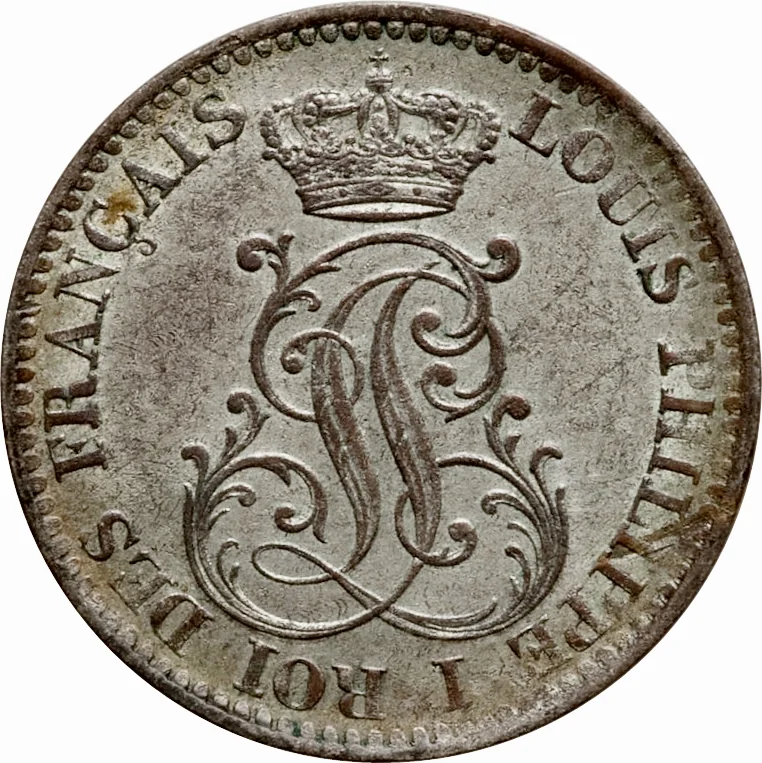
Obverse
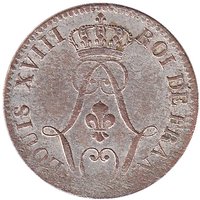
Description:
Crowned monogram with "LOUIS PHILIPPE I ROI DES FRANÇAIS" on the edge.
Inscription:
LOUIS PHILIPPE I ROI DES FRANÇAIS
Translation:
LOUIS PHILIPPE I KING OF THE FRENCH
Script: Latin
Language: French
Engraver: Jacques-Jean Barre
Reverse
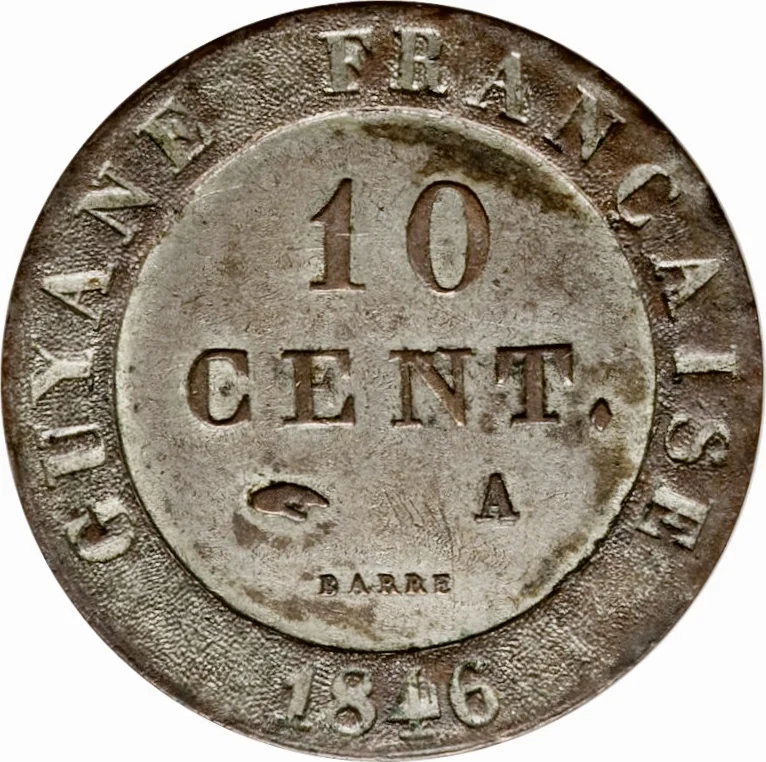
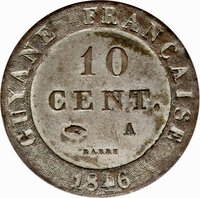
Description:
Circle denomination
Inscription:
GUYANE FRANÇAISE
10
CENT.
A
BARRE
1846
10
CENT.
A
BARRE
1846
Translation:
French Guiana
10
Cents
A
Barre
1846
10
Cents
A
Barre
1846
Script: Latin
Language: French
Engraver: Jacques-Jean Barre
Edge
Plain
Mints
| Name | Mark |
|---|---|
| Monnaie de Paris | A |
Mintings
| Year | Mint Mark | Mintage | Quality | Collection |
|---|---|---|---|---|
| 1846 | A | 1,400,000 |
Historical background
In 1846, French Guiana operated under the monetary system of metropolitan France, with the French franc as its official currency. This integration was a direct result of the colony's status as an overseas department, firmly under French administrative and economic control. However, the practical currency situation on the ground was more complex, characterized by a chronic shortage of official coinage. This scarcity was a common colonial problem, driven by the distance from the metropole and the prioritization of trade balances that often saw coinage flow out of the territory.
The shortage of francs led to the widespread use of alternative and foreign currencies in daily transactions. Notably, Spanish and Spanish-American silver coins, such as pesos and reales, circulated freely alongside French money due to their intrinsic silver value and the region's historical trade links. Portuguese and Brazilian coins were also common, reflecting geographic proximity and commercial exchange. This created a de facto multi-currency system where merchants and settlers had to constantly calculate exchange rates between various coins based on their weight and fineness.
This monetary inconsistency posed significant challenges for administration and commerce, hindering efficient tax collection and government payments. The situation was further strained by the colony's struggling economy, which at the time relied heavily on a declining plantation system and the soon-to-be-abandoned penal colony at Île du Diable (established later, in 1852). While the Bank of France's notes were theoretically legal tender, their practical use in the colony was minimal. The currency chaos of 1846 thus reflected French Guiana's peripheral position within the French Empire, caught between official imperial policy and the pragmatic realities of a remote, economically underdeveloped frontier society.
The shortage of francs led to the widespread use of alternative and foreign currencies in daily transactions. Notably, Spanish and Spanish-American silver coins, such as pesos and reales, circulated freely alongside French money due to their intrinsic silver value and the region's historical trade links. Portuguese and Brazilian coins were also common, reflecting geographic proximity and commercial exchange. This created a de facto multi-currency system where merchants and settlers had to constantly calculate exchange rates between various coins based on their weight and fineness.
This monetary inconsistency posed significant challenges for administration and commerce, hindering efficient tax collection and government payments. The situation was further strained by the colony's struggling economy, which at the time relied heavily on a declining plantation system and the soon-to-be-abandoned penal colony at Île du Diable (established later, in 1852). While the Bank of France's notes were theoretically legal tender, their practical use in the colony was minimal. The currency chaos of 1846 thus reflected French Guiana's peripheral position within the French Empire, caught between official imperial policy and the pragmatic realities of a remote, economically underdeveloped frontier society.
🌟 Uncommon