

Obverse
Description:
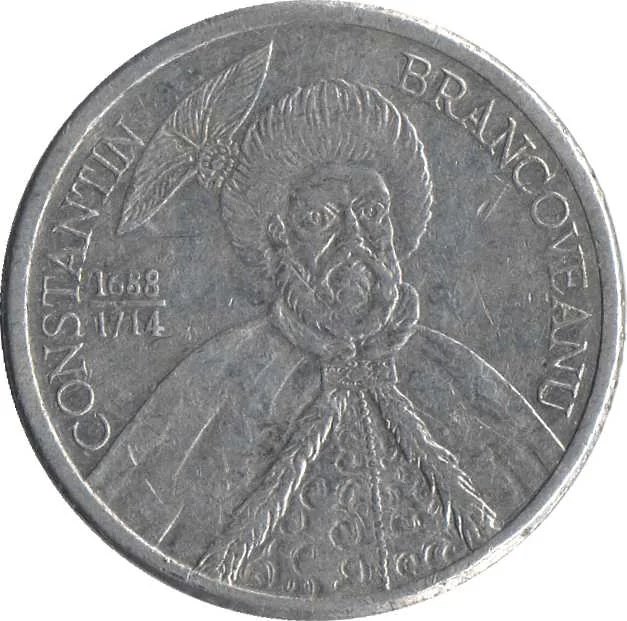
Bust of Prince Constantin Brancoveanu wearing a headdress.
Inscription:
CONSTANTIN BRANCOVEANU
1688
1714
1688
1714
Translation:
CONSTANTIN BRANCOVEANU
1688
1714
1688
1714
Script: Latin
Engraver: Vasile Gabor
Reverse
Description:
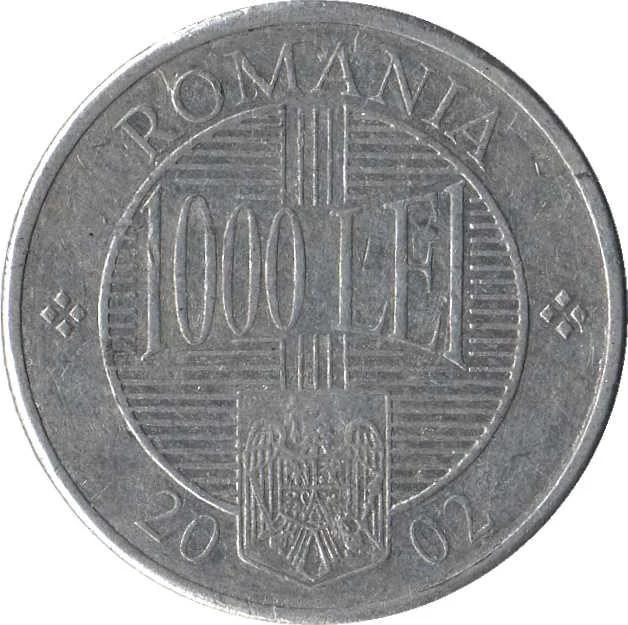
Value over shield in circled line.
Inscription:
ROMANIA
1000 LEI
20 02
1000 LEI
20 02
Script: Latin
Engraver: Vasile Gabor
Edge
Smooth with reeded sections
Categories
| Symbols> Coat of Arms |
| Person> Monarch |
Mints
| Name | Mark |
|---|---|
| State Mint | — |
Mintings
| Year | Mint Mark | Mintage | Quality | Collection |
|---|---|---|---|---|
| — | — | — | ||
| 2000 | — | — | ||
| 2000 | — | 4,500 | Proof | |
| 2001 | — | — | ||
| 2002 | — | — | ||
| 2002 | — | 1,500 | Proof | |
| 2003 | — | — | ||
| 2003 | — | 2,000 | Proof | |
| 2004 | — | — | ||
| 2004 | — | 2,000 | Proof | |
| 2005 | — | — | Proof | |
| 2006 | — | 1,000 | Proof |
Historical background
In the year 2000, Romania's currency situation was characterized by a fragile stabilization following a period of severe crisis. The late 1990s had been tumultuous, culminating in a deep economic and banking crisis in 1998-1999, which severely undermined confidence in the Romanian leu (ROL). This led to high inflation, a significant depreciation of the currency, and the effective collapse of the banking system for many citizens. By the turn of the millennium, the country was operating under a standby agreement with the International Monetary Fund (IMF), which imposed strict austerity measures and required a tight monetary policy from the National Bank of Romania (NBR) to restore macroeconomic balance.
The primary focus of monetary authorities in 2000 was on curbing rampant inflation and preventing further dramatic devaluation. Inflation remained stubbornly high, ending the year at approximately 45%, though this was a notable decrease from the triple-digit hyperinflation of the mid-1990s. The NBR maintained a managed float exchange rate regime, intervening in the market to smooth out excessive volatility, but the leu continued to depreciate gradually under pressure from fiscal deficits and lingering lack of confidence. This environment of high inflation and a weakening currency severely eroded purchasing power, creating ongoing hardship for the population.
Looking forward, 2000 was a transitional year setting the stage for more decisive reforms. The government, under renewed IMF pressure, began implementing stricter fiscal discipline and accelerated the restructuring and privatization of loss-making state-owned enterprises. These steps, though painful in the short term, were aimed at creating the conditions for sustainable growth and eventual EU accession. The currency stability achieved was precarious, but it laid the necessary groundwork for the more successful stabilization and denomination (the replacement of the old leu with a new leu at a rate of 10,000:1) that would follow later in the decade.
The primary focus of monetary authorities in 2000 was on curbing rampant inflation and preventing further dramatic devaluation. Inflation remained stubbornly high, ending the year at approximately 45%, though this was a notable decrease from the triple-digit hyperinflation of the mid-1990s. The NBR maintained a managed float exchange rate regime, intervening in the market to smooth out excessive volatility, but the leu continued to depreciate gradually under pressure from fiscal deficits and lingering lack of confidence. This environment of high inflation and a weakening currency severely eroded purchasing power, creating ongoing hardship for the population.
Looking forward, 2000 was a transitional year setting the stage for more decisive reforms. The government, under renewed IMF pressure, began implementing stricter fiscal discipline and accelerated the restructuring and privatization of loss-making state-owned enterprises. These steps, though painful in the short term, were aimed at creating the conditions for sustainable growth and eventual EU accession. The currency stability achieved was precarious, but it laid the necessary groundwork for the more successful stabilization and denomination (the replacement of the old leu with a new leu at a rate of 10,000:1) that would follow later in the decade.


🌱 Very Common