

¼ Dinar – Jordan
Jordan
Context
Years: 1970–1975
Issuer: Jordan 
Ruler: Hussein bin Talal
Currency:
(since 1949)
Total mintage: 1,000,000
Material
Diameter: 34 mm
Weight: 17 g
Thickness: 2.5 mm
Shape: Round
Composition: Copper-nickel
Technique: Milled
Alignment: Medal alignment
flip
References
KM: #Click to copy to clipboard28
Numista: #20721
Value
Exchange value: ¼ JOD
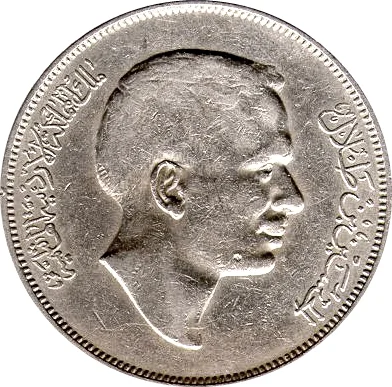
Obverse
Description:
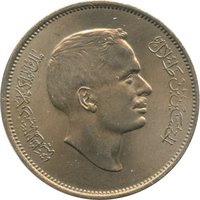
King Hussein of Jordan
Inscription:
الحسين بن طلال
ملك المملكة الأردنية الهاشمية
ملك المملكة الأردنية الهاشمية
Translation:
Hussein bin Talal
King of the Hashemite Kingdom of Jordan
King of the Hashemite Kingdom of Jordan
Script: Arabic
Language: Arabic
Engraver: Philip Nathan
Reverse
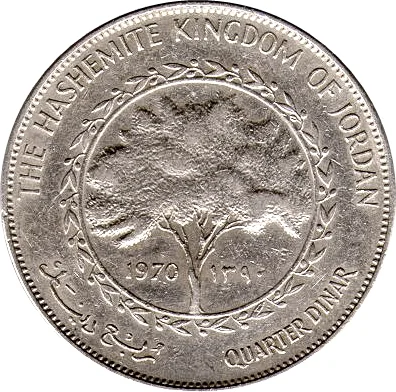
Description:
Olive tree encircled by leaves and fruit. *Olea europaea*.
Inscription:
THE HASHEMITE KINGDOM OF JORDAN
1970 ١٣٩٠
ربع دينار QUARTER DINAR
1970 ١٣٩٠
ربع دينار QUARTER DINAR
Translation:
The Hashemite Kingdom of Jordan
1970 1390
Quarter Dinar Quarter Dinar
1970 1390
Quarter Dinar Quarter Dinar
Engraver: Michael Rizzello
Edge
Milled
Categories
| Person> Monarch |
| Mustache/Beard |
| Plant> Tree |
Mints
| Name | Mark |
|---|---|
| Royal Mint | — |
Mintings
| Year | Mint Mark | Mintage | Quality | Collection |
|---|---|---|---|---|
| 1970 | — | 500,000 | ||
| 1974 | — | 400,000 | ||
| 1975 | — | 100,000 |
Historical background
In 1970, Jordan's currency situation was intrinsically linked to the nation's profound political and economic turmoil. The country was grappling with the aftermath of the 1967 Arab-Israeli War, which had resulted in the loss of the West Bank—a significant economic and agricultural region—and an influx of hundreds of thousands of Palestinian refugees. This placed immense strain on the state's resources and budget. Furthermore, the Jordanian dinar (JD), which was pegged to the British pound sterling, faced indirect pressure from the sterling's own devaluation in 1967, affecting the stability and purchasing power of the currency in a time of national crisis.
The primary economic challenge of the year, however, was not a formal currency devaluation but a severe fiscal and monetary crisis precipitated by the conflict between the Jordanian government and Palestinian fedayeen factions, culminating in the events of "Black September." The intense civil war disrupted trade, crippled key sectors like tourism, and led to a massive flight of private capital from the country. This internal conflict effectively paralyzed the economy, creating a liquidity crunch and threatening the dinar's stability as confidence in the state's immediate future wavered.
Despite these extreme pressures, the Hashemite monarchy, under King Hussein, maintained the official peg and avoided a currency collapse. This was achieved through critical financial support from allied Arab states, particularly Saudi Arabia and Kuwait, which provided emergency aid to shore up the central bank's reserves and the government's budget following the September war. Consequently, while the Jordanian dinar's economic foundation was severely tested in 1970, its formal exchange rate was preserved through political lifelines, setting the stage for a period of difficult stabilization and recovery in the following years.
The primary economic challenge of the year, however, was not a formal currency devaluation but a severe fiscal and monetary crisis precipitated by the conflict between the Jordanian government and Palestinian fedayeen factions, culminating in the events of "Black September." The intense civil war disrupted trade, crippled key sectors like tourism, and led to a massive flight of private capital from the country. This internal conflict effectively paralyzed the economy, creating a liquidity crunch and threatening the dinar's stability as confidence in the state's immediate future wavered.
Despite these extreme pressures, the Hashemite monarchy, under King Hussein, maintained the official peg and avoided a currency collapse. This was achieved through critical financial support from allied Arab states, particularly Saudi Arabia and Kuwait, which provided emergency aid to shore up the central bank's reserves and the government's budget following the September war. Consequently, while the Jordanian dinar's economic foundation was severely tested in 1970, its formal exchange rate was preserved through political lifelines, setting the stage for a period of difficult stabilization and recovery in the following years.
🌱 Fairly Common