

50 pence – United Kingdom
Add to wishlist
United Kingdom
Context
Year: 1997
Issuer: United Kingdom
Ruler: Elizabeth II
Currency:
(since 1971)
Total mintage: 456,554,398
Material
Diameter: 27.3 mm
Weight: 8 g
Thickness: 1.78 mm
Shape: Equilateral curve heptagon
Composition: Copper-nickel
Technique: Milled
Alignment: Medal alignment
flip
References
KM: #
Numista: #20700
Value
Exchange value: 0.50 GBP
Inflation-adjusted value: 1.20 GBP
Obverse
Description:
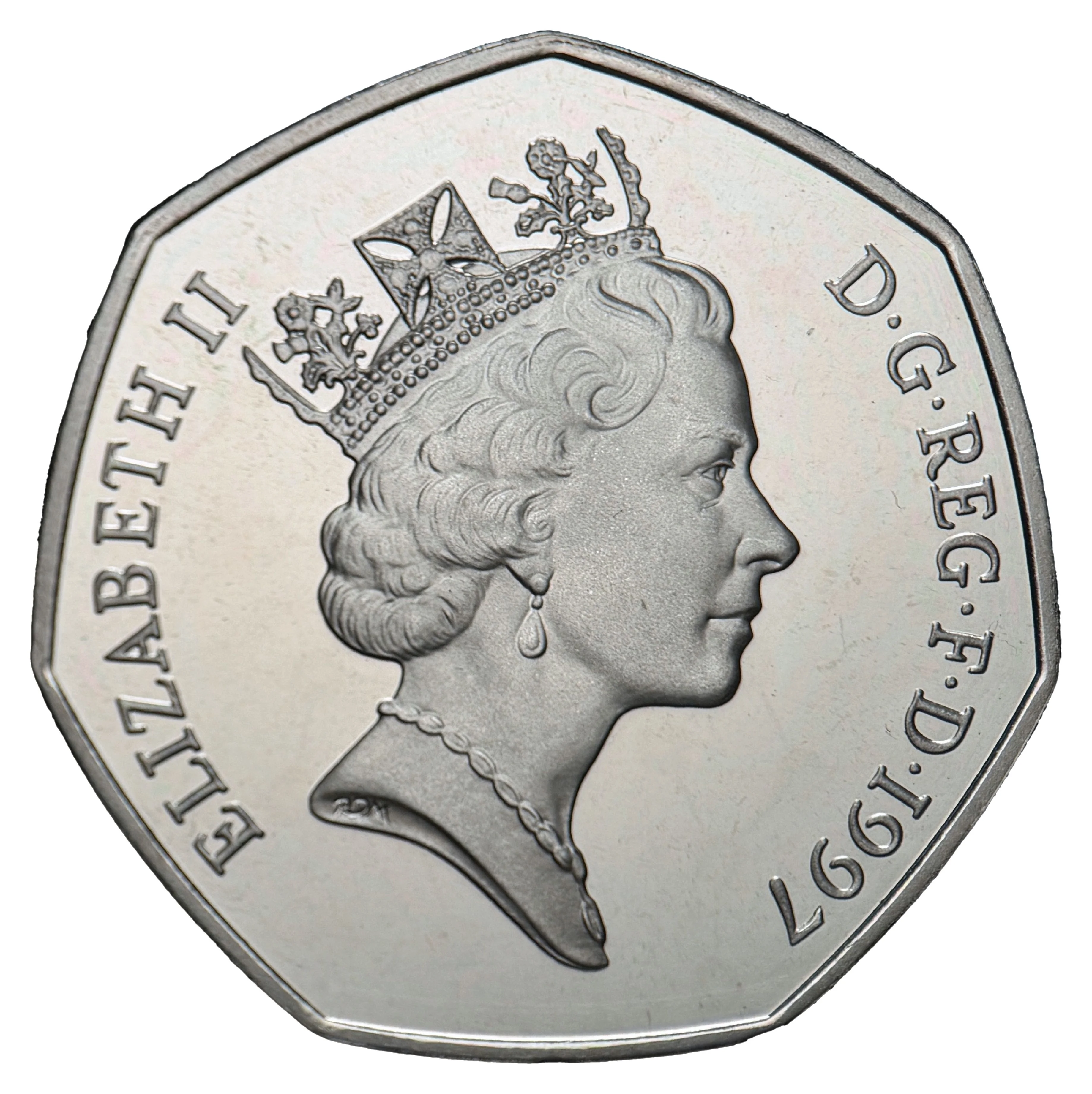
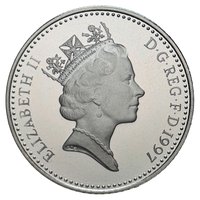
Third crowned portrait of Queen Elizabeth II facing right, wearing the George IV State Diadem.
Inscription:
ELIZABETH II D·G·REG·F·D·1997
RDM
RDM
Translation:
Elizabeth II, by the Grace of God, Queen, Defender of the Faith, 1997
Script: Latin
Language: Latin
Engraver: Raphael David Maklouf
Reverse
Description:
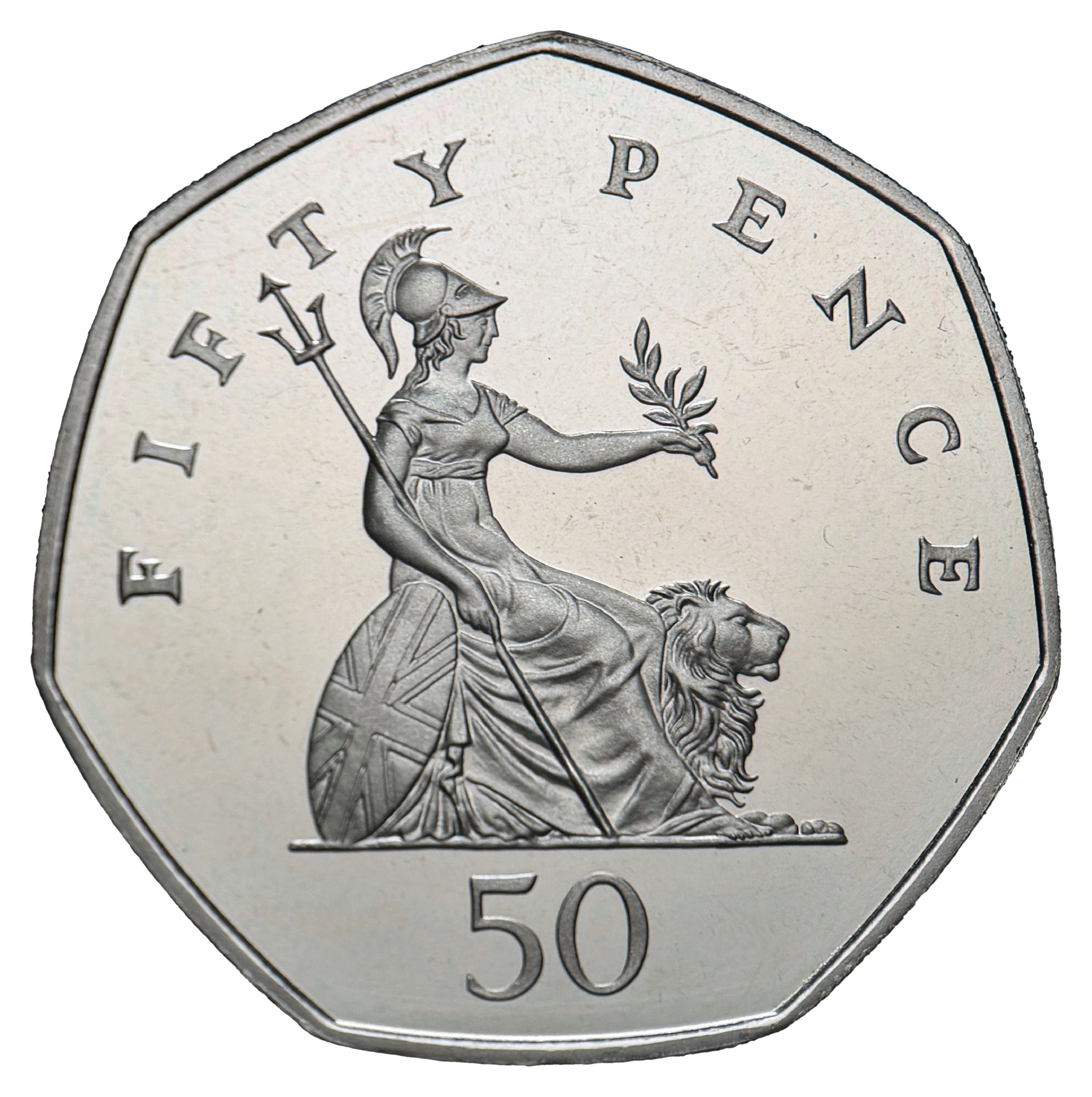
Britannia seated beside a lion, holding a trident and olive branch, with a shield at her side. Denomination below, legend above.
Inscription:
FIFTY PENCE
50
50
Script: Latin
Engraver: Christopher Ironside
Edge
Plain
Mints
| Name | Mark |
|---|---|
| Royal Mint | — |
Mintings
| Year | Mint Mark | Mintage | Quality | Collection |
|---|---|---|---|---|
| 1997 | — | 456,364,100 | ||
| 1997 | — | 109,550 | BU | |
| 1997 | — | 80,748 | Proof |
Historical background
In 1997, the United Kingdom's currency situation was dominated by the legacy of the Exchange Rate Mechanism (ERM) crisis of September 1992, when sterling was forced to withdraw and devalue. This event, known as "Black Wednesday," had a profound psychological impact, fostering a deep political aversion to fixed exchange rates and early membership in the European single currency, the euro. The newly elected Labour government, under Chancellor Gordon Brown, inherited a policy of a "strong pound" rhetoric from the outgoing Conservatives, but the memory of the ERM collapse cast a long shadow over any debate about surrendering monetary sovereignty.
Upon taking office, Chancellor Brown moved swiftly to redefine the framework. In one of his first major acts, he granted operational independence to the Bank of England in May 1997, removing the government's direct control over interest rates. This was a seminal reform designed to depoliticise monetary policy and target inflation explicitly, marking a decisive shift away from exchange rate targeting. The pound, now floating freely, was subject to market forces, and its value became a secondary concern to domestic price stability.
Concurrently, the government faced the looming question of European Economic and Monetary Union (EMU). In October 1997, Brown outlined the famous "five economic tests" that would need to be met before the UK could consider joining the euro. This effectively placed the decision on indefinite hold, creating a durable policy of "prepare and decide" rather than "wait and see." Consequently, 1997 ended with a clear new orthodoxy: an independent Bank of England managing a floating pound, and the prospect of euro membership deferred to a distant and uncertain future.
Upon taking office, Chancellor Brown moved swiftly to redefine the framework. In one of his first major acts, he granted operational independence to the Bank of England in May 1997, removing the government's direct control over interest rates. This was a seminal reform designed to depoliticise monetary policy and target inflation explicitly, marking a decisive shift away from exchange rate targeting. The pound, now floating freely, was subject to market forces, and its value became a secondary concern to domestic price stability.
Concurrently, the government faced the looming question of European Economic and Monetary Union (EMU). In October 1997, Brown outlined the famous "five economic tests" that would need to be met before the UK could consider joining the euro. This effectively placed the decision on indefinite hold, creating a durable policy of "prepare and decide" rather than "wait and see." Consequently, 1997 ended with a clear new orthodoxy: an independent Bank of England managing a floating pound, and the prospect of euro membership deferred to a distant and uncertain future.
🌱 Very Common