

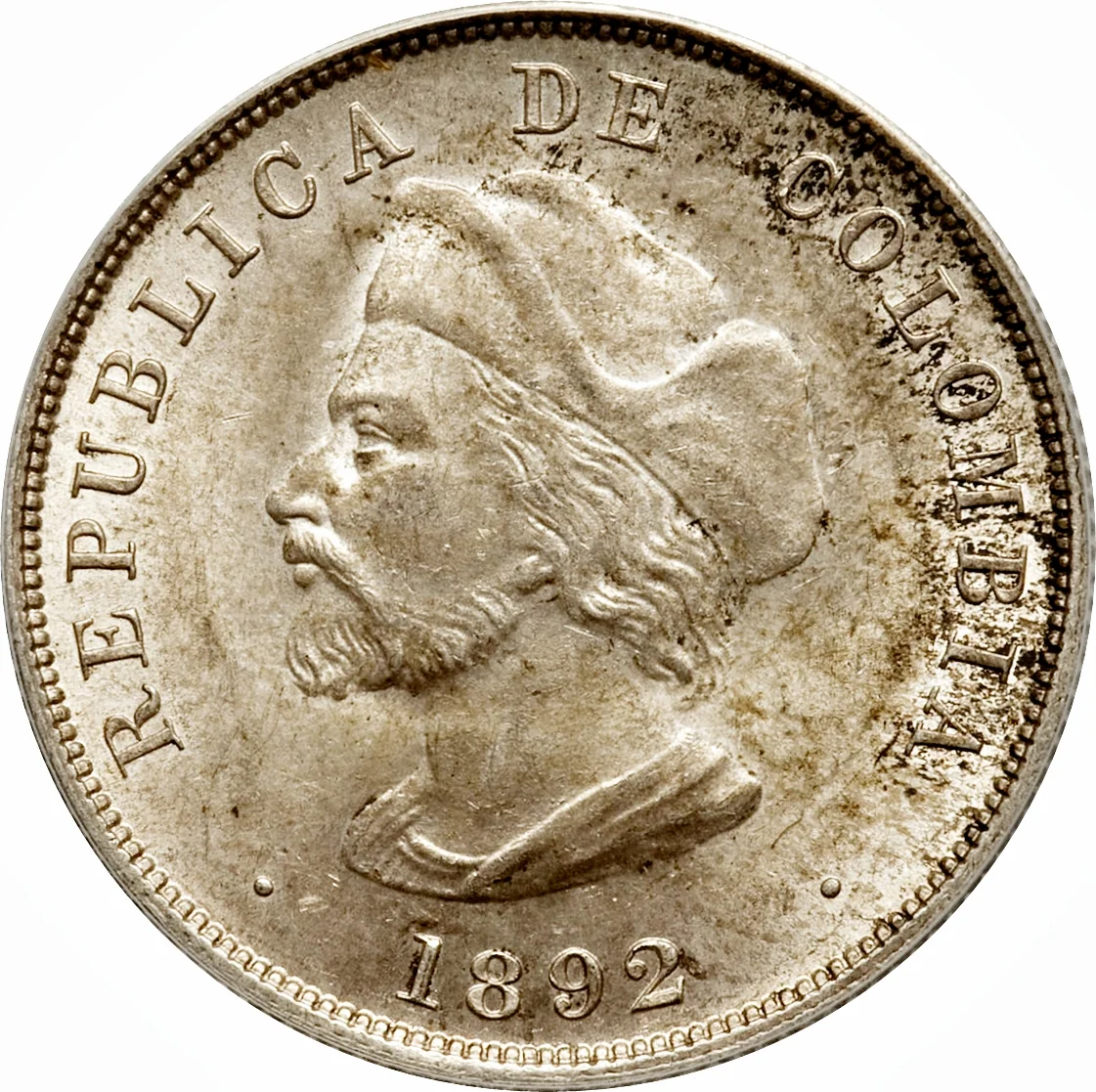
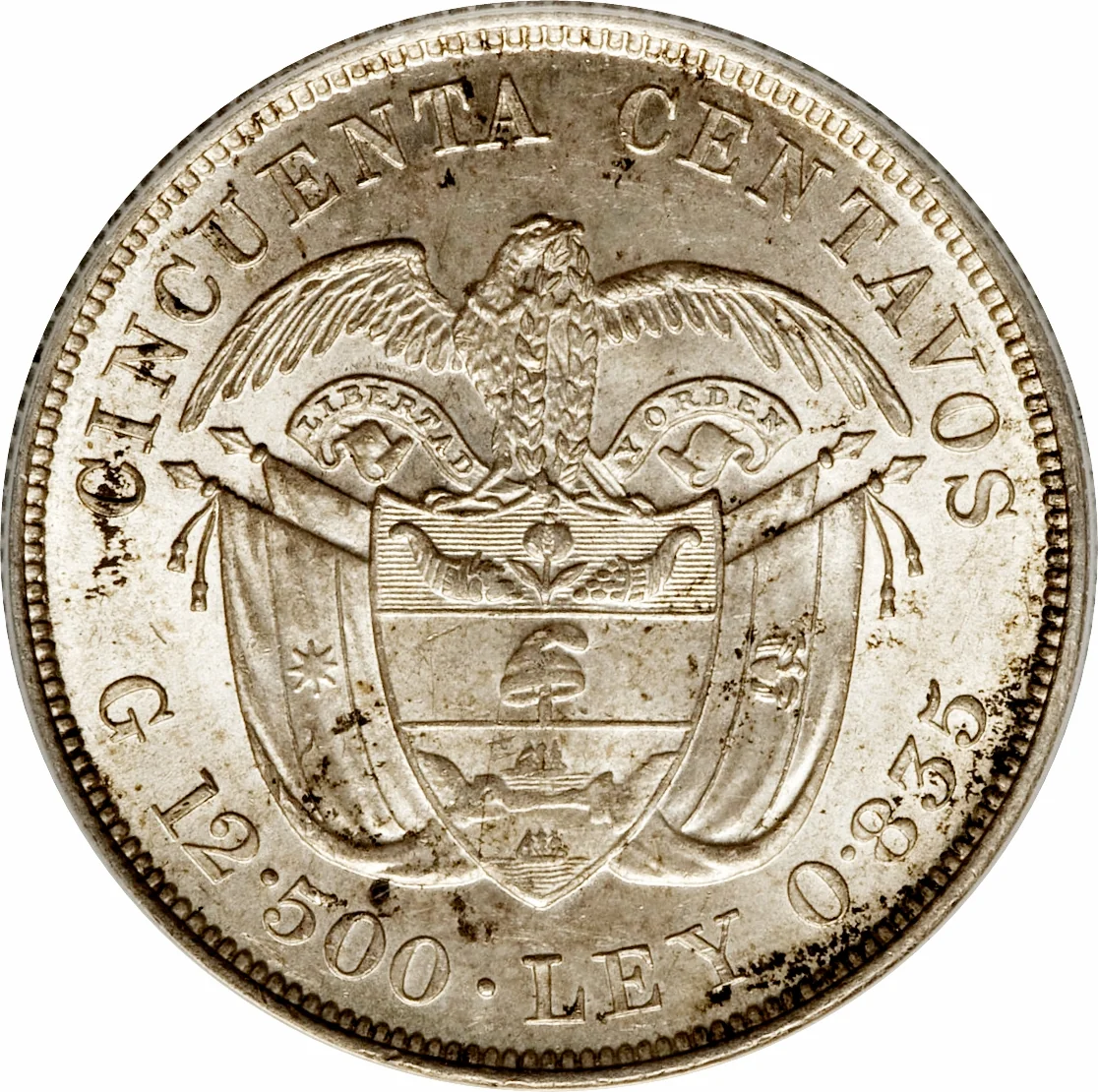
50 centavos (Columbus' Discovery of America) – Colombia
Add to wishlist
Circulating commemorative coins
Commemoration: 400th Anniversary of Columbus' Discovery of America
Colombia
Obverse
Reverse
Description:
Condor over flagged arms, encircled by value, weight, and silver fineness.
Inscription:
CINCUENTA CENTAVOS
LIBERTAD Y ORDEN
G 12·500 · LEY 0·835
LIBERTAD Y ORDEN
G 12·500 · LEY 0·835
Script: Latin
Edge
Reeded
Categories
| Symbols> Coat of Arms |
| Person> Explorer |
Mintings
| Year | Mint Mark | Mintage | Quality | Collection |
|---|---|---|---|---|
| 1892 | — | 4,826,000 | ||
| 1892 | — | 3 | Proof |
Historical background
In 1892, Colombia was operating under a complex and unstable monetary system, a direct legacy of its 19th-century political fragmentation. Following independence, the nation had struggled to establish a unified currency, leading to a circulation of diverse coins from the colonial era, neighboring countries, and private bank issues. The most significant attempt at reform came with the 1880 Monetary Law, which sought to place Colombia on the gold standard with the peso oro as the official unit. However, the political and economic chaos of the 1880s, including the devastating Thousand Days' War (1899–1902) which was brewing, prevented the full implementation of this system.
Consequently, the everyday economy in 1892 relied heavily on silver and paper money. The peso plata (silver peso) and its fractional coins were the common media of exchange, but their value fluctuated against the theoretical gold standard. Furthermore, numerous private banks, authorized by the government, issued their own paper banknotes with varying degrees of convertibility and reliability. This resulted in a lack of uniform national currency, where the value and acceptance of money could differ significantly from one region to another, hindering domestic trade and creating confusion.
The situation was further strained by severe fiscal deficits and a heavy reliance on coffee exports for foreign exchange. The government's chronic shortage of hard currency (gold) made it impossible to sustain the gold standard in practice, leading to periods of de facto silver standard and inflation. Thus, in 1892, Colombia's currency landscape was characterized by a disjointed mix of unredeemable paper, fractional silver, and an unattainable gold ideal—a fragile system that would be pushed into crisis by the civil war that erupted at the decade's end.
Consequently, the everyday economy in 1892 relied heavily on silver and paper money. The peso plata (silver peso) and its fractional coins were the common media of exchange, but their value fluctuated against the theoretical gold standard. Furthermore, numerous private banks, authorized by the government, issued their own paper banknotes with varying degrees of convertibility and reliability. This resulted in a lack of uniform national currency, where the value and acceptance of money could differ significantly from one region to another, hindering domestic trade and creating confusion.
The situation was further strained by severe fiscal deficits and a heavy reliance on coffee exports for foreign exchange. The government's chronic shortage of hard currency (gold) made it impossible to sustain the gold standard in practice, leading to periods of de facto silver standard and inflation. Thus, in 1892, Colombia's currency landscape was characterized by a disjointed mix of unredeemable paper, fractional silver, and an unattainable gold ideal—a fragile system that would be pushed into crisis by the civil war that erupted at the decade's end.
🌟 Limited