

½ New Sheqel – Israel
Circulating commemorative coins
Commemoration: Edmond de Rothschild
Israel
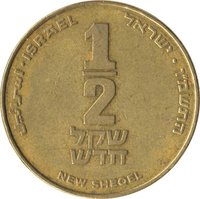
Obverse
Description:
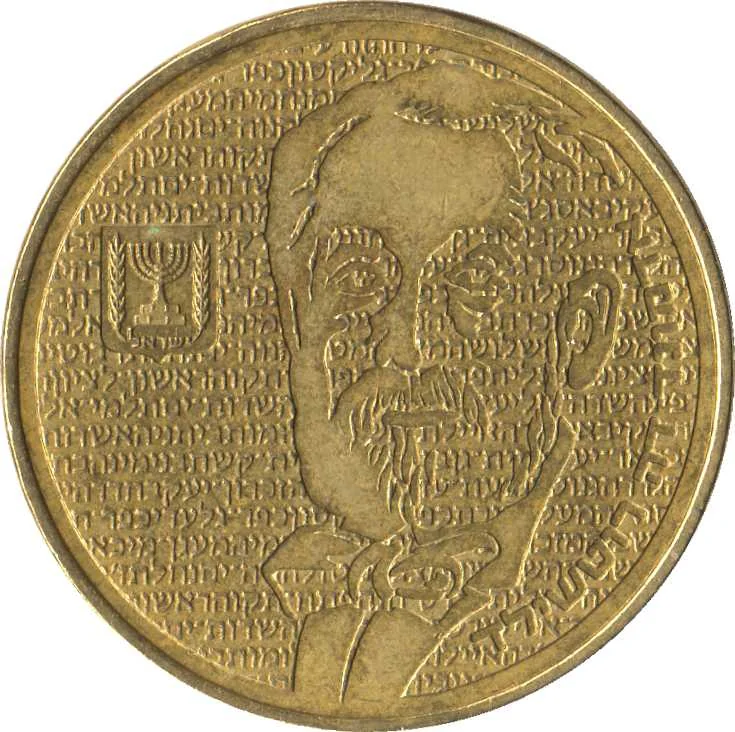
Baron Edmond de Rothschild overlaid with the names of 44 Israeli settlements.
Inscription:
אדמונד דה רוטשילד
Translation:
Edmond de Rothschild
Script: Hebrew
Language: Hebrew
Engraver: Gabi Neumann
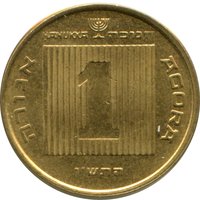
Reverse
Edge
Plain
Mints
| Name | Mark |
|---|---|
| Royal Dutch Mint | — |
Mintings
| Year | Mint Mark | Mintage | Quality | Collection |
|---|---|---|---|---|
| 1986 | — | 2,000,000 |
Historical background
By the mid-1980s, Israel's economy was in a state of profound crisis, characterized by hyperinflation that had spiraled out of control, peaking at an annual rate of nearly 450% in 1984. This "inflationary whirlwind" was the result of decades of deep structural issues: massive government deficits used to fund extensive social programs, a large defense budget, and settlements, coupled with a heavily indexed economy where wages and prices were automatically linked to the cost-of-living index. This indexing created a vicious cycle, embedding inflation into the very fabric of economic life and eroding public confidence in the Israeli shekel, which had been repeatedly devalued and redenominated.
The situation reached a breaking point, compelling the national unity government of Shimon Peres to implement a radical and risky stabilization plan on July 1, 1985. Known simply as the Economic Stabilization Plan, it was a "shock therapy" program designed in collaboration with prominent American economists. Its key measures included a sharp, one-time devaluation of the shekel followed by a fixed exchange rate peg to the U.S. dollar, deep cuts to government subsidies and spending, a temporary freeze on wages and prices, and a severe tightening of monetary policy. Crucially, the plan was backed by a significant $1.5 billion emergency aid package from the United States.
The 1985 plan was a decisive turning point. It succeeded in abruptly halting hyperinflation, bringing the annual rate down to 20% within a year and restoring basic stability. However, the victory came at a significant short-term cost, including a recession and a spike in unemployment. The legacy of the 1986 currency situation, therefore, is one of a painful but necessary correction that ended an era of economic chaos. It established greater fiscal discipline and shifted Israel toward a more market-oriented economy, laying the essential groundwork for the high-tech boom and sustained growth that would follow in the 1990s and beyond.
The situation reached a breaking point, compelling the national unity government of Shimon Peres to implement a radical and risky stabilization plan on July 1, 1985. Known simply as the Economic Stabilization Plan, it was a "shock therapy" program designed in collaboration with prominent American economists. Its key measures included a sharp, one-time devaluation of the shekel followed by a fixed exchange rate peg to the U.S. dollar, deep cuts to government subsidies and spending, a temporary freeze on wages and prices, and a severe tightening of monetary policy. Crucially, the plan was backed by a significant $1.5 billion emergency aid package from the United States.
The 1985 plan was a decisive turning point. It succeeded in abruptly halting hyperinflation, bringing the annual rate down to 20% within a year and restoring basic stability. However, the victory came at a significant short-term cost, including a recession and a spike in unemployment. The legacy of the 1986 currency situation, therefore, is one of a painful but necessary correction that ended an era of economic chaos. It established greater fiscal discipline and shifted Israel toward a more market-oriented economy, laying the essential groundwork for the high-tech boom and sustained growth that would follow in the 1990s and beyond.
🌱 Common