

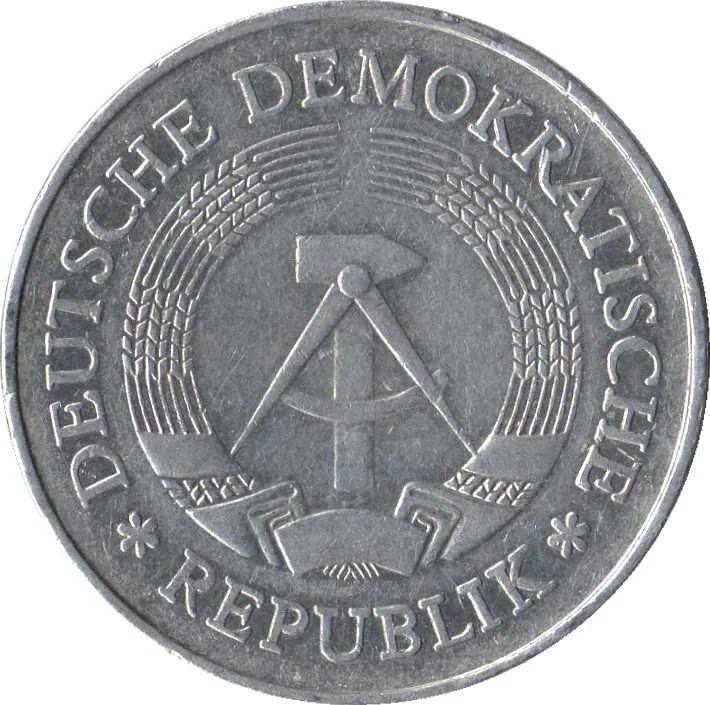
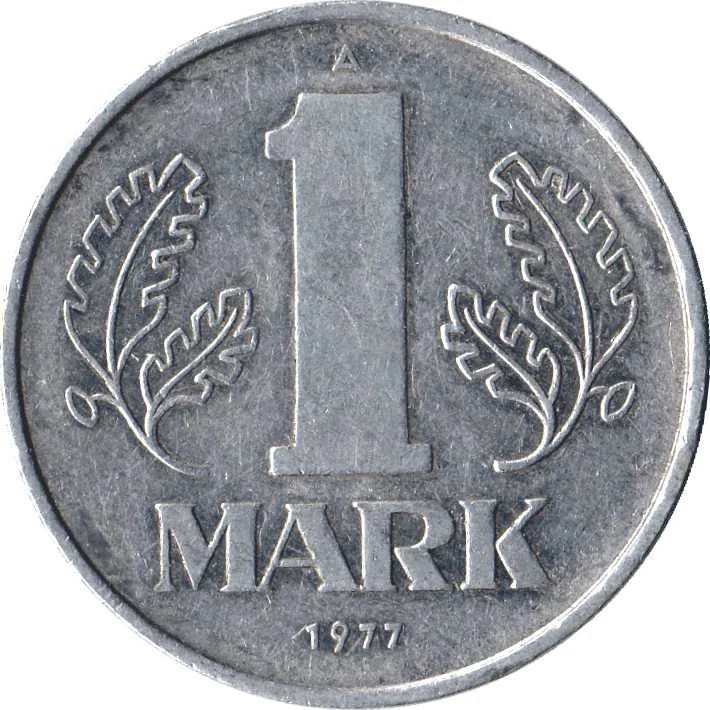
1 mark – German Democratic Republic
Add to wishlist
Germany
Context
Years: 1972–1990
Country: Germany
Issuer: German Democratic Republic
Period:
(1949—1990)
Currency:
(1948—1990)
Demonetization: 30 June 1990
Total mintage: 265,989,616
Material
References
KM: #
Numista: #2031
Value
Exchange value: 1 DDM
Inflation-adjusted value: 4.11 DDM
Obverse
Reverse
Description:
Face value and oak leaves, mintmark above.
Inscription:
A
1
MARK
1977
1
MARK
1977
Script: Latin
Engraver: Rudi Högner
Edge
Smooth with imprints (13 six-rays stars).
Mints
| Name | Mark |
|---|---|
| Berlin | A |
Mintings
| Year | Mint Mark | Mintage | Quality | Collection |
|---|---|---|---|---|
| 1972 | A | 30,288,415 | ||
| 1973 | A | 6,971,786 | ||
| 1975 | A | 32,093,900 | ||
| 1977 | A | 119,813,200 | ||
| 1978 | A | 18,823,650 | ||
| 1979 | A | 1,002,999 | ||
| 1979 | A | — | Proof | |
| 1980 | A | 1,069,000 | ||
| 1980 | A | — | Proof | |
| 1981 | A | 1,006,000 | ||
| 1981 | A | 40 | Proof | |
| 1982 | A | 51,619,000 | ||
| 1982 | A | 2,500 | Proof | |
| 1983 | A | 1,065,000 | ||
| 1983 | A | 2,550 | Proof | |
| 1984 | A | 5,000 | ||
| 1984 | A | 3,015 | Proof | |
| 1985 | A | 1,128,000 | ||
| 1985 | A | 2,816 | Proof | |
| 1986 | A | 1,000,000 | ||
| 1986 | A | 2,800 | Proof | |
| 1987 | A | 21,000 | In sets | |
| 1987 | A | 2,345 | Proof | |
| 1988 | A | 15,000 | In sets | |
| 1988 | A | 2,300 | Proof | |
| 1989 | A | 33,000 | ||
| 1989 | A | 2,300 | Proof | |
| 1990 | A | 14,000 | In sets |
Historical background
In 1972, the currency situation in the German Democratic Republic (GDR) was defined by the rigid separation of its economic system from that of West Germany and the wider capitalist world. The official currency was the GDR Mark (Mark der DDR), often colloquially called the "Ostmark." Its value was strictly controlled by the state and was not freely convertible on international markets. Internally, it functioned as the sole legal tender for all transactions within the planned economy, but its exchange rate was artificially set and did not reflect real purchasing power or economic performance.
A critical feature of this system was the existence of a separate, privileged currency for use by foreigners and in special shops. The Forum Check was an instrument used in the Intershops, which sold high-quality imported and scarce goods. These could only be purchased with hard currencies like the Deutsche Mark (DM) or, later, with Forum Checks bought using such hard currency. This created a two-tier economy where average citizens, paid in non-convertible Ostmarks, were excluded from access to a range of consumer goods, while those with access to Western currency enjoyed a higher standard of living. This practice drained hard currency from the population but was a vital source of foreign exchange for the state.
The year 1972 fell within a period of relative economic stabilization under Honecker's "Unity of Economic and Social Policy," which aimed to improve consumer supply and social benefits. However, the fundamental currency contradictions remained. The economic gap with West Germany was widening, and the state's need for hard currency intensified. The policy of "Abgrenzung" (demarcation) sought to insulate the GDR economically, but the allure of the Deutsche Mark and Western goods continued to undermine the legitimacy of the Ostmark, foreshadowing the persistent economic weaknesses that would plague the GDR until its end.
A critical feature of this system was the existence of a separate, privileged currency for use by foreigners and in special shops. The Forum Check was an instrument used in the Intershops, which sold high-quality imported and scarce goods. These could only be purchased with hard currencies like the Deutsche Mark (DM) or, later, with Forum Checks bought using such hard currency. This created a two-tier economy where average citizens, paid in non-convertible Ostmarks, were excluded from access to a range of consumer goods, while those with access to Western currency enjoyed a higher standard of living. This practice drained hard currency from the population but was a vital source of foreign exchange for the state.
The year 1972 fell within a period of relative economic stabilization under Honecker's "Unity of Economic and Social Policy," which aimed to improve consumer supply and social benefits. However, the fundamental currency contradictions remained. The economic gap with West Germany was widening, and the state's need for hard currency intensified. The policy of "Abgrenzung" (demarcation) sought to insulate the GDR economically, but the allure of the Deutsche Mark and Western goods continued to undermine the legitimacy of the Ostmark, foreshadowing the persistent economic weaknesses that would plague the GDR until its end.
🌱 Very Common