

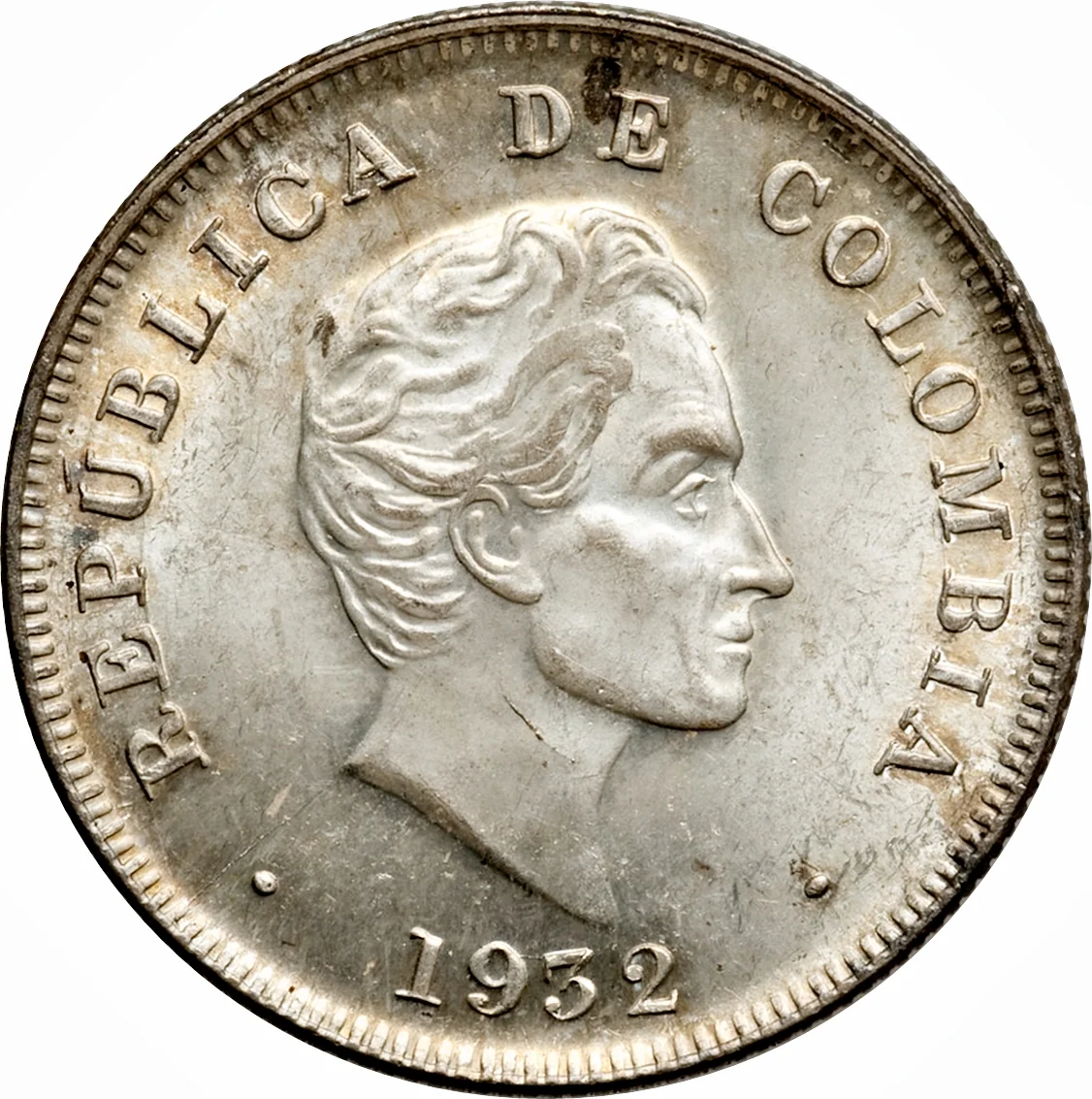
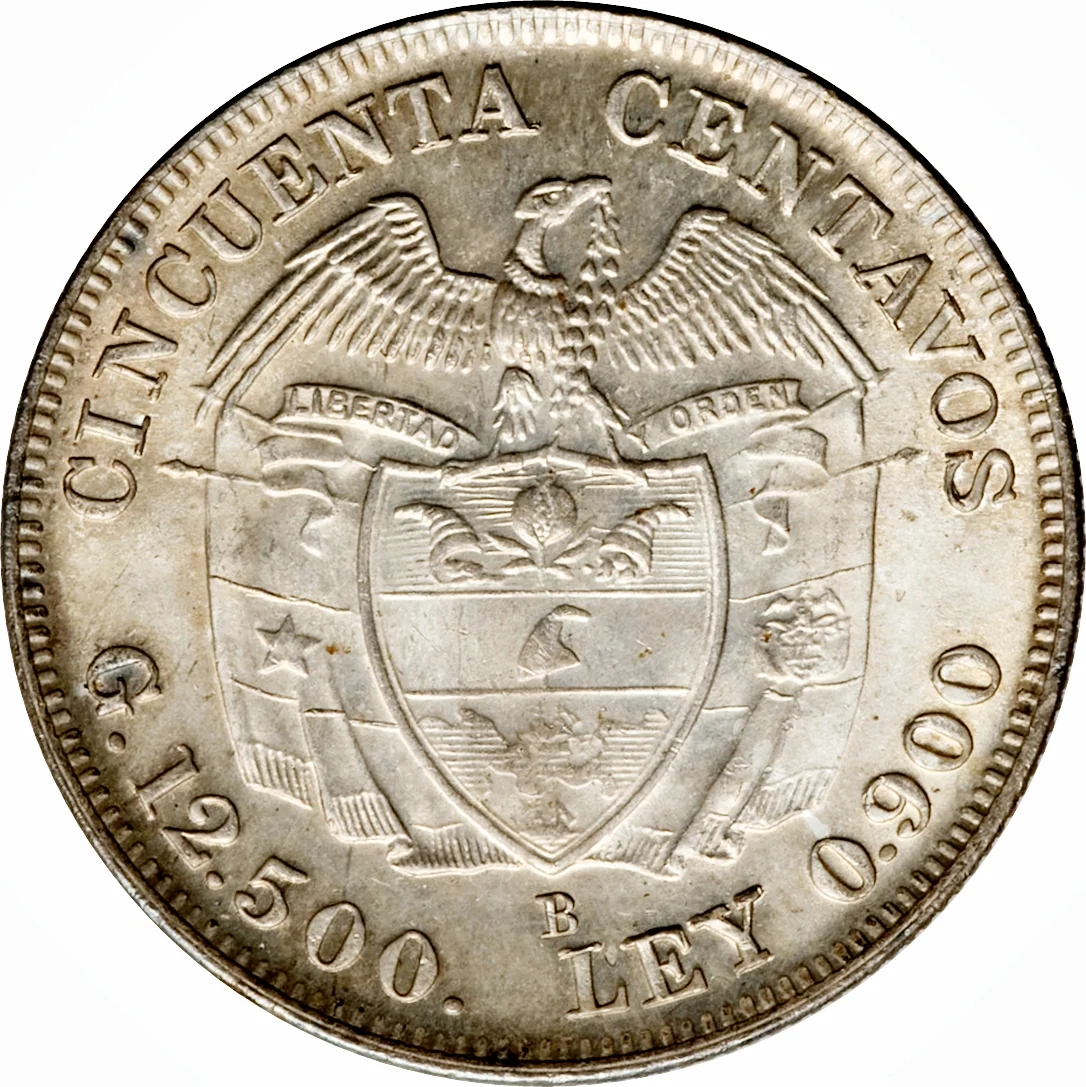
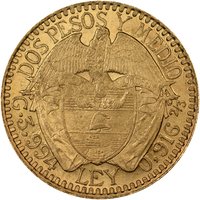
50 Centavos – Colombia
Colombia
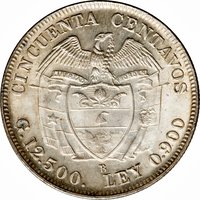
Obverse
Reverse
Edge
Reeded
Categories
| Symbols> Coat of Arms |
| Symbol> Cornucopia |
| Symbol> Phrygian cap |
| Animal> Bird |
| Person> Military leader |
| Person> Politician |
Mints
| Name | Mark |
|---|---|
| Bogota Mint | — |
| Casa de Moneda de Colombia | — |
| Heaton and Sons / The Mint Birmingham | — |
| Bogota Mint | (B) |
| Heaton and Sons / The Mint Birmingham | B |
| Casa de Moneda de Colombia | M |
Mintings
Historical background
In 1912, Colombia’s currency system was in a state of transition and instability, emerging from the profound economic and political disruptions of the Thousand Days' War (1899-1902). The war had been catastrophically expensive, financed largely by the unrestrained printing of paper money (papel moneda) by both conservative and liberal factions. This resulted in hyperinflation, the collapse of the paper peso's value, and a widespread loss of public confidence in the national currency. By the war's end, the country was left with a fragmented monetary system where precious metal coins, when used, traded at a significant premium over vastly depreciated paper notes.
The government of President Rafael Reyes (1904-1909) initiated a painful stabilization process, culminating in the Law of Monetary Reform (Law 33 of 1905). This law aimed to restore the gold standard and retire the inflationary paper money by establishing a conversion rate of 100 paper pesos to 1 new "gold peso." The process, managed by the newly created Banco Central de Colombia, was protracted and socially painful, effectively wiping out savings denominated in the old currency. By 1912, under the presidency of Carlos Eugenio Restrepo, the monetary reform was largely complete in a technical sense, with the gold peso (peso colombiano) as the official unit. However, the economy was still grappling with the aftermath.
Consequently, in 1912, the currency situation was characterized by a fragile stability. The gold standard was formally in place, but the money supply was constrained, and the economy was still under-monetized. Economic activity, particularly the crucial coffee export sector, relied heavily on foreign exchange (especially British pounds and U.S. dollars) and gold itself for major transactions. While the worst inflation was over, the memory of monetary chaos was fresh, and the financial system remained underdeveloped. The period was one of cautious consolidation, laying a shaky foundation for growth in a country still deeply scarred by civil war and its monetary consequences.
The government of President Rafael Reyes (1904-1909) initiated a painful stabilization process, culminating in the Law of Monetary Reform (Law 33 of 1905). This law aimed to restore the gold standard and retire the inflationary paper money by establishing a conversion rate of 100 paper pesos to 1 new "gold peso." The process, managed by the newly created Banco Central de Colombia, was protracted and socially painful, effectively wiping out savings denominated in the old currency. By 1912, under the presidency of Carlos Eugenio Restrepo, the monetary reform was largely complete in a technical sense, with the gold peso (peso colombiano) as the official unit. However, the economy was still grappling with the aftermath.
Consequently, in 1912, the currency situation was characterized by a fragile stability. The gold standard was formally in place, but the money supply was constrained, and the economy was still under-monetized. Economic activity, particularly the crucial coffee export sector, relied heavily on foreign exchange (especially British pounds and U.S. dollars) and gold itself for major transactions. While the worst inflation was over, the memory of monetary chaos was fresh, and the financial system remained underdeveloped. The period was one of cautious consolidation, laying a shaky foundation for growth in a country still deeply scarred by civil war and its monetary consequences.
🌱 Fairly Common