

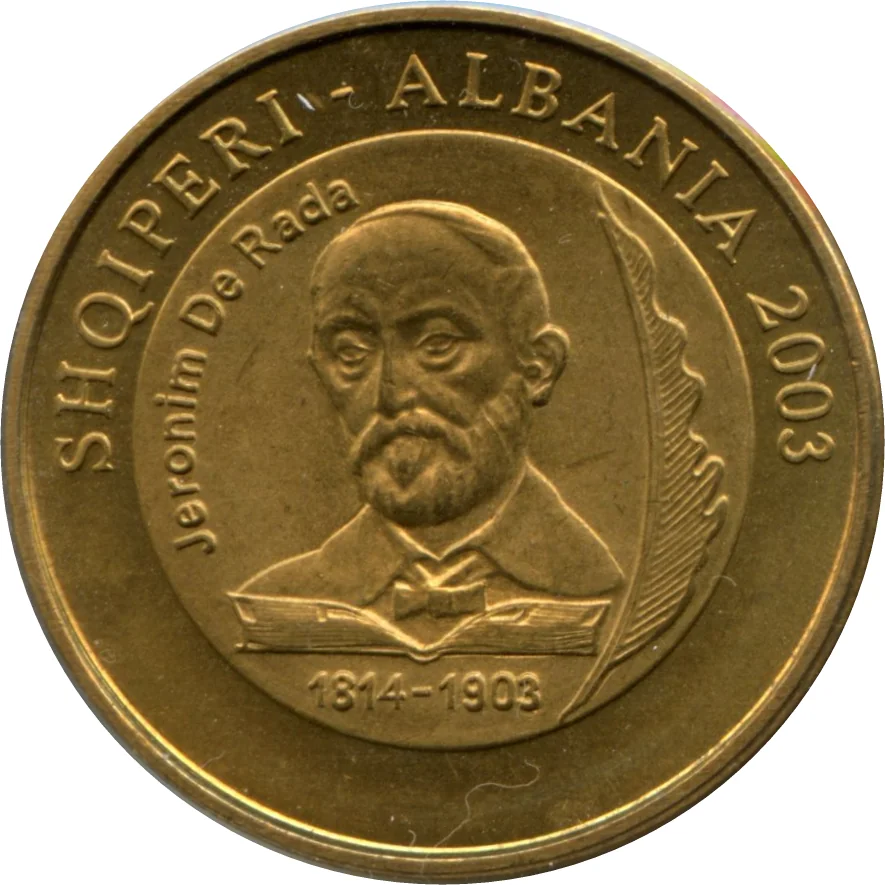
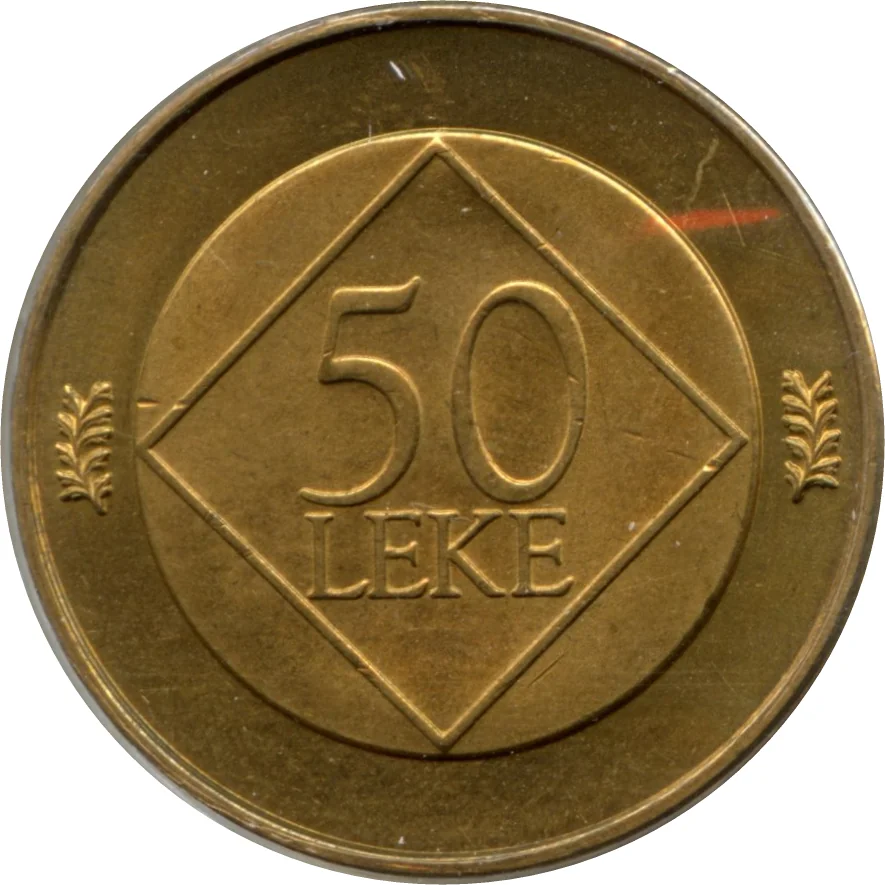
50 Lekë (Jeronim de Rada) – Albania
Non-circulating coins
Commemoration: 100th Anniversary of the Death of Jeronim de Rada
Albania

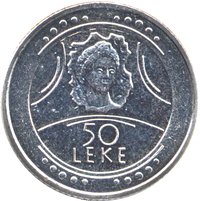
Obverse
Description:
Bust sculpture
Inscription:
SHQIPERI-ALBANIA 2003
Jeronim De Rada
1814-1903
Jeronim De Rada
1814-1903
Translation:
Albania 2003
Jeronim De Rada
1814-1903
Jeronim De Rada
1814-1903
Script: Latin
Language: Albanian
Engraver: Petraq Papa
Reverse
Edge
Plain
Categories
| Event> Death anniversary |
| Person> Artist |
Mints
| Name | Mark |
|---|---|
| Kremnica | — |
Mintings
| Year | Mint Mark | Mintage | Quality | Collection |
|---|---|---|---|---|
| 2003 | — | 20,000 |
Historical background
In 2003, Albania's currency situation was characterized by stability and gradual modernization, a significant achievement following the turmoil of the 1990s. The national currency, the lek (ALL), operated under a managed float regime, with the Bank of Albania (the central bank) intervening to smooth out excessive volatility without targeting a fixed exchange rate. This period saw low and stable inflation, which bolstered public confidence in the lek and supported a steady, though modest, appreciation against major currencies like the euro and US dollar. This stability was a cornerstone of the broader macroeconomic consolidation after the 1997 pyramid scheme crisis, which had caused hyperinflation and a collapse of the financial system.
The currency landscape was also marked by a high degree of euroization, particularly in the banking sector. While daily transactions were conducted predominantly in lek, a large portion of savings, loans, and deposits were held in euros, reflecting lingering public distrust in the domestic currency's long-term stability. This "financial euroization" presented an ongoing challenge for monetary policy, as the central bank's ability to influence credit conditions was limited for a significant segment of the economy. The Bank of Albania continued to pursue a strategy of de-euroization through maintaining price stability and developing deeper domestic financial markets.
Furthermore, 2003 was a period of technical and institutional preparation for deeper European integration. Albania was implementing structural reforms as part of its Stabilisation and Association Process with the European Union, which included strengthening the independence and regulatory capacity of the Bank of Albania. While adoption of the euro was a distant prospect, these reforms aimed to align monetary and financial frameworks with EU standards, laying the groundwork for future integration. Thus, the currency situation was one of hard-won stability, while policymakers navigated the legacy of dollarization and prepared for future challenges within a European context.
The currency landscape was also marked by a high degree of euroization, particularly in the banking sector. While daily transactions were conducted predominantly in lek, a large portion of savings, loans, and deposits were held in euros, reflecting lingering public distrust in the domestic currency's long-term stability. This "financial euroization" presented an ongoing challenge for monetary policy, as the central bank's ability to influence credit conditions was limited for a significant segment of the economy. The Bank of Albania continued to pursue a strategy of de-euroization through maintaining price stability and developing deeper domestic financial markets.
Furthermore, 2003 was a period of technical and institutional preparation for deeper European integration. Albania was implementing structural reforms as part of its Stabilisation and Association Process with the European Union, which included strengthening the independence and regulatory capacity of the Bank of Albania. While adoption of the euro was a distant prospect, these reforms aimed to align monetary and financial frameworks with EU standards, laying the groundwork for future integration. Thus, the currency situation was one of hard-won stability, while policymakers navigated the legacy of dollarization and prepared for future challenges within a European context.
🌟 Uncommon