

100 korun (Extermination of Lidice and Ležáky) – Czechoslovakia
Add to wishlist
Non-circulating coins
Commemoration: 50th Anniversary of Extermination of Villages Lidice and Ležáky
Context
Year: 1992
Issuer: Czechoslovakia
Period:
(1990—1992)
Currency:
(1953—1992)
Demonetization: 30 September 2000
Total mintage: 73,000
Material
References
KM: #
Numista: #20238
Value
Exchange value: 100 CSK
Bullion value: $22.71
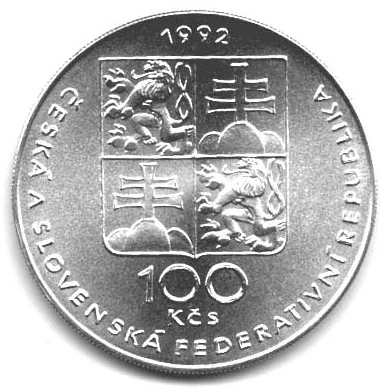
Obverse
Description:
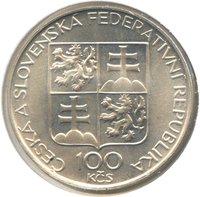
Czechoslovak federal emblem, year, value.
Inscription:
1992
ČESKÁ A SLOVENSKÁ FEDERATIVNÍ REPUBLIKA
100
Kčs
ČESKÁ A SLOVENSKÁ FEDERATIVNÍ REPUBLIKA
100
Kčs
Translation:
1992
CZECH AND SLOVAK FEDERATIVE REPUBLIC
100
Kčs
CZECH AND SLOVAK FEDERATIVE REPUBLIC
100
Kčs
Script: Latin
Engraver: Jarmila Truhlíková - Spěváková
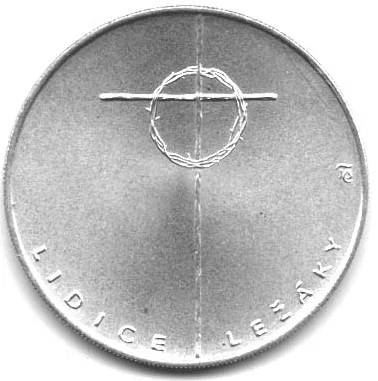
Reverse
Description:
Crucifixion, thorns.
Inscription:
LIDICE LEŽÁKY
Translation:
Lidice Ležáky
Script: Latin
Language: Czech
Engraver: Jarmila Truhlíková - Spěváková
Edge
Reeded
Mintings
| Year | Mint Mark | Mintage | Quality | Collection |
|---|---|---|---|---|
| 1992 | — | 70,000 | ||
| 1992 | — | 3,000 | Proof |
Historical background
By 1992, Czechoslovakia was navigating a complex and urgent currency crisis precipitated by the impending "Velvet Divorce." Following the June 1992 elections, political consensus had collapsed, with the Czech and Slovak political leaderships agreeing to dissolve the federation by the end of the year. A critical and immediate challenge was determining the fate of the common state currency, the Czechoslovak koruna (Kčs). Slovakia, facing higher unemployment and a less competitive industrial base, favored a looser monetary union or a gradual introduction of separate currencies to cushion its economy. The Czech side, led by Finance Minister Václav Klaus, insisted on a swift and clean split into two distinct currencies to prevent Slovak fiscal policy from undermining Czech economic stability.
The technical and political negotiations were intense. Initially, a short-lived monetary union was considered but quickly rejected due to the Czech fear of being forced to bankroll Slovak deficits and the lack of a common central bank to enforce discipline. Consequently, it was decided that the federation would formally end at midnight on December 31, 1992, and two new currencies would be created. In a remarkable logistical feat, over the first week of January 1993, the old Czechoslovak banknotes were physically stamped in each republic—with Czech and Slovak stickers respectively—to serve as temporary currencies, while new Czech koruna (CZK) and Slovak koruna (SKK) banknotes and coins were printed and minted in secrecy.
The actual separation was executed with impressive technical efficiency, avoiding panic or major disruption. However, the economic background was starkly different for the two nascent states. The Czech Republic entered the split with lower inflation, a more balanced budget, and a stronger industrial export sector, allowing its new currency to stabilize quickly. Slovakia, conversely, began its independence with the challenges it had feared: higher inflation, a larger budget deficit, and immediate pressure on its new currency, which devalued shortly after introduction. Thus, the currency situation of 1992 was not merely a technical divorce but a fundamental economic divergence, setting the two nations on distinctly different paths for their first decade of independence.
The technical and political negotiations were intense. Initially, a short-lived monetary union was considered but quickly rejected due to the Czech fear of being forced to bankroll Slovak deficits and the lack of a common central bank to enforce discipline. Consequently, it was decided that the federation would formally end at midnight on December 31, 1992, and two new currencies would be created. In a remarkable logistical feat, over the first week of January 1993, the old Czechoslovak banknotes were physically stamped in each republic—with Czech and Slovak stickers respectively—to serve as temporary currencies, while new Czech koruna (CZK) and Slovak koruna (SKK) banknotes and coins were printed and minted in secrecy.
The actual separation was executed with impressive technical efficiency, avoiding panic or major disruption. However, the economic background was starkly different for the two nascent states. The Czech Republic entered the split with lower inflation, a more balanced budget, and a stronger industrial export sector, allowing its new currency to stabilize quickly. Slovakia, conversely, began its independence with the challenges it had feared: higher inflation, a larger budget deficit, and immediate pressure on its new currency, which devalued shortly after introduction. Thus, the currency situation of 1992 was not merely a technical divorce but a fundamental economic divergence, setting the two nations on distinctly different paths for their first decade of independence.
🌟 Limited