

10 euro – Estonia
Add to wishlist
Non-circulating coins
Commemoration: In celebration of the changeover to the Euro
Estonia
Context
Year: 2011
Issuer: Estonia
Issuing organization: Bank of Estonia
Period:
(since 1991)
Currency:
(since 2011)
Total mintage: 30,000
Material
References
KM: #
Numista: #20124
Value
Exchange value: 10 EUR
Bullion value: $73.01
Inflation-adjusted value: 17.46 EUR
Obverse
Reverse
Description:
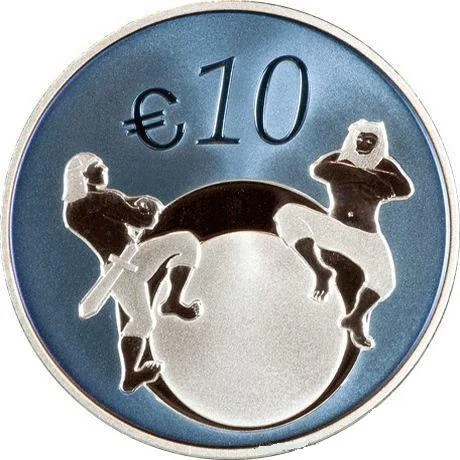
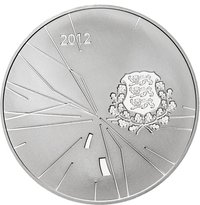
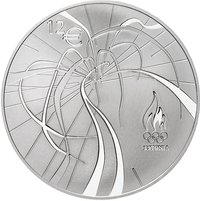
Kalevipoeg and Vanapagan dance the folk dance Kaerajaan against a blue Estonian sky.
Inscription:
€ 10
Script: Latin
Designer: Simson von Seakyl
Edge
Smooth with inscription
Legend:
Ag 999.9
Categories
| Art> Dance |
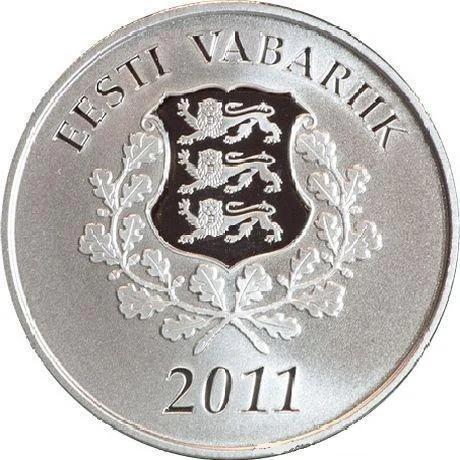
| Symbols> Coat of Arms |
| Object> Cold weapons |
Mints
| Name | Mark |
|---|---|
| Mint of Finland | — |
Mintings
| Year | Mint Mark | Mintage | Quality | Collection |
|---|---|---|---|---|
| 2011 | — | 30,000 | Proof |
Historical background
In 2011, Estonia stood out as a remarkable success story in the aftermath of the global financial crisis, having just adopted the euro on January 1st of that year. This move marked the culmination of a long-held strategic goal to deepen integration with Western Europe and secure economic stability. The adoption proceeded smoothly, with the Estonian kroon fixed at an irrevocable rate of 15.6466 krooni to one euro, a peg it had maintained since 2002 under its currency board system. This disciplined framework had provided crucial stability and was a key factor in Estonia meeting the strict Maastricht convergence criteria, even during the severe recession of 2008-2009.
The context for euro adoption was one of dramatic economic recovery. Following a sharp GDP contraction of nearly 15% in 2009, Estonia implemented stringent austerity measures and maintained its fixed exchange rate, leading to a rapid rebound. By 2011, the economy was growing again at one of the fastest rates in the European Union, public finances were in surplus, and debt levels were among the lowest in the EU. The euro was thus adopted from a position of strength, not weakness, which bolstered public and market confidence. For Estonians, the euro symbolized a definitive break from the Soviet past and a permanent anchor within the core of the European economic and political project.
Domestically, the transition was well-prepared and generally accepted, though not without some public concern about potential price increases, a phenomenon often called "euro inflation." While some rounding up of prices occurred in sectors like services, overall inflation remained manageable. The primary benefit was the immediate elimination of currency exchange costs and risks for trade and investment, a significant advantage for Estonia’s open, export-oriented economy. By the end of 2011, the euro was firmly established as Estonia’s legal tender, cementing its financial stability and enhancing its profile as a gateway for business between the eurozone and Nordic markets.
The context for euro adoption was one of dramatic economic recovery. Following a sharp GDP contraction of nearly 15% in 2009, Estonia implemented stringent austerity measures and maintained its fixed exchange rate, leading to a rapid rebound. By 2011, the economy was growing again at one of the fastest rates in the European Union, public finances were in surplus, and debt levels were among the lowest in the EU. The euro was thus adopted from a position of strength, not weakness, which bolstered public and market confidence. For Estonians, the euro symbolized a definitive break from the Soviet past and a permanent anchor within the core of the European economic and political project.
Domestically, the transition was well-prepared and generally accepted, though not without some public concern about potential price increases, a phenomenon often called "euro inflation." While some rounding up of prices occurred in sectors like services, overall inflation remained manageable. The primary benefit was the immediate elimination of currency exchange costs and risks for trade and investment, a significant advantage for Estonia’s open, export-oriented economy. By the end of 2011, the euro was firmly established as Estonia’s legal tender, cementing its financial stability and enhancing its profile as a gateway for business between the eurozone and Nordic markets.
⭐ Somewhat Rare