

100 Denars – North Macedonia
Non-circulating coins
Commemoration: Icons of the Saints: St. Nicholas the Wonderworker
North Macedonia
Context

Material
Weight: 31.1 g
Silver weight: 28.77 g
Shape: Rectangular
Composition: 92.5% Silver
Standard: Silver ounce
Magnetic: No
References
KM: #Click to copy to clipboard58
Numista: #108871
Value
Exchange value: 100 MKD
Bullion value: $81.78
Obverse
Description:
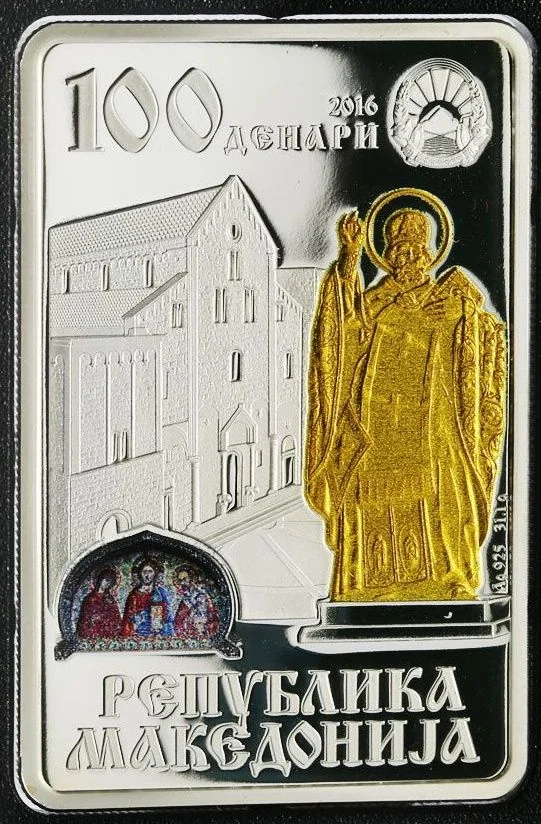
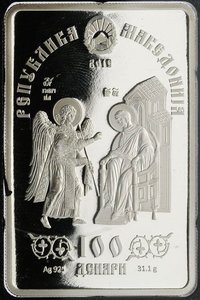
The obverse features the Macedonian coat of arms, "100 Denars," and the year 2016. The central design shows the Basilica di San Nicola in Bari, with a mosaic from its Russian Orthodox Church below. To the right is a statue of St. Nicholas from Saint Petersburg’s Saint Isaac’s Cathedral, along with the "Ag925" hallmark and weight "31.1g." The bottom bears the inscription "Republic of Macedonia."
Reverse
Description:
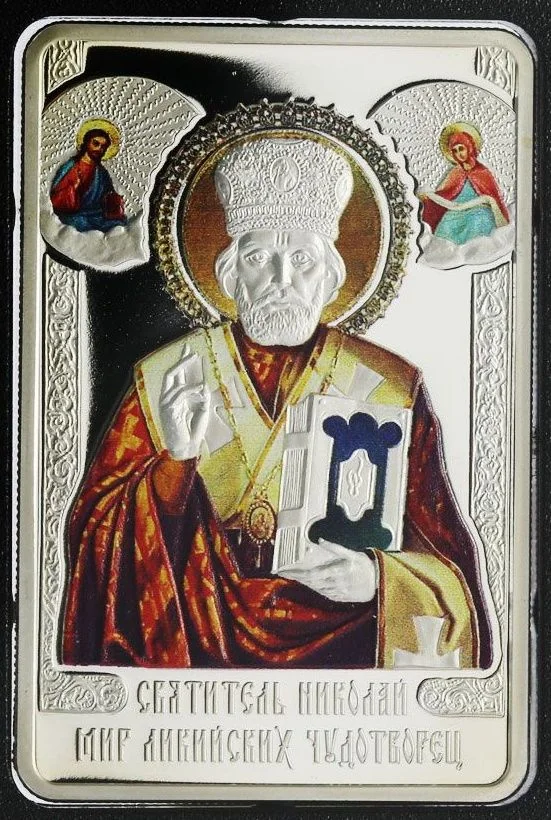
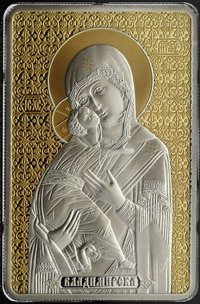
The center features an engraved and painted portrait of St. Nicholas the Wonderworker, based on an icon from St. Petersburg's St. Seraphim of Sarov Church, with the Russian inscription "Saint Nicholas the Wonderworker" below.
Edge
Categories
| Building> Religious building |
| Person> Religious figure |
Mintings
| Year | Mint Mark | Mintage | Quality | Collection |
|---|---|---|---|---|
| 2016 | — | — |
Historical background
In 2016, the currency situation in North Macedonia (then the Republic of Macedonia) was characterized by a stable but carefully managed exchange rate regime. The country operated under a de facto currency board arrangement, with the Macedonian denar (MKD) pegged to the euro at an approximate fixed rate of 61.5 denars per euro. This system, administered by the National Bank of the Republic of Macedonia (NBRM), had been in place since 1995 and was credited with delivering decades of low inflation and monetary stability, providing a crucial anchor for the small, open economy.
However, this stability was tested by a significant political crisis that began in 2015 and extended throughout 2016. A deep political deadlock, involving mass protests and revelations of a wiretapping scandal, led to prolonged uncertainty and delayed reforms. This environment triggered capital outflows and pressure on foreign exchange reserves as confidence wavered. The NBRM was compelled to intervene periodically in the foreign exchange market to defend the peg, leading to a notable drawdown of reserves, which fell by approximately €500 million over the course of the year.
Despite these pressures, the currency board remained intact and the denar's peg to the euro was successfully maintained throughout 2016. The NBRM's commitment to the regime was unwavering, and the situation did not escalate into a currency crisis. The episode highlighted the regime's resilience but also its vulnerability to domestic political shocks, underscoring that the primary risks to monetary stability were not external economic factors but internal political fragility and the resulting erosion of investor and public confidence.
However, this stability was tested by a significant political crisis that began in 2015 and extended throughout 2016. A deep political deadlock, involving mass protests and revelations of a wiretapping scandal, led to prolonged uncertainty and delayed reforms. This environment triggered capital outflows and pressure on foreign exchange reserves as confidence wavered. The NBRM was compelled to intervene periodically in the foreign exchange market to defend the peg, leading to a notable drawdown of reserves, which fell by approximately €500 million over the course of the year.
Despite these pressures, the currency board remained intact and the denar's peg to the euro was successfully maintained throughout 2016. The NBRM's commitment to the regime was unwavering, and the situation did not escalate into a currency crisis. The episode highlighted the regime's resilience but also its vulnerability to domestic political shocks, underscoring that the primary risks to monetary stability were not external economic factors but internal political fragility and the resulting erosion of investor and public confidence.
✨ Legendary