

Obverse
Description:
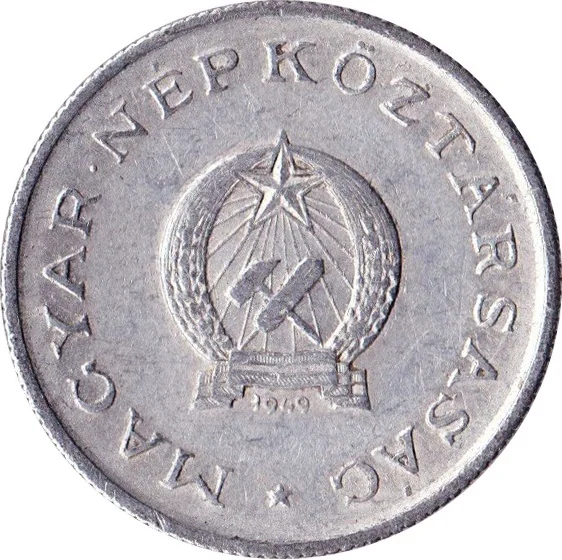
First Hungarian People's Republic coat of arms: a wreath encircling a wheat ear and hammer, on a radiant field beneath a red star.
Inscription:
MAGYAR NÉPKÖZTÁRSASÁG
1949
1949
Translation:
HUNGARIAN PEOPLE'S REPUBLIC
1949
1949
Script: Latin
Language: Hungarian
Designer: Iván István
Reverse
Edge
Reeded (130 pieces)
Categories
| Symbols> Coat of Arms |
Mints
| Name | Mark |
|---|---|
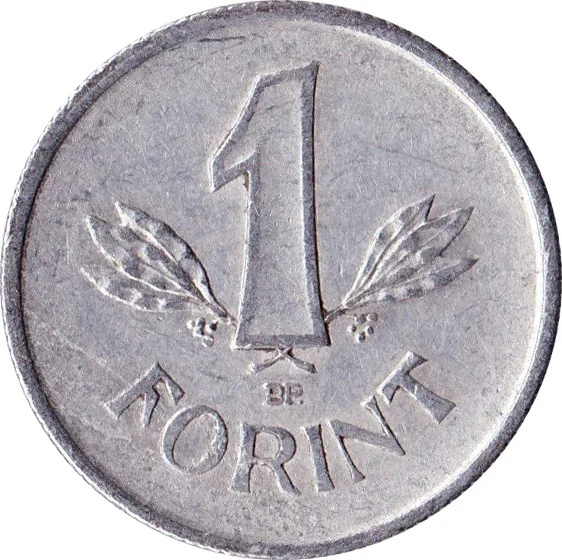
| Hungarian mint | BP. |
Historical background
Following World War II, Hungary experienced the most severe hyperinflation in recorded history. By July 1946, the pengő had become utterly worthless, with an astronomical inflation rate peaking at a daily rate of 195% and banknotes reaching a face value of 100 quintillion pengős. To end this chaos, the government introduced a new, stable currency—the forint—in August 1946, backed by gold reserves and a balanced state budget. This successful stabilization, known as the "forint reform," provided a brief period of monetary normality and economic recovery.
By 1949, however, this stability was being systematically dismantled by Hungary's rapid transformation into a Stalinist state. The Hungarian Working People's Party, under Mátyás Rákosi, had completed its communist takeover, aligning the economy entirely with the Soviet model. The forint remained the official currency, but its character changed fundamentally; it became a non-convertible "soft currency" whose value and use were dictated by central planning rather than market forces. The state focused on heavy industry and collectivization, with prices and monetary policy serving as instruments of control rather than economic indicators.
Consequently, the currency situation in 1949 was defined by strict isolation from the global economy and the suppression of inflation through administrative means, including widespread price controls and subsidies. A black market for goods and hard currency persisted, reflecting the disparity between official prices and reality. The forint's stability was now an artificial facade, maintained by repression and central directives, marking the end of its brief era as a genuine, stable currency and its new role as a tool of the communist command economy.
By 1949, however, this stability was being systematically dismantled by Hungary's rapid transformation into a Stalinist state. The Hungarian Working People's Party, under Mátyás Rákosi, had completed its communist takeover, aligning the economy entirely with the Soviet model. The forint remained the official currency, but its character changed fundamentally; it became a non-convertible "soft currency" whose value and use were dictated by central planning rather than market forces. The state focused on heavy industry and collectivization, with prices and monetary policy serving as instruments of control rather than economic indicators.
Consequently, the currency situation in 1949 was defined by strict isolation from the global economy and the suppression of inflation through administrative means, including widespread price controls and subsidies. A black market for goods and hard currency persisted, reflecting the disparity between official prices and reality. The forint's stability was now an artificial facade, maintained by repression and central directives, marking the end of its brief era as a genuine, stable currency and its new role as a tool of the communist command economy.
🌱 Very Common