

600 Bahts – Thailand
Non-circulating coins
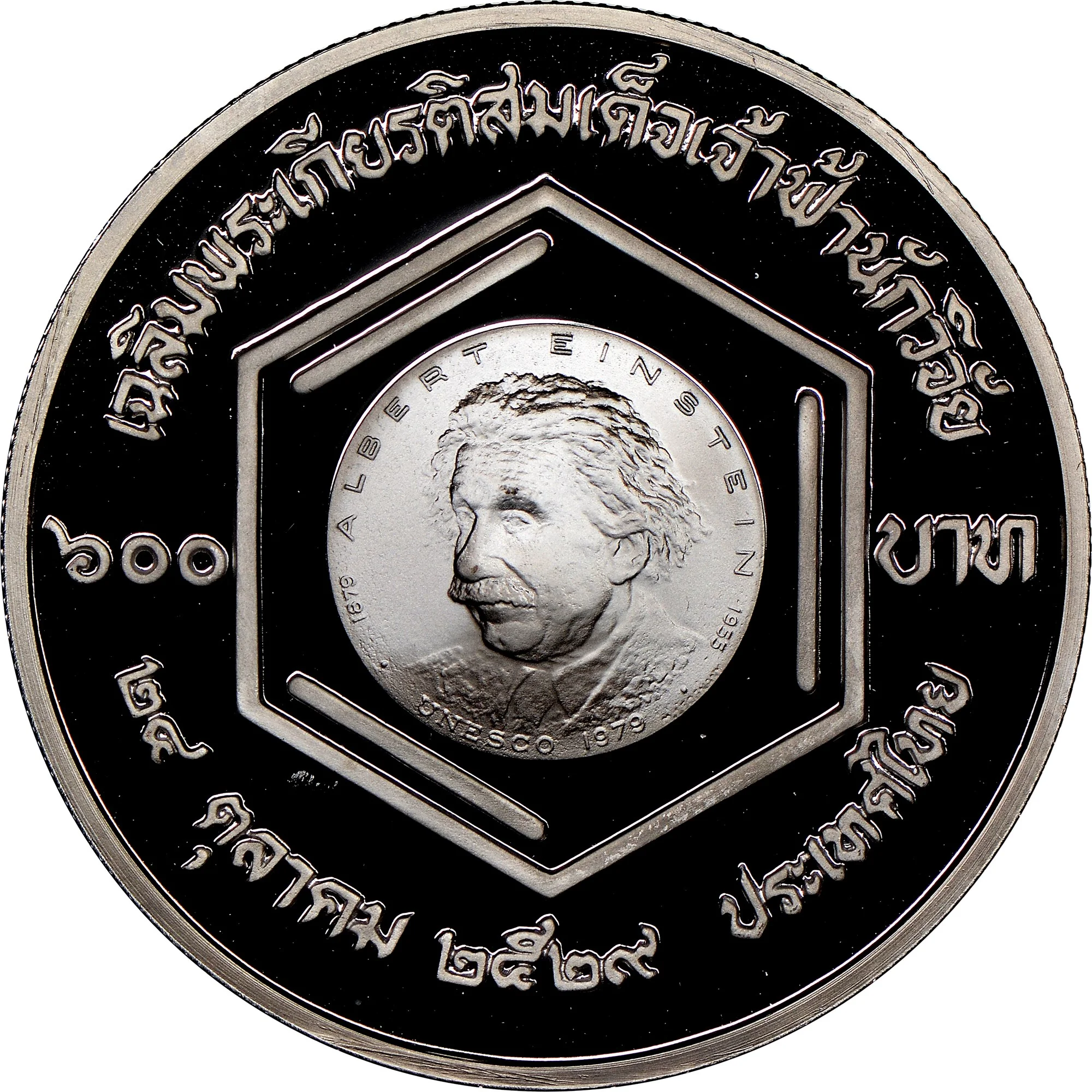
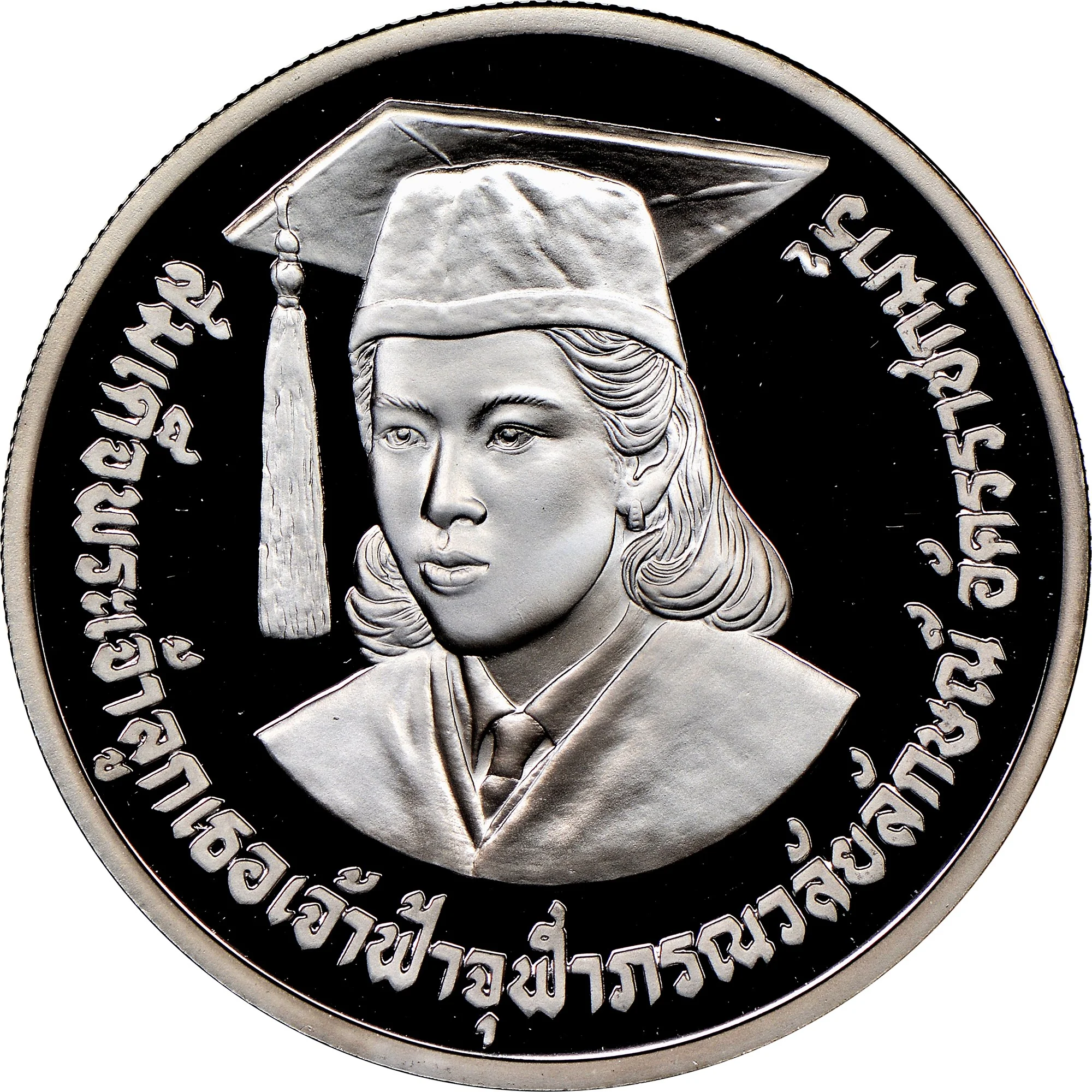
Commemoration: Princess Chulabhorn Awarded Einstein Medal
Thailand
Context
Year: 1986
Thai Year: 2529
Issuer: Thailand 
Ruler: Bhumibol Adulyadej
Currency:
(since 1897)
Total mintage: 2,612
Material
References
Y: #Click to copy to clipboard193
Numista: #199119
Value
Exchange value: 600 THB = $19.32
Bullion value: $62.97
Obverse
Description:
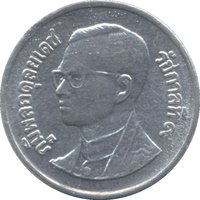
Einstein's head centered in a hexagon.
Reverse
Description:
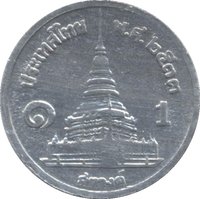
Graduate facing left
Edge
Reeded
Mintings
| Year | Mint Mark | Mintage | Quality | Collection |
|---|---|---|---|---|
| 1986 | — | 2,400 | ||
| 1986 | — | 212 | Proof |
Historical background
In 1986, Thailand's currency, the baht, operated under a de facto fixed exchange rate system, pegged to a basket of currencies dominated by the US dollar. This arrangement, managed by the Bank of Thailand, provided a crucial anchor for stability during a period of significant economic transition. The country was emerging from a decade of political instability and was in the early stages of an export-led boom, heavily reliant on foreign investment and trade. A predictable exchange rate was deemed essential to foster confidence for international investors and to facilitate planning for the growing export sector, particularly in textiles, agriculture, and nascent electronics.
However, this stability came with inherent challenges and policy constraints. The peg required the central bank to maintain substantial foreign exchange reserves to defend the baht's value, limiting its ability to use monetary policy independently to manage the domestic economy. Furthermore, the baht's value was influenced heavily by the strength of the US dollar, which had been exceptionally high in the first half of the 1980s. This contributed to a period of baht overvaluation, making Thai exports less competitive on the global market just as the country was pushing for export-oriented growth—a tension that policymakers had to carefully navigate.
The year 1986 proved to be a pivotal turning point. The Plaza Accord of 1985, an agreement among major economies to depreciate the US dollar, began to have a significant delayed impact. As the dollar weakened against the yen and European currencies, the baht (pegged to the dollar's basket) also depreciated in real effective terms. This provided a powerful, unexpected boost to Thai export competitiveness. Coupled with falling oil prices and rising foreign direct investment from Japan seeking cheaper production bases, the currency dynamics of 1986 helped ignite the economic boom that would transform Thailand into one of Asia's "Tiger Economies" in the subsequent decade.
However, this stability came with inherent challenges and policy constraints. The peg required the central bank to maintain substantial foreign exchange reserves to defend the baht's value, limiting its ability to use monetary policy independently to manage the domestic economy. Furthermore, the baht's value was influenced heavily by the strength of the US dollar, which had been exceptionally high in the first half of the 1980s. This contributed to a period of baht overvaluation, making Thai exports less competitive on the global market just as the country was pushing for export-oriented growth—a tension that policymakers had to carefully navigate.
The year 1986 proved to be a pivotal turning point. The Plaza Accord of 1985, an agreement among major economies to depreciate the US dollar, began to have a significant delayed impact. As the dollar weakened against the yen and European currencies, the baht (pegged to the dollar's basket) also depreciated in real effective terms. This provided a powerful, unexpected boost to Thai export competitiveness. Coupled with falling oil prices and rising foreign direct investment from Japan seeking cheaper production bases, the currency dynamics of 1986 helped ignite the economic boom that would transform Thailand into one of Asia's "Tiger Economies" in the subsequent decade.
✨ Legendary