

1 yuan (People's Republic of China) – People's Republic of China
Add to wishlist
Circulating commemorative coins
Commemoration: 40th Anniversary of the People's Republic of China
China
Context
Year: 1989
Country: China
Issuer: People's Republic of China
Period:
(since 1949)
Currency:
(since 1955)
Total mintage: 21,010,000
Material
Diameter: 30 mm
Weight: 9.32 g
Shape: Round
Composition: Copper-nickel
Technique: Milled
Alignment: Medal alignment
flip
References
KM: #
Numista: #10870
Value
Exchange value: 1 CNY
Inflation-adjusted value: 3.97 CNY
Obverse
Description:
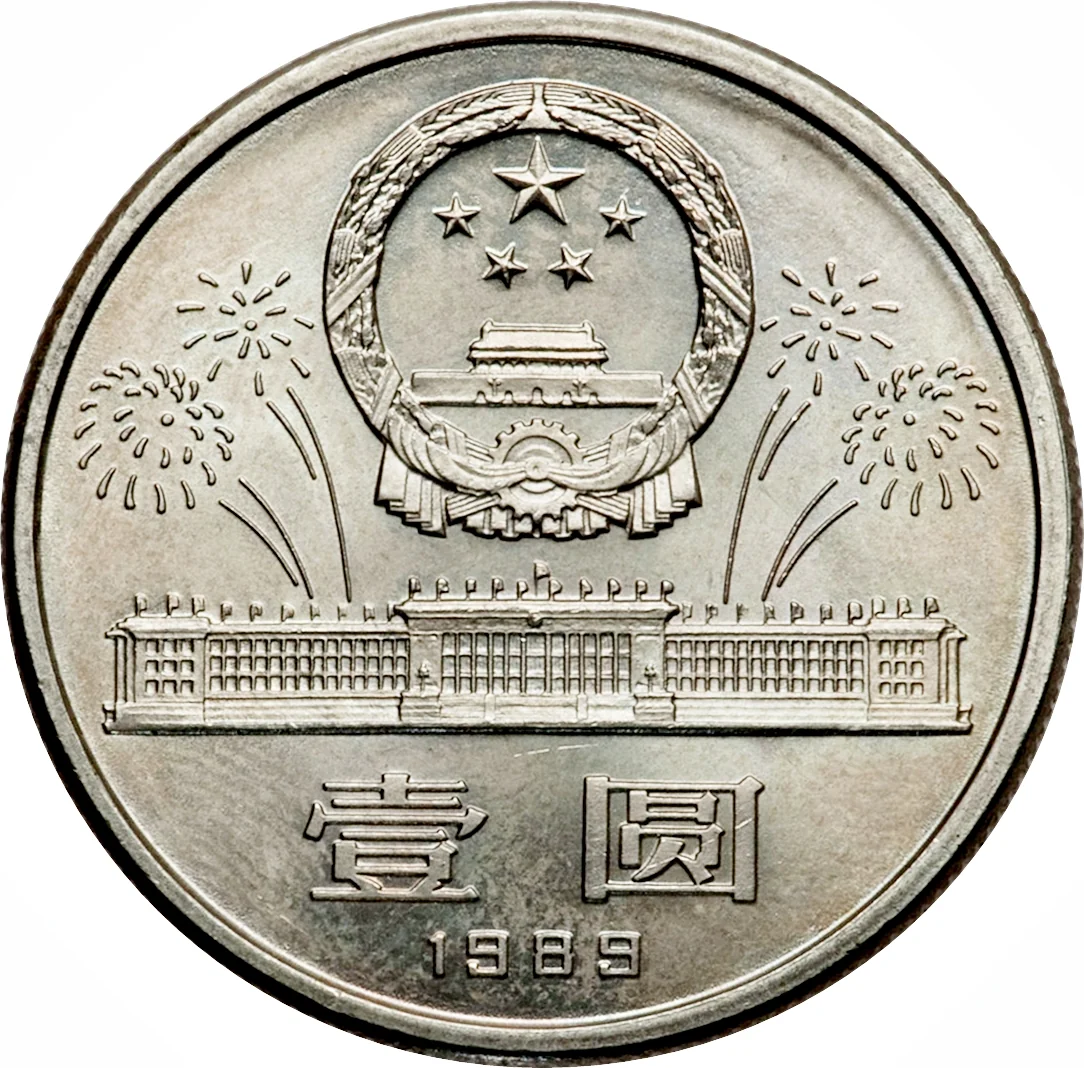
China's emblem (Tian'anmen) under five stars, with fireworks above the Great Hall of the People and the date below.
Inscription:
壹圆
1989
1989
Translation:
One Dollar
1989
1989
Script: Chinese (simplified)
Language: Chinese
Reverse
Description:
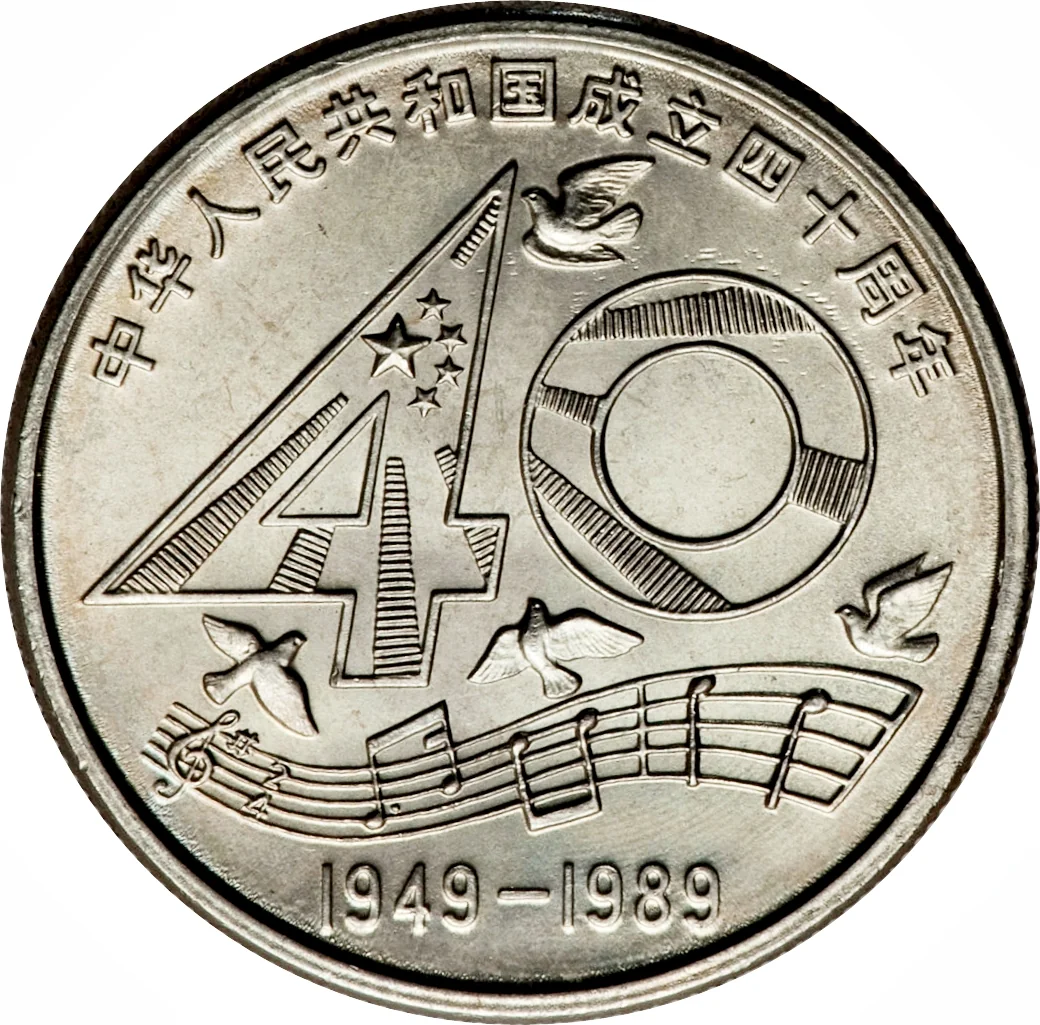
A stylized 40 with a 5-star emblem, doves, and the anthem's opening notes on a staff.
Inscription:
中华人民共和国成立四十周年
40
1949-1989
40
1949-1989
Translation:
Fortieth Anniversary of the Founding of the People's Republic of China
40
1949-1989
40
1949-1989
Script: Chinese (simplified)
Language: Chinese
Edge
Reeded
Mintings
| Year | Mint Mark | Mintage | Quality | Collection |
|---|---|---|---|---|
| 1989 | — | 21,000,000 | ||
| 1989 | — | 10,000 | Proof |
Historical background
In 1989, the People's Republic of China was grappling with significant economic challenges that directly impacted its currency, the Renminbi (RMB). The period followed a decade of reform and opening-up, which had spurred growth but also led to high inflation, estimated at over 18% in 1988. This inflationary pressure, driven by rapid credit expansion and price liberalization, severely eroded the currency's purchasing power and public confidence. The government's attempt to cool the overheated economy through austerity measures contributed to widespread public discontent, which was one factor among many in the social tensions of that spring.
The currency's exchange rate was managed under a dual-track system. The official rate, set by the state, was artificially strong, while a more market-driven swap centre rate existed for trade transactions. This created distortions, encouraging arbitrage and leading to a depletion of foreign exchange reserves as China struggled to maintain the official peg. The economic instability and the political events of 1989 resulted in international sanctions and a sharp decline in foreign investment, further straining the country's foreign exchange position and putting downward pressure on the currency's value in external markets.
In response to these crises, the Chinese government undertook a decisive economic retrenchment in late 1989 and the early 1990s. Financial discipline was reasserted, and reforms were cautiously continued. A pivotal step came in 1990 with the establishment of the Shanghai Foreign Exchange Adjustment Centre, a move towards unifying the exchange rate mechanisms. These stabilization efforts, part of a broader recovery strategy, laid the groundwork for the more radical unification and devaluation of the RMB in 1994, which marked a turning point in China's modern economic integration.
The currency's exchange rate was managed under a dual-track system. The official rate, set by the state, was artificially strong, while a more market-driven swap centre rate existed for trade transactions. This created distortions, encouraging arbitrage and leading to a depletion of foreign exchange reserves as China struggled to maintain the official peg. The economic instability and the political events of 1989 resulted in international sanctions and a sharp decline in foreign investment, further straining the country's foreign exchange position and putting downward pressure on the currency's value in external markets.
In response to these crises, the Chinese government undertook a decisive economic retrenchment in late 1989 and the early 1990s. Financial discipline was reasserted, and reforms were cautiously continued. A pivotal step came in 1990 with the establishment of the Shanghai Foreign Exchange Adjustment Centre, a move towards unifying the exchange rate mechanisms. These stabilization efforts, part of a broader recovery strategy, laid the groundwork for the more radical unification and devaluation of the RMB in 1994, which marked a turning point in China's modern economic integration.
🌟 Uncommon