

1 Dukát – Czechoslovakia
Context

Material
References
KM: #Click to copy to clipboard8
Numista: #19852
Value
Bullion value: $573.24
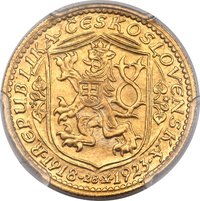
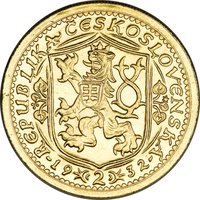
Obverse
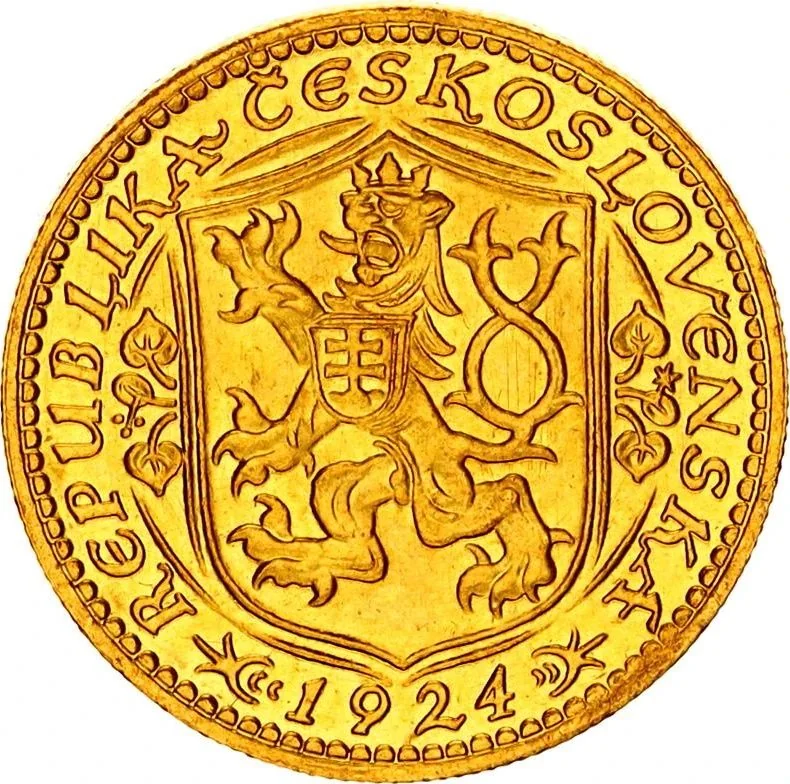
Description:
Czech lion bearing Slovak shield.
Inscription:
REPUBLIKA ČESKOSLOVENSKÁ
1924
1924
Translation:
REPUBLIC OF CZECHOSLOVAKIA
1924
1924
Script: Latin
Engravers: Jaroslav Benda, Otakar Španiel
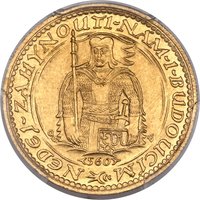
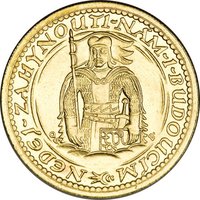
Reverse
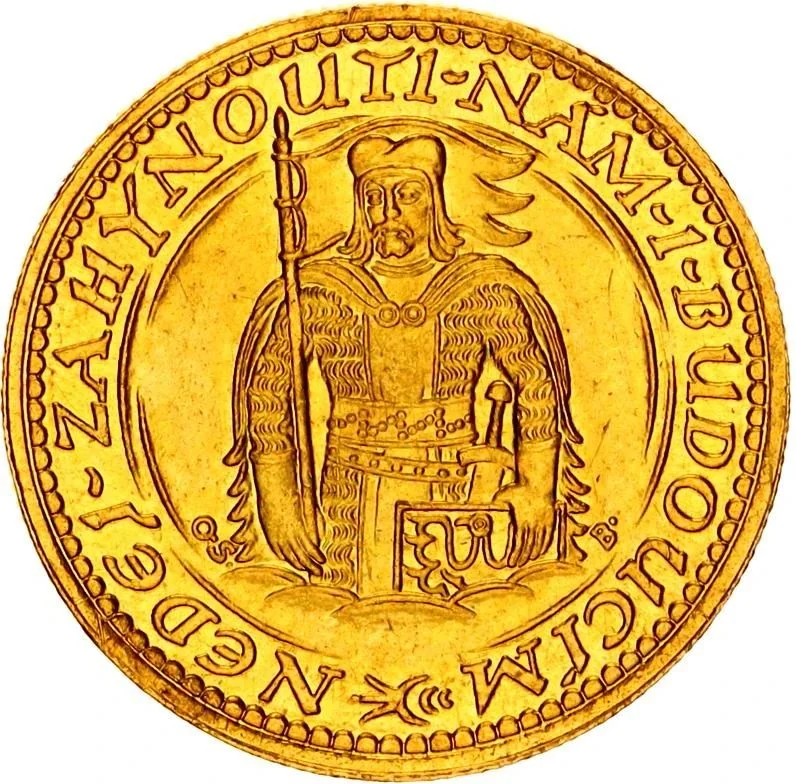
Description:
St. Wenceslaus banner (unmarked).
Inscription:
NEDEJ·ZAHYNOUTI·NÁM·I·BUDOUCÍM
Translation:
Do not let us and our descendants perish.
Script: Latin
Language: Czech
Engravers: Jaroslav Benda, Otakar Španiel
Edge
Milled
Mints
| Name | Mark |
|---|---|
| Kremnica | — |
Mintings
| Year | Mint Mark | Mintage | Quality | Collection |
|---|---|---|---|---|
| 1923 | — | 61,861 | ||
| 1924 | — | 32,814 | ||
| 1925 | — | 66,279 | ||
| 1926 | — | 58,669 | ||
| 1927 | — | 25,774 | ||
| 1928 | — | 18,983 | ||
| 1929 | — | 10,253 | ||
| 1930 | — | 11,338 | ||
| 1931 | — | 43,482 | ||
| 1932 | — | 26,217 | ||
| 1933 | — | 57,597 | ||
| 1934 | — | 9,729 | ||
| 1935 | — | 13,178 | ||
| 1936 | — | 14,556 | ||
| 1937 | — | 324 | ||
| 1938 | — | 56 | ||
| 1939 | — | 276 | ||
| 1951 | — | 500 |
Historical background
In 1923, Czechoslovakia found itself grappling with the severe aftermath of the First World War and the dissolution of the Austro-Hungarian Empire, from which it inherited a legacy of hyperinflation. The new state, established in 1918, initially continued using the Austro-Hungarian crown, but the unchecked printing of this currency by the successor states to finance their deficits led to a catastrophic loss of value. By early 1923, this inflationary spiral reached a crisis point, severely eroding savings, disrupting economic planning, and causing widespread social hardship, threatening the stability of the young republic.
Recognizing the existential threat, the government, under the leadership of Minister of Finance Alois Rašín, embarked on a radical and courageous stabilization program. Its cornerstone was the physical separation of the currency in February 1923: existing banknotes were stamped, effectively creating a distinct Czechoslovak crown (koruna) and cutting the monetary link with the inflationary pressures of other successor states. This was combined with a strict deflationary policy of balanced budgets, reduced government spending, and a commitment to backing the currency with gold reserves.
These decisive actions proved remarkably successful. The currency separation halted the hyperinflation almost overnight, and by the end of 1923, the Czechoslovak crown had become one of the strongest and most stable currencies in Central Europe. This monetary stabilization, often called the "Rašín Reform," laid the essential foundation for a decade of remarkable economic growth and political consolidation during the 1920s, cementing Czechoslovakia's reputation for prudent financial management.
Recognizing the existential threat, the government, under the leadership of Minister of Finance Alois Rašín, embarked on a radical and courageous stabilization program. Its cornerstone was the physical separation of the currency in February 1923: existing banknotes were stamped, effectively creating a distinct Czechoslovak crown (koruna) and cutting the monetary link with the inflationary pressures of other successor states. This was combined with a strict deflationary policy of balanced budgets, reduced government spending, and a commitment to backing the currency with gold reserves.
These decisive actions proved remarkably successful. The currency separation halted the hyperinflation almost overnight, and by the end of 1923, the Czechoslovak crown had become one of the strongest and most stable currencies in Central Europe. This monetary stabilization, often called the "Rašín Reform," laid the essential foundation for a decade of remarkable economic growth and political consolidation during the 1920s, cementing Czechoslovakia's reputation for prudent financial management.
⭐ Somewhat Rare