

5 leva (Alexander Stamboliiski) – Bulgaria
Add to wishlist
Non-circulating coins
Commemoration: 50th Anniversary - Death of Alexander Stamboliiski, Politician
Bulgaria
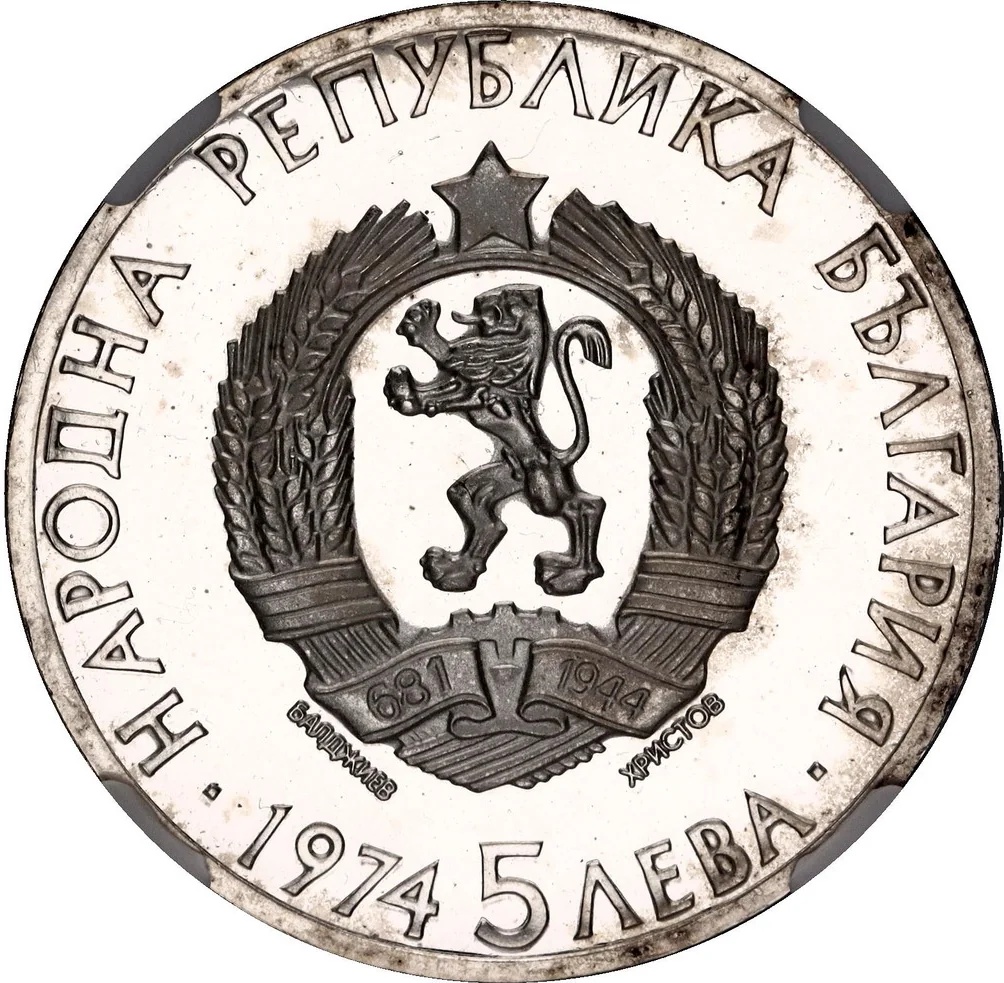
Obverse
Description:
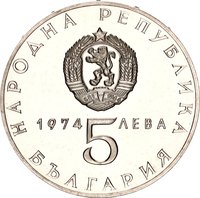
Coat of arms of Bulgaria. 1 lev, 1974.
Inscription:
НАРОДНА РЕПУБЛИКА БЪЛГАРИЯ
1974
5 ЛЕВА
1974
5 ЛЕВА
Translation:
PEOPLE'S REPUBLIC OF BULGARIA
1974
5 LEVA
1974
5 LEVA
Script: Cyrillic
Language: Bulgarian
Engravers: G. Baldjiev, Y. S. Christov
Reverse
Description:
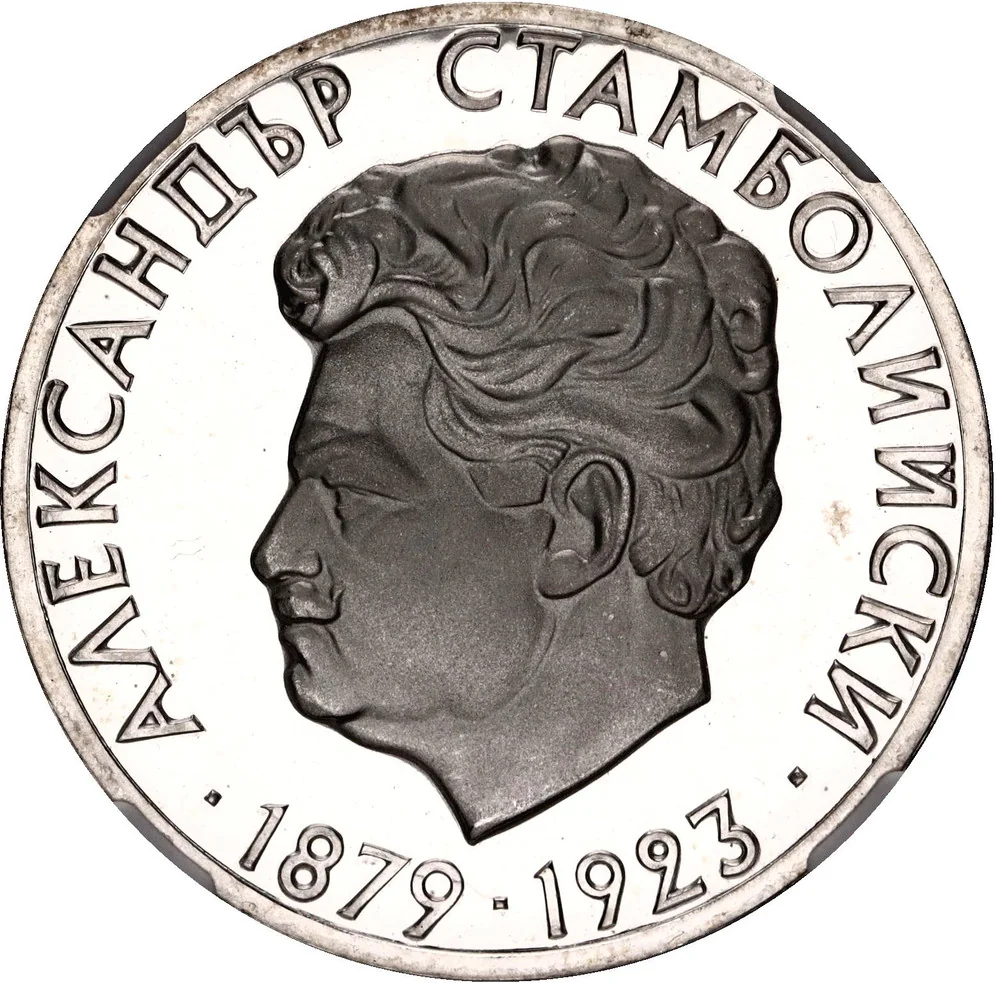
Portrait of Alexander Stamboliyski.
Inscription:
АЛЕКСАНДЪР СТАМБОЛИЙСКИ
∙ 1879 ∙ 1923 ∙
∙ 1879 ∙ 1923 ∙
Translation:
Alexander Stamboliyski
∙ 1879 ∙ 1923 ∙
∙ 1879 ∙ 1923 ∙
Script: Cyrillic
Language: Bulgarian
Engravers: G. Baldjiev, Y. S. Christov
Edge
Plain
Mints
| Name | Mark |
|---|---|
| Bulgarian Mint | — |
Mintings
| Year | Mint Mark | Mintage | Quality | Collection |
|---|---|---|---|---|
| 1974 | — | 200,000 | Proof |
Historical background
In 1974, Bulgaria's currency situation was entirely defined by its position as a centrally planned economy within the Soviet-led Council for Mutual Economic Assistance (COMECON). The official national currency, the Lev, was a non-convertible "soft currency." Its exchange rate, pegged at 1.18 Leva to 1 US Dollar since 1962, was an administrative fiction with no relation to market forces or the currency's actual purchasing power. Internationally, the Lev was worthless for trade, and domestically, its function was primarily as an accounting unit within the state plan, not a tool for macroeconomic policy.
Internally, the currency regime was characterized by severe restrictions and a dual-circuit monetary system. The population used Leva for daily transactions in state stores, where prices were heavily subsidized and set by planners, leading to a chronic mismatch between the money supply and the availability of goods, resulting in suppressed inflation and frequent shortages. Crucially, a separate, parallel system existed for foreign trade and privileged entities. Hard currency earnings were entirely controlled by the state bank, and special "foreign exchange Leva" or convertible ruble accounts were used for accounting in COMECON trade, completely isolated from the domestic money in citizens' pockets.
Externally, Bulgaria's trade and currency flows were overwhelmingly oriented toward the COMECON bloc, conducted through bilateral agreements and clearing in "transferable rubles." This insulated the country from global financial markets but created dependencies and inefficiencies. Any engagement with Western markets required scarce hard currency, strictly rationed by the state. Therefore, the 1974 currency situation reflected a stagnant, controlled system designed for administrative planning and bloc integration, exhibiting none of the flexibility or convertibility of a market economy, a condition that would persist until the political changes of 1989-1990.
Internally, the currency regime was characterized by severe restrictions and a dual-circuit monetary system. The population used Leva for daily transactions in state stores, where prices were heavily subsidized and set by planners, leading to a chronic mismatch between the money supply and the availability of goods, resulting in suppressed inflation and frequent shortages. Crucially, a separate, parallel system existed for foreign trade and privileged entities. Hard currency earnings were entirely controlled by the state bank, and special "foreign exchange Leva" or convertible ruble accounts were used for accounting in COMECON trade, completely isolated from the domestic money in citizens' pockets.
Externally, Bulgaria's trade and currency flows were overwhelmingly oriented toward the COMECON bloc, conducted through bilateral agreements and clearing in "transferable rubles." This insulated the country from global financial markets but created dependencies and inefficiencies. Any engagement with Western markets required scarce hard currency, strictly rationed by the state. Therefore, the 1974 currency situation reflected a stagnant, controlled system designed for administrative planning and bloc integration, exhibiting none of the flexibility or convertibility of a market economy, a condition that would persist until the political changes of 1989-1990.
🌟 Limited